Beetle Races! Measuring Distance and Time and Calculating Rate in a - - PDF document

beetle races measuring distance and time and calculating
SMART_READER_LITE
LIVE PREVIEW

Beetle Races! Measuring Distance and Time and Calculating Rate in a - - PDF document

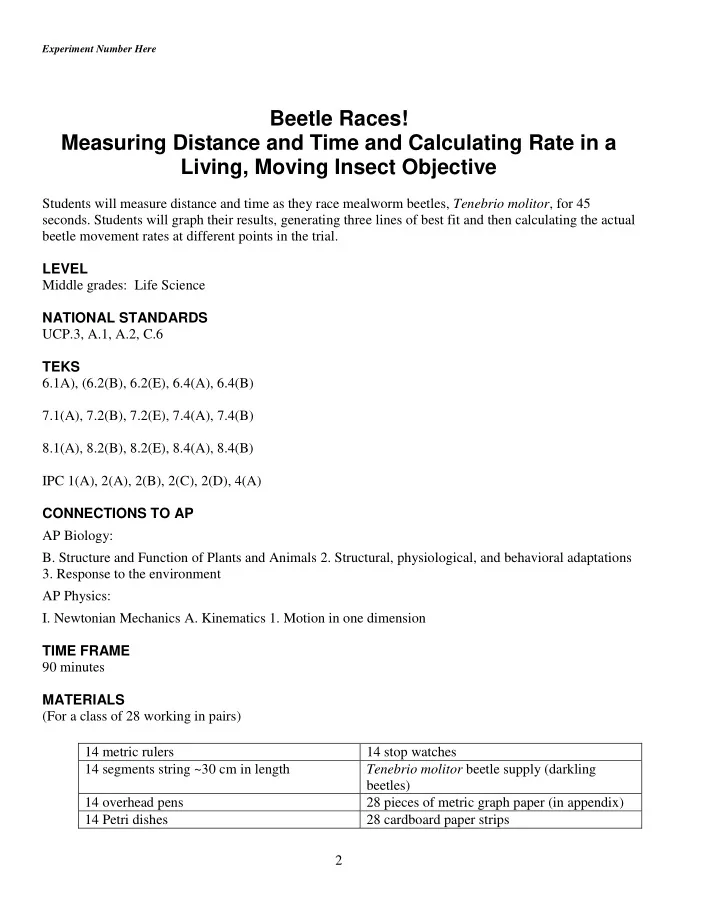
Experiment Number Here Beetle Races! Measuring Distance and Time and Calculating Rate in a Living, Moving Insect Objective Students will measure distance and time as they race mealworm beetles, Tenebrio molitor , for 45 seconds. Students will


slide-1
SLIDE 1

Experiment Number Here

2

Beetle Races! Measuring Distance and Time and Calculating Rate in a Living, Moving Insect Objective

Students will measure distance and time as they race mealworm beetles, Tenebrio molitor, for 45

  • seconds. Students will graph their results, generating three lines of best fit and then calculating the actual

beetle movement rates at different points in the trial. LEVEL Middle grades: Life Science NATIONAL STANDARDS UCP.3, A.1, A.2, C.6 TEKS 6.1A), (6.2(B), 6.2(E), 6.4(A), 6.4(B) 7.1(A), 7.2(B), 7.2(E), 7.4(A), 7.4(B) 8.1(A), 8.2(B), 8.2(E), 8.4(A), 8.4(B) IPC 1(A), 2(A), 2(B), 2(C), 2(D), 4(A) CONNECTIONS TO AP AP Biology:

  • B. Structure and Function of Plants and Animals 2. Structural, physiological, and behavioral adaptations
  • 3. Response to the environment

AP Physics:

  • I. Newtonian Mechanics A. Kinematics 1. Motion in one dimension

TIME FRAME 90 minutes MATERIALS (For a class of 28 working in pairs) 14 metric rulers 14 stop watches 14 segments string ~30 cm in length Tenebrio molitor beetle supply (darkling beetles) 14 overhead pens 28 pieces of metric graph paper (in appendix) 14 Petri dishes 28 cardboard paper strips

slide-2
SLIDE 2

Chapter Title Here

3 TEACHER NOTES This activity serves as a fun introduction to the mathematical concept of rate. Students will measure the distance and movement of beetles at given time intervals. Students let beetles race across their desks, following and tracing the circuitous path of the beetle with an overhead pen, while timing the run with a

  • stopwatch. An X drawn on the student’s desk serves as the starting point. The beetles move in a

roundabout path, so the students must measure the distance traveled with a string. This is accomplished by overlaying the pen path with the string and subsequently measuring the distance traveled by measuring the length of the string with a meter stick or metric ruler. Students then graph their results on a distance versus time graph to calculate various rates. Emphasize that the slope of this graph IS the rate. The students begin by selecting the fastest looking specimens from the container of bran. They should try to select the most active beetles. A small prize awarded to the pair of students having the fastest beetle will encourage students to be enthusiastic about getting the beetle to move quickly. Beetles that do not move at all on the table should be rejected and placed back into the container. Once a beetle is placed on the X, it should begin moving right away. If the beetle does not move immediately, the students can gently nudge the beetle to initiate its movement, but should not push it any way that will affect the rate. Typically, the beetles move at approximately 1-3 cm/sec, but they can certainly move much faster or much slower than that. ANY lab that involves the use of live animals will have variable results. Animals simply will not do what we want them to, when we want them to, particularly insects. One way to make the lab more successful is to have a very large supply of T. molitor beetles on hand so students can have many specimens to choose from.. This activity can also serve as an introduction to the observation of living organisms in a laboratory

  • setting. Students love working with the live beetles since they find them fascinating and repulsive all at

the same time. You should initiate a discussion about ethical issues and animal cruelty before introducing students to the beetles, or any live creature in the lab. Many teachers have a supply of these beetles in their rooms and you can easily start a culture of your

  • wn. This website explains the care and maintenance of your culture

http://www.rygepetersen.dk/tenebrio_molitor.htm . These beetles are quite easy to maintain since the larval stage is the common mealworm. . If you cannot find a teacher to help you supply a starting population, most of the scientific supply companies can send you a starting population of adults/pupae/larvae for about $20. If you have a few weeks before you want to start the investigation, you can purchase mealworms, the larval stage, at feed or pet stores. Another interesting aspect of this lab is the humorous, and non-threatening, introduction of the idea of natural (or in this case, artificial) selection, and evolution. If you have a lizard or snake in the classroom, you can tell the students that the slow, rejected beetles are eaten, while the faster ones that got put back into the container of bran to continue breeding thus continuing the genetic line. If this experiment was repeated hundreds of times, then ideally, the population within the bran container could indeed pass along more “fast” genes, leading to a “faster” beetle population. This will inevitably lead to questions about natural and artificial selection and ultimately evolution. Somehow the idea of beetle evolution is less threatening to students (as well as parents and administrators) than human evolution but the same

slide-3
SLIDE 3

Experiment Number Here

4 concepts of natural selection, artificial selection, genetic/phenotypic variation, and evolution can be taught to the students, in a non-threatening way. To aid in the transferring of the beetle from place to place, two cardboard paper strips can be used, to gently lift and hold the beetle without injuring it. Each paper strip is just a thin strip cut from a 3 X 5 index card. The strip should probably be around 2 cm wide and is 3 inches long. Quite a few of the 3 inch long paper strips can be cut from one index card. With a little practice, students can become quite adept at moving the beetles around and flipping them over with the two cardboard paper strips. POSSIBLE ANSWERS TO THE CONCLUSION QUESTIONS AND SAMPLE DATA

  • 1. By looking at your graph, which trial (1, 2 or 3) was the fastest?

Answers will vary but the steepest curve will represent the fastest trial, representing the greatest distance traveled in the least amount of time. In other words, the line with the greatest, steepest slope. In the sample graph above, the fastest trial would be the top line on the graph.

  • 2. By looking at your graph, which trial (1, 2 or 3) was the slowest?

Answers will vary according to student data but students are looking for the trial where the beetle went the farthest distance in 45 seconds (Time is always a constant in this experiment.).

  • 3. What evidence from your graph allowed you to select the fastest trial?

Again the students will have to explain the idea that a particular line is steeper, versus one that is not as steep. The line with the steepest curve, or greatest slope represents the fastest rate.

  • 4. Using your graph, calculate the average rate for each one of your trials. Show your work and label

each calculation as “Trial 1”, “Trial 2” and “Trial 3”. The equation for rate is: Be sure to include units of cm/sec in your answers. . . . . Answers will vary but the average rate equals the total distance traveled divided by the total time, 45 seconds. If the beetle traveled 90 centimeters in 45 seconds, the rate would be 2 cm/sec. distance(cm) rate= time (seconds)

slide-4
SLIDE 4

Chapter Title Here

5

  • 5. Look at your graph and determine the fastest 5-second segment rate that your beetle traveled in all of

the trials. (What is the farthest distance that a beetle traveled in 5 seconds?) Show your work in your answer. Be sure to include units of cm/sec in your answers. Answers will vary, but students find on their data table the farthest distance traveled in any 5 second interval. Students divide the distance traveled in that segment by 5. A fast rate is probably 3 to 5 cm/sec but occasionally a student will record a rate of up to and possibly

  • ver10 cm/sec.
  • 6. Look at your data table and determine the slowest 5-second segment rate that your beetle traveled in

all of the trials. (What is the shortest distance that a beetle traveled in 5 seconds?) Show your work in your answer. Be sure to include units of cm/sec in your answers . . . . . . . . . . Answers will vary but students find on their data table the five second interval during which the beetle traveled the shortest distance. The student divides the distance traveled in that segment by 5. A slow rate is probably less than 1 cm/sec. distance(cm) rate= time (seconds) distance(cm) rate= time (seconds)

slide-5
SLIDE 5

Name _____________________________________ Period _____________________________________

6

Experiment

14

Beetle Races!

Measuring Distance and Time and Calculating Rate in a Living, Moving Insect

PURPOSE In this activity you will measure the distance traveled by your selected mealworm beetle, Tenebrio molitor, during three 45 second races. You will collect data at five second intervals during each race. You will analyze your data to determine the five second intervals during which your beetle was the fastest and the slowest as well as determine the average rate of speed of your beetle for each race. You will also generate graphs to better communicate your results. MATERIALS metric ruler stop watch piece of string Tenebrio molitor beetle

  • verhead pen

graph paper Petri dish PROCEDURE

  • 1. . Working with your partner, select what you believe to be the fastest adult Tenebrio molitor beetle

from the mealworm container and put it into a Petri dish. Give your beetle a name. Do not torture or hurt your beetle or you will get no credit for today’s activity. Mark a small X with the overhead pen in the middle of your desk or table. This will serve as the starting point of the race. Carefully transfer your beetle from your Petri dish onto the X. You can use two cardboard paper strips to transfer the beetle onto its legs to begin moving. Student #1 will start the stopwatch as soon as the beetle begins to move off the X. At the same time, student #2 will trace a line following the movement of the beetle with the overhead pen. Student #1 will call time every 5 seconds while student #2 continues to trace the path of the beetle. At these 5 second intervals, student #2 will. also make a small mark on the line to indicate the position of the beetle when time was called. Your line may be squiggly or it might be straight. You can also motivate your beetle by cheering its name, encouraging it go faster, without touching it! Also, you can very gently nudge the beetle with a small piece of paper to initiate its movement but do not push it in any way that it will affect its rate of movement. You must use the same beetle during all three trials. When your beetle has traveled for 45 seconds, stop and make your final mark on the table with the pen. Gently place the beetle back into the Petri dish using a small piece of scratch paper.

slide-6
SLIDE 6

Experiment Number Here

7 Place your piece of string on top of the path you have drawn on the table. Measure in centimeters, to the closest 0.1 millimeter, the distance traveled by the beetle for each 5 second interval. Be sure to measure the total distance for each 5 second interval by measuring from the original starting point, the X you marked on your desk or table. The distance measurements should be increasing with each interval. It is critical that your distance measurements are as accurate as possible. Remember to estimate to the closest 0.1 mm, between the millimeter marks on your ruler for each measurement. For example, in the first segment, measure out to two decimal places: the measurement might read 10.35 cm (if this was how far the beetle traveled) and not 10.4 cm nor 10 cm. Create a data table, using a ruler, showing how far the beetle traveled during each 5 second interval, up to 45 seconds. You will be collecting three sets of this data, one for each of the three races your beetle will run. After you have recorded your data, use a damp paper towel to wipe off the overhead pen marks from your desk. Remove the marks completely from the desk. Once the desk is clean, re-mark another X for the next trial. Be sure to record your data for this second race in your data table. Wipe down the overhead pen markings between each race. Construct an appropriately-titled graph showing the progress of your T. molitor beetle during the three races. Time in seconds is graphed on the x-axis. Distance in centimeters is graphed on the y-axis. Do not connect the points, but rather draw the best straight line through the points keeping an equal number of points above and below the best-fit line you are drawing. This line represents the average distance traveled for the 45 seconds of the race. The line will generally slope upward over time. The 3 trials will be graphed as 3 separate lines on your graph paper. Make each line a different color so you can tell them apart. Also, label each line as Trial #1, Trial #2 and Trial #3. The “faster” beetles will be put back into the gene pool and allowed to breed. The “slower” ones become a tasty meal for a lizard. This is known as artificial selection. This is done with race horses all the time. The “fast” genes will be selected for artificially rather than letting that animal choose its own mate from the total population! Maybe after a million generations, we will have the fastest beetles in the world! CONCLUSION QUESTIONS Each student will turn in an appropriately-titled graph with the axes correctly labeled and 3 labeled lines representing the rate of speed for the beetle during each of the 3 trials. Each student will also answer the following questions on the back of their graph.

slide-7
SLIDE 7

Experiment Number Here

8 Answer the following questions on the back of your graph paper. Numbers 1 and 2 should be in complete sentences and numbers 3-5 should show calculations with the answers circled.

  • 1. By looking at your graph, which trial (1, 2 or 3) was the fastest?
  • 2. By looking at your data table, which trial (1, 2 or 3) was the slowest?
  • 3. What evidence from your graph allowed you to observe and then recognize the fastest trial?
  • 4. Using your graph, calculate the average rate of speed for each one of your trials. This rate is the

slope of the line. It represents the total distance traveled divided by the total time measured. Show your work and label each calculation as “Trial 1”, “Trial 2” and “Trial 3”. The equation for rate is: Be sure to include units of cm/sec in your answers.

  • 5. Look at your data table and determine the fastest 5-second segment rate that your beetle traveled in

all of the trials. (What is the farthest distance that a beetle traveled in 5 seconds?) Show your work in your answer. Be sure to include units of cm/sec in your answers.

  • 6. Look at your data table and determine the slowest 5-second segment rate that your beetle traveled in

all of the trials.. (What is the shortest distance that a beetle traveled in 5 seconds?) Show your work in your answer. Be sure to include units of cm/sec in your answers. . . distance(cm) rate= time(seconds) distance(cm) rate= time(seconds) distance(cm) rate= time(seconds)