Becquerel and Sievert Units of Radiation Sievert (Sv) Sievert (Sv) - - PowerPoint PPT Presentation

becquerel and sievert
SMART_READER_LITE
LIVE PREVIEW

Becquerel and Sievert Units of Radiation Sievert (Sv) Sievert (Sv) - - PowerPoint PPT Presentation

Becquerel and Sievert Units of Radiation Sievert (Sv) Sievert (Sv) Becquerel (Bq) Becquerel (Bq) Unit of radiation exposure dose that a Unit of radiation exposure dose that a Unit indicating the amount of radioactivity Unit indicating the


slide-1
SLIDE 1

Becquerel and Sievert

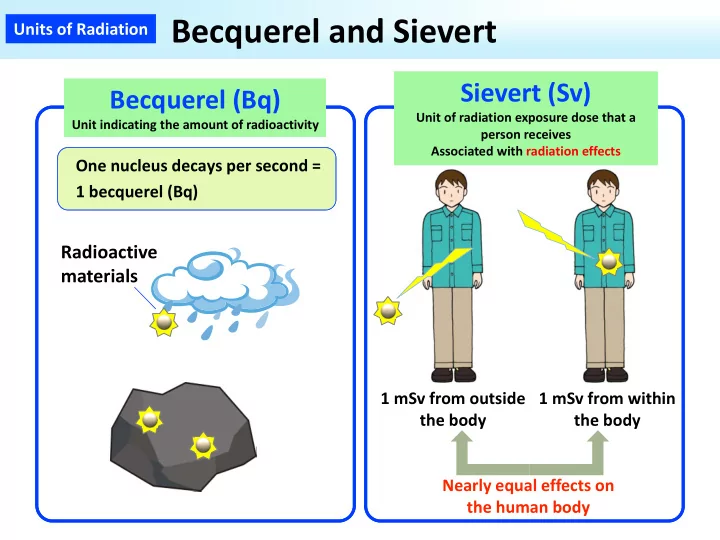
Becquerel (Bq)

Unit indicating the amount of radioactivity

Becquerel (Bq)

Unit indicating the amount of radioactivity

Units of Radiation One nucleus decays per second = 1 becquerel (Bq)

Radioactive materials

Sievert (Sv)

Unit of radiation exposure dose that a person receives Associated with radiation effects

Sievert (Sv)

Unit of radiation exposure dose that a person receives Associated with radiation effects

1 mSv from outside the body 1 mSv from within the body Nearly equal effects on the human body

slide-2
SLIDE 2

Origin of Sievert

Sievert is expressed by the symbol "Sv."

Units of Radiation

  • 1 millisievert (mSv)

= one thousandth of 1 Sv

  • 1 microsievert (μSv)

= one thousandth of 1 mSv

Rolf Sievert (1896‐1966) Founder of the physics laboratory at Sweden's Radiumhemmet Participated in the foundation of the International Commission on Radiological Protection

slide-3
SLIDE 3

Relationship between Units

Differences in effects depending on types of radiation

Source of radiation Gy=

*2: Energy absorbed per 1 kg of substances (Joule: J; 1J≒0.24 calories); SI unit is J/kg.

Units of Radiation

Radiation intensity*1 Becquerel (Bq)

Radioactive materials

*1: Number of nuclei that decay per second

Receiving side Absorbed dose*2 Gray (Gy)

Amount of energy absorbed by a substance of unit mass that received radiation

Absorbed energy (J) Mass of the part receiving radiation (kg) Equivalent dose (Sv)

Unit for expressing radiation doses in terms

  • f effects on the human body

Effective dose Sievert (Sv)

Differences in sensitivity among organs

slide-4
SLIDE 4

Conversion from Gray to Sievert

Units of Radiation

Radiation weighting factor wR

Multiply

Tissue weighting factor wT

Multiply Add up

Absorbed dose

Grays (Gy)

Dose that each organ receives (equivalent dose)

α‐particles Twenty times β‐particles One time γ‐rays One time Neutrons 2.5 to 21 times

Differences in effects depending on types of radiation Dose that the whole body receives Differences in sensitivity among organs

Effective dose

Sieverts (Sv)

slide-5
SLIDE 5

Various Factors

Type of radiation Tissue weighting factor wR γ‐rays, X‐rays, β‐particles 1 Proton beams 2 α‐particles, heavy ions 20 Neutron beams 2.5〜21 Tissue Tissue weighting factor wT Red bone marrow, colon, lungs, stomach, breasts 0.12 Gonad 0.08 Bladder, esophagus, liver, thyroid 0.04 Bone surface, brain, salivary gland, skin 0.01 Total of the remaining tissues 0.12

Source: 2007 Recommendations of the ICRP

Sv: sieverts; Gy: grays

Effective dose (Sv) = Σ (Tissue weighting factor wT × Equivalent dose)

Units of Radiation

Equivalent dose (Sv) = Radiation weighting factor wR × Absorbed dose (Gy)

slide-6
SLIDE 6

Calculation of Equivalent Dose and Effective Dose

Units of Radiation

Effective dose (sievert (Sv)) = Σ (Tissue weighting factor × Equivalent dose)

When the whole body is evenly exposed to 1 mGy of γ‐ray irradiation

Effective dose = 0.12 X 1 (mSv): bone marrow + 0.12 X 1 (mSv): colon + 0.12 X 1 (mSv): lungs + 0.12 X 1 (mSv): stomach : + 0.01 X 1 (mSv): skin = 1.00 X 1 (mSv)

= 1 millisievert (mSv)

When only the head is exposed to 1 mGy of γ‐ray irradiation

Effective dose = 0.04 X 1 (mSv): thyroid + 0.01 X 1 (mSv): brain + 0.01 X 1 (mSv): salivary gland + 0.12 X 1 (mSv) × 0.1: bone marrow (10%) + 0.01 X 1 (mSv) × 0.15: skin (15%) :

= 0.07 millisieverts (mSv)

slide-7
SLIDE 7

Equivalent dose (Sv: sievert)

indicates effects on individual human

  • rgans and tissues

Effective dose (Sv: sievert)

indicates effects on the whole body by combining effects on individual organs and tissues

Concepts of Doses: Physical Quantities, Protection Quantities and Operational Quantities

Physical quantities: directly measurable

Units of Radiation Radiation intensity (Bq: becquerels)

Number of nuclei that decay per second

Radiation fluence (s‐1m‐2: fluence) Number of particles incident on a unit area

Absorbed dose (Gy: grays)

Energy absorbed per 1 kg of substances

Irradiation dose (for X‐rays and γ‐rays) (C/㎏) Energy imparted to 1 kg of air

Doses indicating the effects of exposure on humans: not directly measurable

Defined based

  • n physical

quantity Protection quantities Ambient dose equivalent (Sv: sievert)

Directional dose equivalent (Sv: sievert)

Approximate value for protection quantity used in environmental monitoring Personal dose equivalent (Sv: sievert)

Approximate value for protection quantity used in personal monitoring

Operational quantities
slide-8
SLIDE 8

Ambient dose equivalent (1cm dose equivalent)

Dose equivalent occurring at a depth of 1cm from the surface

  • f an ICRU sphere, which is 30 cm in diameter and simulates

human tissue, placed in a field where radiation is coming from

  • ne direction; Ambient dose equivalent is used in

measurements of ambient doses using survey meters, etc.

Personal dose equivalent (1cm dose equivalent)

Dose equivalent at a depth of 1 cm at a designated point on the human body; Since measurement is conducted using an instrument worn on the body, exposure from all directions is evaluated while a self‐shielding effect is always at work. ⇒ Personal dose equivalents are always smaller than survey meter readings!

Dose equivalent = Absorbed dose at a reference point meeting requirements × Quality factor

To substitute for "effective doses" that cannot be actually measured, "operational quantities" that can be measured as nearly the same values as effective doses, such as an ambient dose equivalent and personal dose equivalent, are defined under certain conditions. ICRU sphere Gamma‐rays

Dose Equivalents:

Measurable Operational Quantities for Deriving Effective Doses

ICRU slab Units of Radiation

slide-9
SLIDE 9

Extract from the 9th meeting of the Atomic Energy Commission of Japan in 2012 (a report by Akira Endo of JAEA)

The ambient dose equivalent measured with a survey meter is defined as the dose equivalent at a depth of 1 cm from the surface of an ICRU sphere that is 30 cm in diameter. The ambient dose equivalent is also called 1 cm dose equivalent.

Difference between Values of Effective Dose and Dose Equivalent

Units of Radiation Ambient dose equivalent Effective dose/air kerma (Sv/Gy) Photon energy (MeV)

Effective dose (rotation irradiation)

Three months

  • ld

Five years old Ten years old Fifteen years

  • ld

One year old Adult

Radiation

slide-10
SLIDE 10

Doses in Units of Sieverts

(i) Whole‐body exposure Effective dose (ii) Internal exposure Committed effective dose (iv) Survey meter readings

Survey meter

Units of Radiation

Personal dosimeter

(iii) Local exposure Equivalent dose Radioactive materials

(radioactive iodine, radioactive cesium, etc.)