Basic Oxygen Furnace steel slag and apatite for sustainable - - PowerPoint PPT Presentation

basic oxygen furnace steel slag and apatite for
SMART_READER_LITE
LIVE PREVIEW

Basic Oxygen Furnace steel slag and apatite for sustainable - - PowerPoint PPT Presentation

Basic Oxygen Furnace steel slag and apatite for sustainable phosphorus removal at small wastewater treatment plants SWWS2016 Naiara Fonseca PhD student 15 th September 2016 Background Why remove phosphorus and to what extent? The largest


slide-1
SLIDE 1

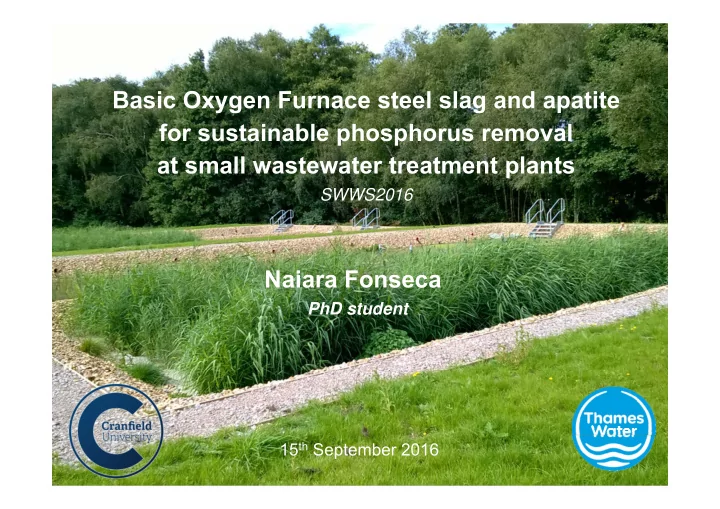
Basic Oxygen Furnace steel slag and apatite for sustainable phosphorus removal at small wastewater treatment plants

SWWS2016

Naiara Fonseca

PhD student 15th September 2016

slide-2
SLIDE 2

2

Why remove phosphorus and to what extent?

  • The largest source of phosphorus (P) in rivers in the UK is sewage effluent
  • Current consents based on the Urban Wastewater Treatment Directive
  • Water Framework Directive – Good ecological status
  • New TP consents 1-2 mg/L, and as low as 0.5 mg/L regardless of WWTP size

Background

WWTP size (population equivalent) Total Phosphorus consent (mg/L) < 10,000 none 10,000 – 100,000 2 > 100,000 1

slide-3
SLIDE 3

3

Conventional solution: chemical dosing + tertiary filtration

Solutions to remove P at small WWTP

Sand filter Coagulant Coagulant

Screens Primary Settlement Tanks Trickling Filters Humus tanks

slide-4
SLIDE 4

4

Conventional solution: chemical dosing + tertiary filtration

Solutions to remove P at small WWTP

slide-5
SLIDE 5

5

Sustainable solution: Constructed wetlands with reactive media

Solutions to remove P at small WWTP

Constructed wetlands with P reactive media

Screens Primary Settlement Tanks Trickling Filters Humus tanks

slide-6
SLIDE 6

6

Sustainable solution: reactive media within constructed wetlands

Solutions to remove P at small WWTP

BASIC OXYGEN FURNACE STEEL SLAG APATITE

slide-7
SLIDE 7

7

Sustainable solution: reactive media within constructed wetlands

Solutions to remove P at small WWTP

BASIC OXYGEN FURNACE STEEL SLAG APATITE

Material Origin Type of material Price BOF steel slag Tarmac (Wales) Waste £ Apatite TIMAB (France) Manufactured £££

slide-8
SLIDE 8

8

Configuration

Full-scale constructed wetland trial

Bed Material Type vHRT (h) Days in operation 1 SS 10‐20mm Horizontal sub‐ surface flow 24 379 2 SS 4‐10mm 24 374 3 SS 2‐6mm 24 291 4 Apatite 2‐8mm 12 404

< 10% of QT TP = 3 - 4 mg/L

slide-9
SLIDE 9

9

Configuration

Lab-scale column experiments

Column Material vHRT (h) Flow Water type Days in

  • peration

1 SS 4‐10mm 6, 24, 48 Downwards, submerged Synthetic,

NH4H2PO4

45 2 Apatite 2‐8mm 60 3 Apatite2 2‐8mm 6

slide-10
SLIDE 10

10

Results

Full-scale constructed wetland trial

  • All slag fractions <0.5 mg/L for most of the time. Apatite consistently <0.5 mg/L
  • Apatite higher P removal capacity than slag
  • Conditioning period
slide-11
SLIDE 11

11

Results

Full-scale constructed wetland trial

  • High effluent pH linked to Ca(OH)2 dissolution
  • Effluent pH decrease with time for both materials, but higher for apatite and <9
slide-12
SLIDE 12

12

Results – Phosphorus removal

Full-scale constructed wetland trial

  • Removal efficiency: apatite > small slag > medium slag > large slag
slide-13
SLIDE 13

13

Results – Effect of HRT on steel slag performance

Lab-scale column experiments

  • Higher P removal for higher HRT
  • Higher effluent pH for higher HRT
slide-14
SLIDE 14

14

Results – Effect of HRT on apatite performance

Lab-scale column experiments

  • High P removal regardless of HRT
  • Higher effluent pH for higher HRT, but lower than slag
slide-15
SLIDE 15

15

Results – comparison of two different apatite materials

Lab-scale column experiments

  • So far, same P removal for both apatite materials
  • Apatite2 lower effluent pH linked to the binder employed (Fe based instead of Ca based)
slide-16
SLIDE 16

16

Conclusions

  • Constructed wetlands with reactive media can be a sustainable and

appropriate solution for P removal at small WWTPs.

  • BOF steel slag could be employed for consents > 1.5 mg TP/L.
  • Apatite shows higher P removal capacity than BOF steel slag.
  • HRT key operational parameter for slag, but less for apatite.
  • New apatite generation produces lower effluent pH while

maintaining same high level of P removal.

slide-17
SLIDE 17

17

Naiara Fonseca

Naiara.FonsecaGalarraga@thameswater.co.uk N.Fonseca@cranfield.ac.uk

THANK YOU FOR YOUR ATTENTION

Basic Oxygen Furnace steel slag and apatite for sustainable phosphorus removal at small wastewater treatment plants