Basic Dynamics in the Health System and Recap Why S/E/E Drivers are - - PowerPoint PPT Presentation

basic dynamics in the health system
SMART_READER_LITE
LIVE PREVIEW

Basic Dynamics in the Health System and Recap Why S/E/E Drivers are - - PowerPoint PPT Presentation

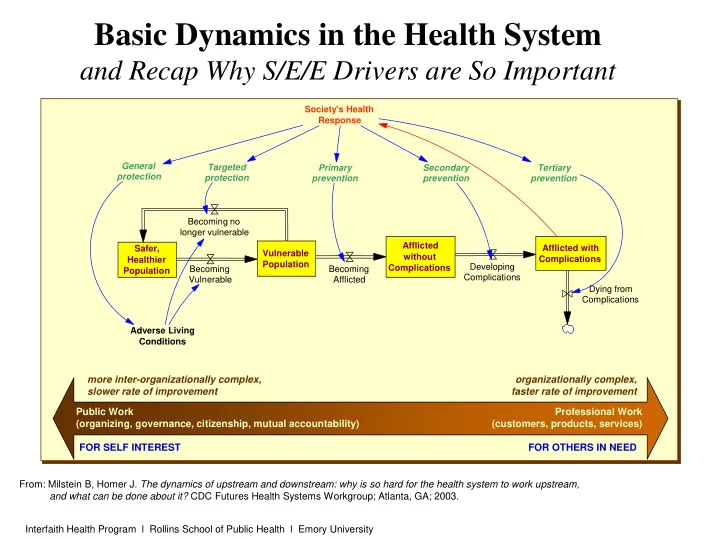
Basic Dynamics in the Health System and Recap Why S/E/E Drivers are So Important Society's Health Response General Targeted Primary Secondary Tertiary protection protection prevention prevention prevention Becoming no longer


slide-1
SLIDE 1

Basic Dynamics in the Health System

and Recap Why S/E/E Drivers are So Important

Public Work (organizing, governance, citizenship, mutual accountability) Professional Work (customers, products, services) more inter-organizationally complex, slower rate of improvement

  • rganizationally complex,

faster rate of improvement FOR SELF INTEREST FOR OTHERS IN NEED

Safer, Healthier Population Becoming Vulnerable Becoming no longer vulnerable Vulnerable Population Becoming Afflicted Afflicted without Complications Developing Complications Afflicted with Complications Targeted protection Primary prevention Secondary prevention Dying from Complications Tertiary prevention Society's Health Response General protection Adverse Living Conditions

From: Milstein B, Homer J. The dynamics of upstream and downstream: why is so hard for the health system to work upstream, and what can be done about it? CDC Futures Health Systems Workgroup; Atlanta, GA; 2003. Interfaith Health Program l Rollins School of Public Health l Emory University

slide-2
SLIDE 2

A Rare Opportunity to Complement Downstream Health Care with Upstream Health Action

Safer, Healthier Population Becoming Vulnerable Becoming no longer vulnerable Vulnerable Population Becoming Afflicted Afflicted without Complications Developing Complications Afflicted with Complications Targeted protection Primary prevention Secondary prevention Dying from Complications Tertiary prevention Society's Health Response General protection Adverse Living Conditions

World of Providing…

  • Education
  • Screening
  • Disease management
  • Pharmaceuticals
  • Clinical services
  • Physical and financial access
  • Etc…

Medical and Public Health Policy

World of Transforming…

  • Deprivation
  • Dependency
  • Violence
  • Disconnection
  • Environmental decay
  • Stress
  • Insecurity
  • Etc…

By Strengthening…

  • Leaders
  • Institutions
  • The meaning of work
  • Mutual accountability
  • Plurality
  • Democracy
  • Freedom
  • Etc…

Healthy Public Policy

BCBSMF Initiative

Interfaith Health Program l Rollins School of Public Health l Emory University

slide-3
SLIDE 3

New BCBSMF Program Directions

Local Action Minnesota-wide Action

Broad-based Cross-sector Work

Issues Agenda Special Populations Communities Macro/Policy

  • C H Workers
  • REACH
  • STEP
  • Literacy
  • Growing Up

Healthy

  • Bethel New Life
  • North Karelia
  • Minnesota Decides
  • TCWF Policy Brief
  • HIA/Social Reports
  • “Northstar Corps”
slide-4
SLIDE 4

Tips for Staying Healthy : A Lifestyle Approach

1. Don’t smoke. If you do stop. If you can’t cut back. 2. Eat a balanced diet, eat plenty of fruits and vegetables. 3. Keep physically active. 4. If you drink, do so in moderation. 5. Cover up in the sun and protect your children. 6. Practice safe sex. 7. Participate in appropriate health screening. 8. Drive defensively; don’t drink and drive. 9. Manage your stress.

  • 10. Maintain social ties

Interfaith Health Program l Rollins School of Public Health l Emory University

slide-5
SLIDE 5

Tips for Staying Healthy: A Social Determinants Approach

1. Don’t be poor. If you can, stop. If you can’t, try not to be poor for too long. 2. Don’t have poor parents. 3. Don’t live in a poor neighborhood. 4. Own a car – but use only for weekend outings. Walk to work. 5. Practice not losing your job and don’t become unemployed. 6. Don’t be illiterate. 7. Avoid social isolation.

Interfaith Health Program l Rollins School of Public Health l Emory University