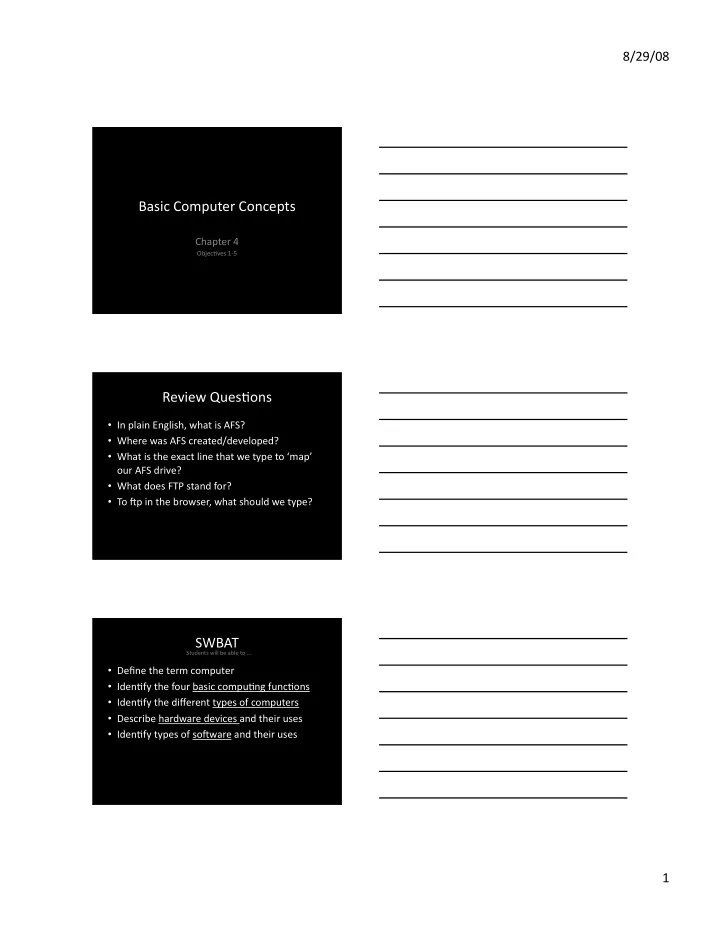
BasicComputerConcepts Chapter4 Objec;ves15 ReviewQues;ons - - PDF document

basic computer concepts
SMART_READER_LITE
LIVE PREVIEW

BasicComputerConcepts Chapter4 Objec;ves15 ReviewQues;ons - - PDF document

8/29/08 BasicComputerConcepts Chapter4 Objec;ves15 ReviewQues;ons InplainEnglish,whatisAFS? WherewasAFScreated/developed?


slide-1
SLIDE 1

8/29/08
 1


Basic
Computer
Concepts


Chapter
4


Objec;ves
1‐5


Review
Ques;ons


  • In
plain
English,
what
is
AFS?

  • Where
was
AFS
created/developed?

  • What
is
the
exact
line
that
we
type
to
‘map’

  • ur
AFS
drive?

  • What
does
FTP
stand
for?

  • To
Tp
in
the
browser,
what
should
we
type?


SWBAT


  • Define
the
term
computer

  • Iden;fy
the
four
basic
compu;ng
func;ons

  • Iden;fy
the
different
types
of
computers

  • Describe
hardware
devices
and
their
uses

  • Iden;fy
types
of
soTware
and
their
uses


Students
will
be
able
to
…


slide-2
SLIDE 2

8/29/08
 2


What
is
a
computer?
 Is
this
a
computer?
 Is
this
a
computer?


slide-3
SLIDE 3

8/29/08
 3


Is
this
a
computer?
 Is
this
a
computer?
 Then,
what
is
a
computer?


  • A
computer
is
a
programmable
electronic


device
that
has
input,

process,
output
and
 store
data.


slide-4
SLIDE 4

8/29/08
 4


Types
of
Computers


  • 1. Microcomputers

  • 2. Servers

  • 3. Mainframes

  • 4. Supercomputers

  • 5. Embedded
Computers


Types
of
Computers


Microcomputers


  • desktop

  • notebooks/laptops

  • tablet
PCs

  • mobile
devices


Servers


  • manage
resources
for
a


group
of
networked
 computers
(eg.
AFS)


Mainframe
Computers


  • large‐scale
compu;ng

  • can
handle
concurrent


transac;ons


– atm
machines
 – credit
cards
 – business
transac;ons


  • ENIAC
(1942)

  • UNIVAC
(1952)

slide-5
SLIDE 5

8/29/08
 5


Supercomputers


  • large,
powerful
computers
that
perform


specialized
tasks.


– weather
forecas;ng

 – simula;ons


Types
of
Computers


Embedded
Computer


  • computers
in
larger


products
 Server


  • manage
resources
for
a


group
of
networked
 computers


– AFS


Computer
Hardware
 Components


Objec;ve
3
 Describe
Hardware
Devices
and
their
Uses


slide-6
SLIDE 6

8/29/08
 6


CPU


  • Purpose

  • Moore’s
Law


– CPU
capacity
doubles
 every
18
months


  • Measured
in
MHz
or


GHz


  • Factors
that
affect


processing
power?


Reference:
Technology
In
Ac;on,
Pren;ce
Hall


RAM


  • Random
Access


Memory
(RAM)


  • Short
Term
Memory

  • Cheap
&
Easy
Upgrade

  • Measured
in
MB
or
GB

slide-7
SLIDE 7

8/29/08
 7


Reference:
Technology
In
Ac;on,
Pren;ce
Hall


Computer
Memory


Name
 Abbrevia6on
 Equivalence
 Rela6ve
Size
 Byte
 B
 1
byte


  • ne
character
of


data
 Kilobyte
 KB
 1,024
bytes
 about
½
of
a
 typewrilen
page
 Megabyte
 MB
 1,024
KB
 about
760
typed
 pages

 Gigabyte
 GB
 1,024MB
 stack
of
typewrilen
 pages,
262
feet
high
 Terabyte
 TB
 1,024GB
 stack
of
typewrilen
 pages,
about
51
 miles
high


Warning: Not Enough Memory to Save File!!!

slide-8
SLIDE 8

8/29/08
 8


Hard
Drive


  • Internal
storage
device

  • Measured
in
gigabytes
(GB)


Reference:
Technology
In
Ac;on,
Pren;ce
Hall
 Reference:
Technology
In
Ac;on,
Pren;ce
Hall


slide-9
SLIDE 9

8/29/08
 9


Reference:
Technology
In
Ac;on,
Pren;ce
Hall
 Reference:
Technology
In
Ac;on,
Pren;ce
Hall
 Reference:
Technology
In
Ac;on,
Pren;ce
Hall


slide-10
SLIDE 10

8/29/08
 10


Reference:
Technology
In
Ac;on,
Pren;ce
Hall
 Reference:
Technology
In
Ac;on,
Pren;ce
Hall


To
Upgrade?
Or
Not?


Reference:
Technology
In
Ac;on,
Pren;ce
Hall