
SLIDE 1
BAMB WP3 and 5.1 Eliot Beeby Introduction Transformable building - - PowerPoint PPT Presentation
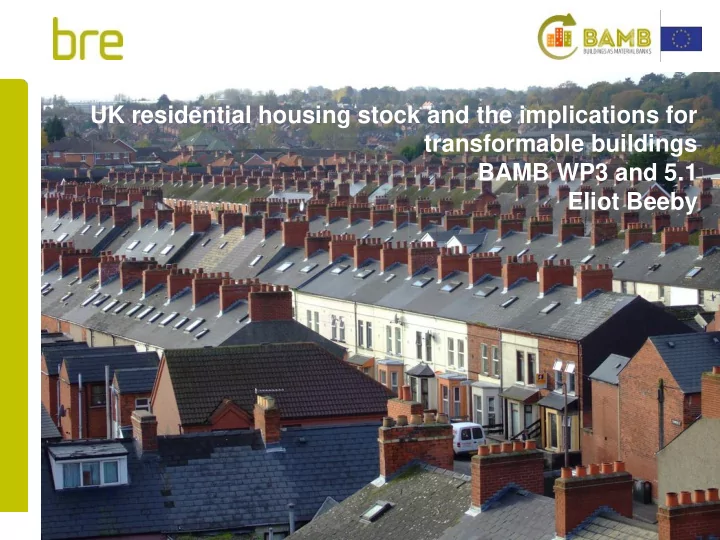
UK residential housing stock and the implications for transformable buildings BAMB WP3 and 5.1 Eliot Beeby Introduction Transformable building design context Brief history of transformable buildings in UK Existing UK residential
www.adaptablefutures.com / Loughborough University
Adapted from Schneider, T., & Till, J. (2007). Flexible housing. Architectural press.
Lawn Road Flats Point-block Alton Gardens The Adaptable House Steelhouse Eastfields Sutton Dwellings Alexandra Road Extendible houses Brockley Park Estate Adelaide Road Estate Honor Oak Park Recording Studio + Living The Transformable Apartment Westferry Studios Affordable Rural Housing Demonstration Project Cala Domus Greenwich Millennium Village (II) Abode Optima Homes Silvertown
Donnybrook Oakridge Village Consort Road Rochdale 1930 1940 1950 1960 1970 1980 1990 2000 2010 2020
Schneider, T., & Till, J. (2007). Flexible housing. Architectural press. The Adaptable House (1962) Eastfields (1968) Alexandra Road (1969-1978) Adelaide Road Estate (1979)
Adapted from Schneider, T., & Till, J. (2007). Flexible housing. Architectural press. Affordable Rural Housing Demonstration Project (2000) Cala Domus (2000) Greenwich Millennium Village II (2001)
NHBC Foundation (2015) Homes through the decades: The making of modern housing.
0,0 10,0 20,0 30,0 40,0 50,0 60,0 70,0 80,0 90,0 100,0 Pre-1850 1850-1899 1900-1918 1919-1944 1945-1964 1965-1980 1981-2002 2003-2013 All ages
% Building stock Age band
Metal frame In situ concrete Precast concrete Timber Frame Masonry Cavity Solid Masonry
0,0 10,0 20,0 30,0 40,0 50,0 60,0 70,0 80,0 90,0 100,0 Pre-1850 1850-1899 1900-1918 1919-1944 1945-1964 1965-1980 1981-2002 2003-2013 All ages
% Building stock Age band
Terraced Semi-detached Detached Bungalow Converted flat Purpose-built low-rise flat Purpose-built high- rise flat
Google Streetview 2016
Building Element Material description Connections Re-use/recycling potential
Foundation Rubble foundation Laid within ground Possible depending on whether it is possible to separate and sort steel and concrete cost-effectively Ground floor Timber joists with timber floor boards, occasionally slate flagged solid flooring Joists clear spanning between
sleeper walls, floor boards nailed onto joists Recyclable; possibly reusable depending on size, structural integrity - reclaimed timber is popular; slate flags possible re-use as hardcore Upper floor Timber joists with timber floor boards Joists bolted together, floor boards nailed on Recyclable; possibly reusable depending on size, structural integrity Lime plaster ceiling Plastered onto timber laths nailed to floor joists Can be recycled as aggregate, likely calcified so unsuitable for reuse External walls Double layer brickwork bonded with lime mortar, with pyramid footings at base Lime mortar bonded to bricks Lime mortar facilitates reuse more easily than cement mortar, but internal plastering must be removed; can be recycled as aggregate Internal walls Mainly brick single skin or
Bonded to external walls and support upper floors Recyclable; possibly reusable depending on size, structural integrity Lime plaster Plastered onto brick or timber laths nailed to timber studs Can be recycled as aggregate, likely calcified so unsuitable for reuse Roof Slate tiles Nailed to battens Use as aggregate; possible to reclaim and reuse if care taken at removal Reinforced bituminous felt Nailed to battens Theoretically recyclable but rarely done Timber rafter roof with King post truss and purlins Bolted Recyclable; possibly reusable depending on size, structural integrity Mineral wool insulation (retrofitted) Sits within cavity If recovered relatively contaminant free, possible to recycle in closed loop system Lime plaster Plastered onto timber laths nailed to ceiling joists Can be recycled as aggregate, likely calcified so unsuitable for reuse Windows and doors Wooden frames Screwed/nailed into masonry Recyclable Double glazed window Fitted into frame Glazing is recyclable Wooden door frames Screwed Recyclable; demand for reclaimed timber products could facilitate reuse
Durmisevic, E. (2006)