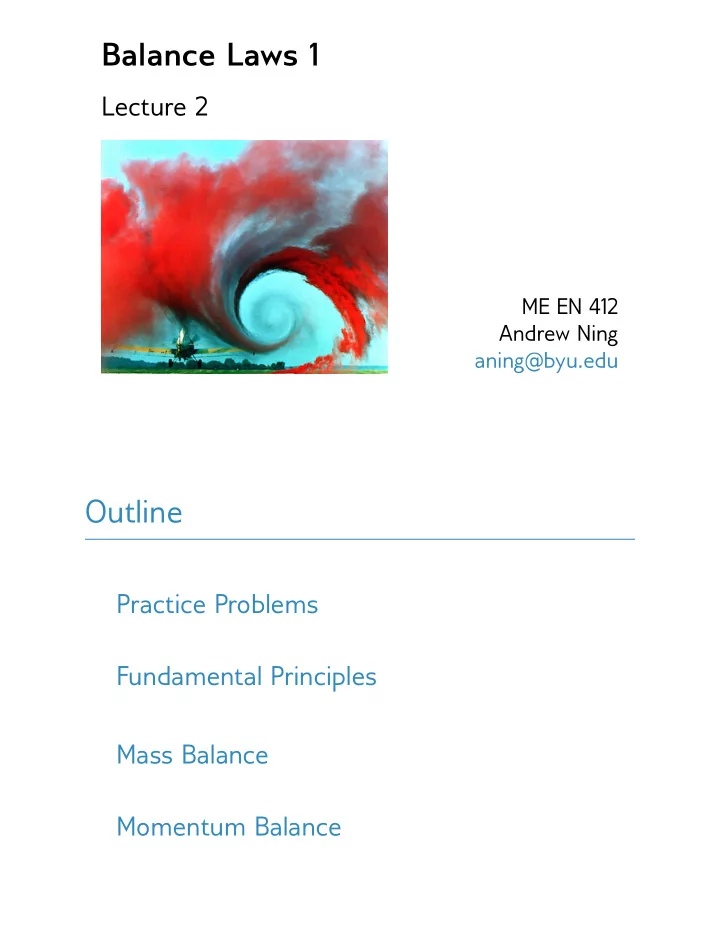
Balance Laws 1 Lecture 2 ME EN 412 Andrew Ning aning@byu.edu - - PDF document

balance laws 1
SMART_READER_LITE
LIVE PREVIEW

Balance Laws 1 Lecture 2 ME EN 412 Andrew Ning aning@byu.edu - - PDF document

Balance Laws 1 Lecture 2 ME EN 412 Andrew Ning aning@byu.edu Outline Practice Problems Fundamental Principles Mass Balance Momentum Balance Practice Problems Prob 7.37 A sphere of diameter d falls slowly in a highly viscous fluid. What


slide-1
SLIDE 1

Balance Laws 1

Lecture 2

ME EN 412 Andrew Ning aning@byu.edu

Outline

Practice Problems Fundamental Principles Mass Balance Momentum Balance

slide-2
SLIDE 2

Practice Problems Prob 7.37

A sphere of diameter d falls slowly in a highly viscous fluid. What parameters might be important?

slide-3
SLIDE 3

Only a limited number of experiments can be

  • performed. Can we build a predictive model for the

settling velocity? From one experimental run:

  • V = 0.42 ft/s
  • d = 0.1 in
  • µ = 0.03 lb-s /ft2
  • ∆γ = 10 lb/ft3

Fundamental Principles

slide-4
SLIDE 4
  • Mass is conserved.
  • F = ma (Newton’s second law) and its angular

counterpart.

  • Energy is conserved (first law of

thermodynamics).

  • Entropy will always increase over time (second

law of thermodynamics). It can be produced but not destroyed. All of these concepts can be expressed in terms of balance laws: rate of accumulation = rate of inflow − rate of outflow + rate of production

slide-5
SLIDE 5

Control Volumes Mass Balance

slide-6
SLIDE 6

Derive mass balance. ∂ ∂t

  • V

– ρdV – +

  • S

ρ W · d A = 0

slide-7
SLIDE 7

W is the relative velocity Total velocity:

  • V =

W + VV –

Momentum Balance

slide-8
SLIDE 8

rate of momentum accumulation + rate of outflow −rate of inflow = rate of production

Newton’s 2nd Law

Σ F = d(m V ) dt

slide-9
SLIDE 9

∂ ∂t

  • V

– ρ V dV – +

  • S

ρ V ( W · d A) = Σ F Any external forces can be applied, but the most common are the fluid pressure forces, fluid viscous forces, and gravitational forces. Pressure: Σ Fp = −

  • S

pd A Viscous shear stress: Σ Fv =

  • S

τ · d A

slide-10
SLIDE 10

∂ ∂t

  • V

– ρ V dV – +

  • S

ρ V ( W · d A) = −

  • S

pd A +

  • S

τ · d A + Fother