BAG 2015 1 Developing learner autonomy: Getting ALL learners - - PowerPoint PPT Presentation

bag 2015 1 developing learner autonomy getting all
SMART_READER_LITE
LIVE PREVIEW

BAG 2015 1 Developing learner autonomy: Getting ALL learners - - PowerPoint PPT Presentation

/ Dennis the Menace The best thing you can do is to become extremely good at being yourself! BAG 2015 1 Developing learner autonomy: Getting ALL learners involved in their own language learning Leni Dam, Denmark lenidam@hotmail.com Outline of


slide-1
SLIDE 1

BAG 2015

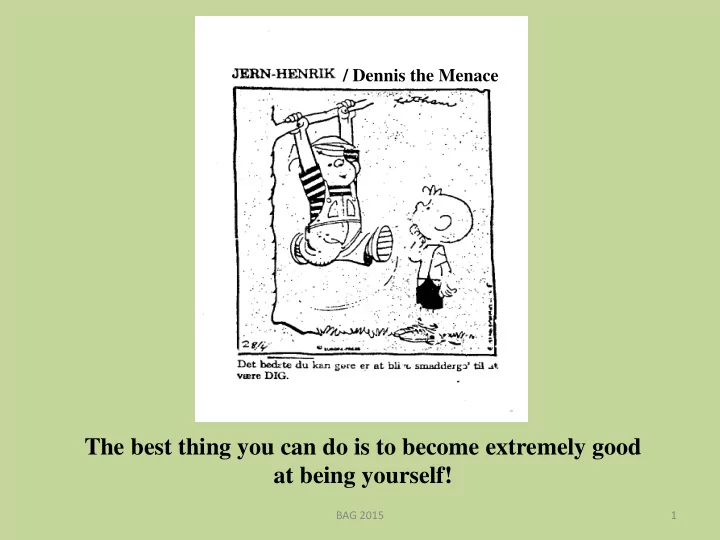
The best thing you can do is to become extremely good at being yourself!

/ Dennis the Menace

1
slide-2
SLIDE 2

Developing learner autonomy: Getting ALL learners involved in their

  • wn language learning

Leni Dam, Denmark

lenidam@hotmail.com

slide-3
SLIDE 3

Outline of presentation

  • The Salamanca statement /

Key-features in inclusive pedagogy

  • Developing learner autonomy – video extract /

Key-features in autonomous learning

  • Developing learner autonomy :

Examples from an autonomous classroom

  • Concluding remarks

BAG 2015 3

slide-4
SLIDE 4

The Salamanca statement (1994)

We believe and proclaim that (extract):

  • every child has a fundamental right to education,

and must be given the opportunity to achieve and maintain an acceptable level of learning,

  • every child has unique characteristics, interests,

abilities and learning needs,

  • education systems should be designed and

educational programmes implemented to take into account the wide diversity of these characteristics and needs.

BAG 2015 4

slide-5
SLIDE 5

Inclusive pedagogy recommends:

  • The establishment of a secure and socially well-functioning

environment: Appreciation and acknowledgement

  • Structure
  • Focus on what to do rather than whom to support (inclusion

as opposed to integration or even worse - exclusion)

  • Activities where everybody can contribute something and

where everybody will gain something (differentiation)

  • Peer-tutoring
  • Participation in decision making as regards own learning
  • Possibilities for choice – partner, content, way of working, etc.

– within certain constraints. (Recent experiences gained by Danish pedagogues and teachers)

BAG 2015 5

slide-6
SLIDE 6

Developing learner autonomy

BAG 2015 6

  • Extract from the video:

It’s up to yourself if you want to learn!

slide-7
SLIDE 7

Key-features in the autonomy classroom

Involving learners‘' identity and previous knowledge (=> security + motivation) The importance

  • f choice

(=> reflection => responsibility) Differentiated activities (=>everybody can take part) Evaluation of learning – looking back, planning ahead Peer tutoring (=>cooperation) Visible aims and expectations (=> clear structure)

BAG 2015

=> Seating in groups (=> Social aspects of learning) Focusing on what rather than who (=> inclusion vs. Integration)

7

slide-8
SLIDE 8

The class - Vocabulary “test” after 6 weeks of English

BAG 2015 8

slide-9
SLIDE 9

Seating in groups

BAG 2015

Group work Social learning Peer tutoring Independence of teacher

9

slide-10
SLIDE 10

Who? What? Emrah / Lars Make an essay Susan / Anne Mette Read books Anders / Karsten / Dennis Make a radio programme Nanna / Birgitte Make a TV programme Jan Helene Translate English songs into Danish Work with poems Jacob / Louise Make a game Lasse/ Louise N. / Michael / Max / Michelle R. / Michelle B.

2nd year of English, 12-year-olds

Make a play

Who does what?

BAG 2015 10

slide-11
SLIDE 11

BAG 2015 11

slide-12
SLIDE 12

OH NO !!!!!!!! Narrator : Jerry and his friend Steve are going home from school, the two big boys Dick and Jack wait for them. Jerry : Oh no, not again. Dick : What’ve got here, mann Jack : It is the little Jerry, and his friend Steve, shall we have some fun. Dick : Yes, we will have some fun, with the two small boys. Jack : Oh Steve are you going home to your mother and give her a big kiss. Dick : Oh yes, and you Jerry, you are on your way home because you will have your dummy. Jerry : Run Steve, run-a-way. Steve : I’m running, Jerry. Narrator : Steve and Jerry run home to Jerry’s place. Later Jerry and Steve go for a little walk. Jerry : Why should we always be teased?. Steve : I dont know. Narrator : Now they are meeting the bigest girl in the town, Djeni. Djeni : Hello micro boys, why should you always be stupid?. Steve : I dont know. Djeni : You dont know. (Play, group work, 1st year of English, 11-year olds – Karsten, Dennis, Helene, Lars, Lasse)

A learner-produced play as group work

BAG 2015 12

slide-13
SLIDE 13

Susan’s logbook entry

BAG 2015 13

slide-14
SLIDE 14

The more the students becomes the teacher and the more the teacher becomes the learner, then the more successful are the outcomes (Hattie 2009 p. 25)

BAG 2015 14

slide-15
SLIDE 15

A possible plan for group work

  • Share homework with your partner(s)
  • Two minutes’ talk
  • Work with the tasks you have chosen / been

given

  • Evaluate your work
  • Plan homework and perhaps the next lesson

(Poster)

BAG 2015 15

slide-16
SLIDE 16

Logbook page - 3rd year of English / girl

BAG 2015 16

slide-17
SLIDE 17

Rules for homework

  • Homework is a must.
  • You can choose from the list of ideas.
  • You must be able to do your homework without

the help of your parents.

  • Whatever you choose should be so interesting

that you can’t help doing it.

  • You must always read in your extra reader until

you have come across at least 5 new words.

  • Whatever you do, you should learn something

from it.

Teacher and learners in cooperation – poster / 2nd year of English

BAG 2015 17

slide-18
SLIDE 18

Peer-tutoring

BAG 2015 18

slide-19
SLIDE 19

Good group work – individual statements

  • A good group work is work everybody take part in, and

discuss everything, and they like each other. Everybody has to talk English all the time. Everybody has to do something for the group. When you learn something from the group.(Emrah)

  • Good group work is: That we talk English all the time, and we

can work without getting mad at each other. Everybody has to work with something. You have to learn something about

  • it. We have to discuss everything what we are doing.(Max)

BAG 2015 19

slide-20
SLIDE 20

Involvement of parents Detailed information about the set-up of teaching and learning:

  • What we do (a plan for a period).
  • Why we do it (e.g. the curricular guidelines).
  • How we do it (e.g. the use of logbooks and

portfolios, homework to be done).

  • Expectations of parents (taking part in their

children’s learning / showing interest in their homework).

BAG 2015 20

slide-21
SLIDE 21

Conclusion

  • It is possible to get all learners involved in

their own learning if the key-features of learner autonomy are catered for.

  • It is possible to create a learning environment

where the individual learner feel accepted and respected – an environment which supports self-esteem and self- respect and thus respect for others.

  • It is possible to make all learners good

language learners.

BAG 2015 21

slide-22
SLIDE 22

D: What did / what should you do today? L: Today I ehm I shall have my birthday. D: Have you birthday today? L: Yes. D: Happy birthday. L: Thank you. So I should home and, and and make made a cake to my- D: Birthday cake? L: Cake, yes, so I should have this cake and, so to, afternoon my eh my friend is coming and ….. (cf. Legenhausen 2001:65)

BAG 2015

Peer-to-peer talks / 2 minutes’ talk – Dennis and Lasse

22

slide-23
SLIDE 23

J: I’m going to have a family with two ehm chil childrens, and I’m going to live in a big house. I: When is your birthday? J: My birthday is now. I: Ah, my birthday is on the sixteen ah ja of ehm of May. When is your sister’s birthday? J: My sister’s birthday is in is on the twenty-seventh of February. I: What films do you like? …

BAG 2015 23

Peer - to – peer talk, German group

slide-24
SLIDE 24

With what result?

  • a learner’s voice

BAG 2015

Most important is probably the way we have worked. That we were expected to and given the chance to decide ourselves what to do. That we worked independently. And we have learned much more because we have worked with different things. In this way we could help each other because some of us had learned something and others had learned something else. It doesn’t mean that we haven’t had a teacher to help us. Because we have, and she has helped us. But the day she didn’t have the time, we could manage on our own. (Max) (Dam 2006)

24

slide-25
SLIDE 25

Remember

“The schools that kids love have the quality of active learning environments, allowing students to become shareholders of their own learning.” (Rogers 1969:9)

BAG 2015 25