BACKEND DESIGN Circuit Partitioning Partitioning System Design - - PDF document

backend design circuit partitioning partitioning
SMART_READER_LITE
LIVE PREVIEW

BACKEND DESIGN Circuit Partitioning Partitioning System Design - - PDF document

BACKEND DESIGN Circuit Partitioning Partitioning System Design Decomposition of a complex system into smaller subsystems. Each subsystem can be designed independently. Decomposition scheme has to minimize the interconnections


slide-1
SLIDE 1

1

BACKEND DESIGN Circuit Partitioning

CAD for VLSI 2

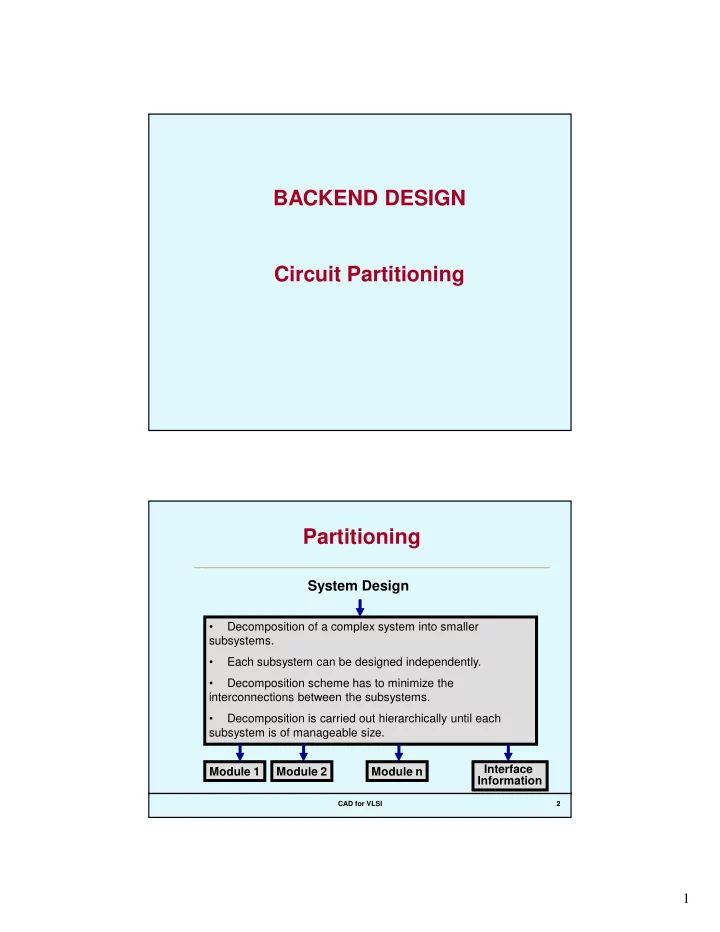
Partitioning

  • Decomposition of a complex system into smaller

subsystems.

  • Each subsystem can be designed independently.
  • Decomposition scheme has to minimize the

interconnections between the subsystems.

  • Decomposition is carried out hierarchically until each

subsystem is of manageable size. Module 1 Module 2 Module n Interface Information

System Design

slide-2
SLIDE 2

2

CAD for VLSI 3

Cut 1 = 4 Cut 2 = 4 Size 1 = 15 Size 2 = 16 Size 3 = 17 Cut 1 Cut 2

CAD for VLSI 4

Partitioning at Different Levels

  • Can be done at multiple levels:

– System level – Board level – Chip level

  • Delay implications are different:

– Intrachip

  • X

– Intraboard

  • 10X

– Interboard

  • 20X
slide-3
SLIDE 3

3

CAD for VLSI 5

Different Delays in a Chip

C C B A B A

X 10X 10X 20X

CAD for VLSI 6

Problem Formulation

  • Partition a given netlist into smaller netlists such

that:

1. Interconnection between partitions is minimized. 2. Delay due to partitioning is minimized. 3. Number of terminals is less than a predetermined maximum value. 4. The area of each partition remains within specified bounds. 5. The number of partitions also remains within specified bounds.

slide-4
SLIDE 4

4

CAD for VLSI 7

Classification of Partitioning Algorithms

Group Migration Performance Driven Simulation Based Partitioning Algorithms

Kernighan-Lin Fiduccia-Mattheyses Goldberg-Burstein Simulated Annealing Simulated Evolution

CAD for VLSI 8

Group Migration Algorithms

  • Kernighan-Lin

– An iterative improvement algorithm for balanced two-way partitioning.

  • Goldberg-Burstein

– Uses properties of graphs to improve the performance of K- L algorithm.

  • Fiduccia-Mattheyses

– Considers multi-pin nets. – Can generate partitions of unequal sizes. – Uses efficient data structure to represent nodes.

slide-5
SLIDE 5

5

CAD for VLSI 9

Extension of K-L Algorithm

  • Unequal sized blocks

– To partition a graph with 2n vertices into two subgraphs of unequal sizes n1 and n2:

  • Divide the nodes into two subsets A and B, containing

MIN(n1,n2) and MAX(n1,n2) vertices respectively.

  • Apply K-L algorithm, but restrict the maximum number
  • f vertices that can be interchanged in one pass to

MIN(n1,n2).

CAD for VLSI 10

  • Unequal sized elements

– To generate a two-way partition of a graph whose vertices have unequal sizes:

  • Assume that the smallest element has unit size.
  • Replace each element of size s with s vertices which are

fully connected (s-clique) with edges of infinite weight.

  • Apply K-L algorithm to the modified graph.
slide-6
SLIDE 6

6

CAD for VLSI 11

Simulated Annealing and Evolution

  • These belong to the probabilistic and iterative class
  • f algorithms.
  • Simulated Annealing

– Simulates the annealing process used for metals. – As in the actual annealing process, the value of temperature is decreased slowly till it approaches the freezing point.

  • Simulated Evolution

– Simulates the biological process of evolution. – Each solution (generation) is improved in each iteration by using operators which simulate the biological events in the evolution process.

CAD for VLSI 12

Simulated Annealing

  • Concept analogous to the annealing process for

metals and glass.

  • A random initial partition is available as input.
  • A new partition is generated by exchanging some

elements.

  • If the quality of partition improves, the move is

always accepted.

  • If not, the move is accepted with a probability which

decreases with the increase in a parameter called temperature (T).

slide-7
SLIDE 7

7

CAD for VLSI 13

The Annealing Curve

T Time Local Minima Global Minima

CAD for VLSI 14

Simulated Annealing Algorithm

Algorithm SA begin t = t0; cur_part = ini_part; cur_score = SCORE (cur_part); repeat repeat comp1 = SELECT (part1); comp2 = SELECT (part2); trial_part = EXCHANGE (comp1,comp2,cur_part); trial_score = SCORE (trial_part); δ δ δ δs = trial_score – cur_score;

slide-8
SLIDE 8

8

CAD for VLSI 15

if (δ δ δ δs < 0) then cur_score = trial_score; cur_part = MOVE (comp1, comp2); else r = RAND (0,1); if (r < exp(- δ δ δ δs/t)) then cur_score = trial_score; cur_part = MOVE (comp1, comp2); until (equilibrium at t is reached); t = α α α αt; /* 0 < α α α α < 1 */ until (freezing point is reached); end.

CAD for VLSI 16

  • The SCORE function

Imbalance (A,B) =

  • size(A) – size(B)
  • Cutcost (A,B) = Sum of weights of cut edges

Cost = W1 * Imbalance(A,B) + W2 * Cutcost(A,B)

  • The MOVE function

– Several alternatives:

  • Pairwise exchange (W1 =0)
  • Subsets of elements exchanged
  • Select that node

– which is internally connected to least number of vertices – whose contribution to external cost is highest

slide-9
SLIDE 9

9

CAD for VLSI 17

Performance Driven Partitioning

  • Typically, on-board delay is three orders of

magnitude larger than on-chip delay.

– On-chip delay is of the order of nanoseconds. – On-board delay can be in the order of milliseconds.

  • If a critical path is cut many times by the partition,

the delay in the path may be too large to meet the goals of high-performance systems.

  • Goal of partitioning in high-performance systems:
  • 1. Reduce the cut-size.
  • 2. Minimize the delay in critical paths.
  • 3. Timing constraints have to be satisfied.

CAD for VLSI 18

Contd.

  • The problem can be modeled as a graph.

– Each vertex represents a component (gate). – Each edge represents a connection between two gates. – Each vertex has a weight specifying the component delay. – Each edge has a weight, which depends on the partitions to which the edges belong.

  • This problem is very general and still a topic of

intensive research.

slide-10
SLIDE 10

10

CAD for VLSI 19

Summary

  • Broadly, two classes of algorithms:

1. Group migration based

  • High speed
  • Poor performance

2. Simulation based

  • Low speed
  • High performance