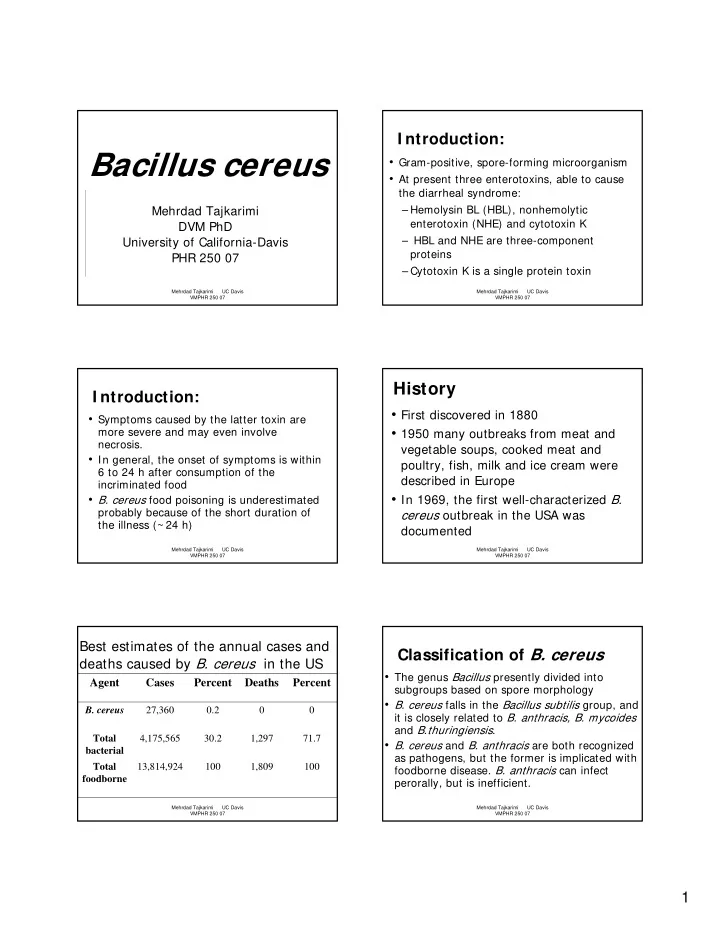
Bacillus cereus Gram-positive, spore-forming microorganism At - - PDF document

bacillus cereus
SMART_READER_LITE
LIVE PREVIEW

Bacillus cereus Gram-positive, spore-forming microorganism At - - PDF document

I ntroduction: Bacillus cereus Gram-positive, spore-forming microorganism At present three enterotoxins, able to cause the diarrheal syndrome: Hemolysin BL (HBL), nonhemolytic Mehrdad Tajkarimi enterotoxin (NHE) and cytotoxin K DVM


slide-1
SLIDE 1

1

Mehrdad Tajkarimi UC Davis VMPHR 250 07

Bacillus cereus

Mehrdad Tajkarimi DVM PhD University of California-Davis PHR 250 07

Mehrdad Tajkarimi UC Davis VMPHR 250 07

I ntroduction:

  • Gram-positive, spore-forming microorganism
  • At present three enterotoxins, able to cause

the diarrheal syndrome: – Hemolysin BL (HBL), nonhemolytic enterotoxin (NHE) and cytotoxin K – HBL and NHE are three-component proteins – Cytotoxin K is a single protein toxin

Mehrdad Tajkarimi UC Davis VMPHR 250 07

I ntroduction:

  • Symptoms caused by the latter toxin are

more severe and may even involve necrosis.

  • In general, the onset of symptoms is within

6 to 24 h after consumption of the incriminated food

  • B. cereus food poisoning is underestimated

probably because of the short duration of the illness (~ 24 h)

Mehrdad Tajkarimi UC Davis VMPHR 250 07

History

  • First discovered in 1880
  • 1950 many outbreaks from meat and

vegetable soups, cooked meat and poultry, fish, milk and ice cream were described in Europe

  • In 1969, the first well-characterized B.

cereus outbreak in the USA was documented

Mehrdad Tajkarimi UC Davis VMPHR 250 07

Best estimates of the annual cases and deaths caused by B. cereus in the US

100 1,809 100 13,814,924 Total foodborne 71.7 1,297 30.2 4,175,565 Total bacterial 0.2 27,360

  • B. cereus

Percent Deaths Percent Cases Agent

Mehrdad Tajkarimi UC Davis VMPHR 250 07

Classification of B. cereus

  • The genus Bacillus presently divided into

subgroups based on spore morphology

  • B. cereus falls in the Bacillus subtilis group, and

it is closely related to B. anthracis, B. mycoides and B.thuringiensis.

  • B. cereus and B. anthracis are both recognized

as pathogens, but the former is implicated with foodborne disease. B. anthracis can infect perorally, but is inefficient.

slide-2
SLIDE 2

2

Mehrdad Tajkarimi UC Davis VMPHR 250 07

Criteria to differentiate among four closely related Bacillus spp.

No Yes No Yes Yes

White/ Grey B. thuringiensis

No No No No No Rhizoid

  • B. mycoides

Yes No Yes No No White

  • B. anthracis

No No No Yes Yes White

  • B. cereus

Virulent to Mice

Parasporal Body

Susceptibility

to Penicillin

Hemolysis

Motile Colony Species

Mehrdad Tajkarimi UC Davis VMPHR 250 07

Factors Affecting Growth of B. cereus

  • Growth temperature 7-49°C with a

minimum of 4-5°C , maximum 48- 50°C

  • Generally, spore germination

temperature range from 8-30°C

  • pH 4.9-9.3

Mehrdad Tajkarimi UC Davis VMPHR 250 07

Factors Affecting Growth of B. cereus

  • Water activity 0.91-0.93
  • Salt as high as 7.5% NaCl, some tolerate

10%

  • D value for spores at 100°C around 3 min
  • The dose for 90% reduction of spores is

1.25 - 4kGy

  • 0.17-0.65 kGy for vegetative cells

Mehrdad Tajkarimi UC Davis VMPHR 250 07

Name of I llness Caused by B. cereus

  • B. cereus has two recognized types of

foodborne illness: diarrheal , emetic

  • The emetic syndrome is caused by cereulide,

a heat- and pH stable peptide toxin

  • Consumption of food contaminated with this

toxin may lead to emesis between 30 min and 5 h after ingestion

Mehrdad Tajkarimi UC Davis VMPHR 250 07

Name of I llness Caused by B. cereus

  • The diarrhoeal syndrome is caused by enterotoxins

that are produced during growth of B. cereus in the small intestine

  • The diarrheal illness (more common in North America

and Europe) is caused by a high molecular weight protein

  • In some outbreaks there seems to be an overlap

between the diarrheal and the emetic types of illness

Mehrdad Tajkarimi UC Davis VMPHR 250 07

Comparison of diarrheal and emetic types of B. cereus food poisoning

Rice, pasta, noodles, pastries 105-08 per g of food 12-24 h 1-5 h Emetic Milk, soup, meat products, puddings 103-107 CFU, ingested 12-24 h 8-16 h Diarrheal Foods Dose Duration I ncubation Syndrome

Granum, P.E. (1994).

slide-3
SLIDE 3

3

Mehrdad Tajkarimi UC Davis VMPHR 250 07

Which Food?

  • Milk, vegetables, meat, and fish
  • The emetic type of poisoning

include rice products, potato, pasta, and cheese products

Mehrdad Tajkarimi UC Davis VMPHR 250 07

Which Food?

  • Other foods such as sauces,

pastries, soups, puddings, and salads were identified as vehicles in food poisoning

  • utbreaks

Mehrdad Tajkarimi UC Davis VMPHR 250 07

Comparison of food poisoning caused by different bacterial agents.

Cooked meats and poultry and dairy products Intoxication Diarrhea Vomiting 12-24 1-5

  • S. aureus

Fried rice from Chinese restaurants and take out shops Intoxication Diarrhea (fairly common) vomiting 12-24 1-5

  • B. cereus**,

emetic Meats, meat products, and gravy toxico- infection Diarrhea 12-24 8-16

  • C. perfringens

Meat products, soups, vegetables, puddings and sauces toxico- infection Diarrhea 12-24 8-16

  • B. cereus*,

diarrheal Frequently Implicated Food Type of Disease Dominating Signs Duration of Illness, h Incubation (h) Pathogen

Gilbert, R.J. and Kramer, J.M. (1987). Mehrdad Tajkarimi UC Davis VMPHR 250 07

I nfective Dose

  • Infective dose of B. cereus

ranges from 104 to 1011 cells per gram of food

Mehrdad Tajkarimi UC Davis VMPHR 250 07

Detection of B. cereus

  • Blood agar can be used as a plating

medium

  • Nutrient broth followed by blood agar

useful for most probable number count

Mehrdad Tajkarimi UC Davis VMPHR 250 07

Prevention:

  • Preventing contamination of food with

its spores is almost impossible

  • Inhibit spore germination and prevent

the growth of vegetative cells in cooked, ready-to-eat foods

slide-4
SLIDE 4

4

Mehrdad Tajkarimi UC Davis VMPHR 250 07

Prevention:

  • Temperatures under 100°C (212°F)

might allow spore survival

  • Non-refrigerated storage of foods and

especially rice should be avoided

  • Foods that require heating or cooling

should undergo that process rapidly

Mehrdad Tajkarimi UC Davis VMPHR 250 07

Thank you !