Autonomous Navigation Mangal Kothari Department of Aerospace - - PowerPoint PPT Presentation

autonomous navigation
SMART_READER_LITE
LIVE PREVIEW

Autonomous Navigation Mangal Kothari Department of Aerospace - - PowerPoint PPT Presentation

Department of Aerospace Engineering IIT Kanpur, India Autonomous Navigation Mangal Kothari Department of Aerospace Engineering Indian Institute of Technology Kanpur Kanpur 208016 mangal@iitk.ac.in 9460255282 Class Timing: M-12:00-13:15


slide-1
SLIDE 1

1

Department of Aerospace Engineering IIT Kanpur, India

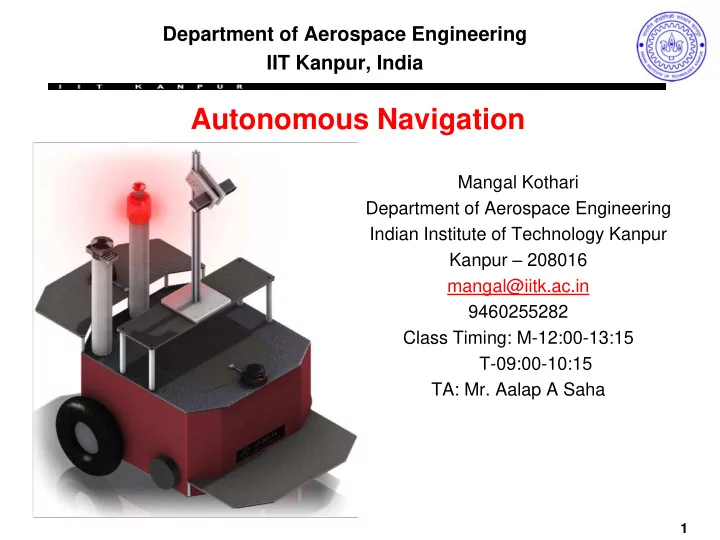
Autonomous Navigation

Mangal Kothari Department of Aerospace Engineering Indian Institute of Technology Kanpur Kanpur – 208016 mangal@iitk.ac.in 9460255282 Class Timing: M-12:00-13:15 T-09:00-10:15 TA: Mr. Aalap A Saha

slide-2
SLIDE 2

2

Autonomous Navigation

slide-3
SLIDE 3

3

Course Content

  • Introduction: practical examples and challenges –

IGVC, SAVe, Mehar Baba competition

  • ROS and state estimation (Bayesian filter-Kalman

Filter, Extended Kalman Filter, Unscented Kalman Filter), Nonparametric filter (particle filter), Localization, SLAM, Cooperative localization

  • Path planning algorithms: Deterministic and

probabilistic algorithms, Task allocation algorithms

  • Vision and communication systems
  • Topics can be added and removed based on

feedback!!!

slide-4
SLIDE 4

4

Reference

  • Probabilistic Robotics. Sebastian Thrun, Wolfram

Burgard and Dieter Fox. MIT press, 2005.

  • Principles of Robot Motion: Theory, Algorithms and

Implementations, Howie Choset et al.. MIT Press, 2005.

  • State Estimation for Robotics: Timothy D. Barfoot.

Cambridge University Press, 2017.

  • A Gentle Introduction to ROS: Jason M. O’Kane.

2013.

slide-5
SLIDE 5

5

Evaluation

  • Assignment – 40%
  • Project (maximum 3 students) – 40%
  • Midterm exam – 10%
  • Quizzes (after midsem) – 10%
  • Plagiarism – de-register/failed
slide-6
SLIDE 6

6

Problem Statement

slide-7
SLIDE 7

7

Specifications

  • Length: Min 3 feet, Max 7 feet
  • Width: Min 2 feet, Max 4 feet
  • Height: Max 6 feet
  • Propulsion: Battery powered
  • Average speed: 1 mph
  • Minimum speed: 1 mph for the first 44 feet
  • Maximum speed: 5 mph
  • Mechanical E stop: Hardware base
  • Wireless stop: Effective with in 100 feet
  • Safety light: Must be on when vehicle is on
  • Payload: 20 pounds, 18”x8”x8”
slide-8
SLIDE 8

8

Qualification

  • Mechanical stop and E stop evaluation
  • Lane following (with U turn)
  • Obstacle avoidance
  • Waypoint following
slide-9
SLIDE 9

9

Intelligent Ground Vehicle Competition (IGVC)

IGVC 2018 GPS Waypoints

North 42.6791159989 -83.1949250546 Midpoint 42.6789603912

  • 83.1951132036

South 42.6788151958 -83.1949093082 Practice1 42.6783260449

  • 83.1946867275

Practice2 42.6781974127

  • 83.1949338822

Qualification1 42.6782191223 -83.1955080989 Qualification2 42.6778987274 -83.1954820799

slide-10
SLIDE 10

10

Vehicle Model

  • Compact design
  • Switchable vehicle design
  • Spring based suspension system
  • Height and angle adjustable camera mount
slide-11
SLIDE 11

11

System Architecture

slide-12
SLIDE 12

12

Robot Operating Systems

  • A meta operating system for robot
  • A collection of packaging, software building tools
  • An architecture for distributed interprocess/ inter-

machine communication and configuration

  • A language-independent architecture (C++,

python, lisp, java, and more)

slide-13
SLIDE 13

13

ROS Communication Layer: ROS Core

  • ROS master

– Centralized communication server based on XML and RPC – Registers and looks up names for ROS graph resources

  • Nodes

– Distributed process over the network (executable runs a separate thread) – Serve as source and sink for data

  • Topics

– Asynchronous many-to-many communication – Publish and subscribe structure

slide-14
SLIDE 14

14

Asynchronous Distributed Communication

ROS Master Manage communication among nodes Every node register when at start up with the master $ roscore

slide-15
SLIDE 15

15

ROS Package

slide-16
SLIDE 16

16

Software Architecture

slide-17
SLIDE 17

17

Lane Detection: Computer Vision

slide-18
SLIDE 18

18

Pinhole Camera Model

slide-19
SLIDE 19

19

Inverse Perspective Transformation

Lane following transformation 𝑌𝑔, 𝑍

𝑔, 𝑎𝑔 ≡ 𝑦𝑔

𝑡 , 𝑧𝑔 𝑡 , 0 𝑌𝑝, 𝑍

𝑝, 𝑎𝑝 ≡ 𝑌𝑔 − 𝑃𝑌, 𝑍 𝑔−𝑃𝑍, 𝑎𝑔

𝑌𝑑, 𝑍

𝑑, 𝑎𝑑

≡ ൫𝑌𝑝, ሺ𝐼 + 𝑎𝑝) cos 𝜄 + 𝑍𝑝si nሺ 𝜄), ሺ𝐼 𝑦𝑑, 𝑧𝑑 ≡ 𝑌𝑑 𝑎𝑑 𝑔

𝑦 + 𝑑𝑦, 𝑍 𝑑

𝑎𝑑 𝑔

𝑧 + 𝑑𝑧

slide-20
SLIDE 20

20

Top View Transformation

𝑦𝑑, 𝑧𝑑 ≡ 𝑦𝑔 𝑡 −𝑃𝑌 𝐼 sin 𝜄 − 𝑧𝑔 𝑡 −𝑃𝑍 cos 𝜄 𝑔

𝑦 + 𝑑𝑦,

ቁ 𝐼 cos 𝜄 + 𝑧𝑔 𝑡 −𝑃𝑍 si nሺ 𝜄 𝐼 sin 𝜄 − 𝑧𝑔 𝑡 −𝑃𝑍 cos 𝜄 𝑔

𝑧 + 𝑑𝑧

OpenCV implementation

ThiRef: https://docs.opencv.org/2.4/modules/imgproc/doc/geometric_transformations.html#warpperspective

slide-21
SLIDE 21

21

Super-Pixel Segmentation

Reducing the dimensionality of data without loss of important information

slide-22
SLIDE 22

22

Super-Pixel Segmentation

 Performing an unsupervied algorithm for image

clustering

 Using an open Source and GPU acclerated

implementation of SLIC (Simple Linear Iterative Clustering )

 SLIC divides the image into segments based on

5 dimensional distance

 Three dimensions are for RGB colors and 2

dimensions are for XY coordinates

slide-23
SLIDE 23

23

Lane Detection

slide-24
SLIDE 24

24

Obstacle Detection

 Obstacle detection is done using the depth from

stereo camera

 Alternatively, Lidar is used for avoidance

slide-25
SLIDE 25

25

Indoor Navigation

slide-26
SLIDE 26

26

Simultaneous Localization and Mapping

slide-27
SLIDE 27

27

Simultaneous Localization and Mapping

 UKF  Cartographer  Odometry

slide-28
SLIDE 28

28

Motion Planning and Control

slide-29
SLIDE 29

29

Sampling-based Algorithm

Path planning using modified RRT

slide-30
SLIDE 30

30

Chance constrained RRT (CC-RRT) Algorithm

  • Grow a tree of state distributions for a given time
  • sample reference path (similar to waypoint selection)
  • generate trajectory for the sampled path (use a control/guidance law to

generate trajectory)

  • evaluate the feasibility of the generated trajectory (using chance constraint)
  • include the path in the existing tree if it is feasible

CC-RRT: Tree expansion Closed-loop prediction (a priori distribution)

30

slide-31
SLIDE 31

31

Robust:ACL@MIT

slide-32
SLIDE 32

32

Kinematic Model: Ackerman Steering

Explicit steering vehicle model

slide-33
SLIDE 33

33

Skid Steering Model

slide-34
SLIDE 34

34

Path Following Problem

  • Calculate lateral acceleration
slide-35
SLIDE 35

35

kinematic model Path following law: pursuit and LOS components

Error dynamics

Mathematical Formulation

slide-36
SLIDE 36

36

Straight Line following

slide-37
SLIDE 37

37

Circle following

slide-38
SLIDE 38

38

SLAM and Motion Planning

slide-39
SLIDE 39

39

Vision based Autonomous Tracking and Landing

slide-40
SLIDE 40

40

Acknowledgement

  • IGVC Team
  • Harsh Sinha, Shubh Gupta, Swati Gupta, Deepak

Gangwar

  • Aalap Saha, Hemanth Bollamreddi, Abhishek

Yadav, Vaibhav Agarwal, Vardhan Gupta

slide-41
SLIDE 41

41

Thanks

slide-42
SLIDE 42