
SLIDE 1
Automation of the Precision ID NGS System for routine use - - PowerPoint PPT Presentation
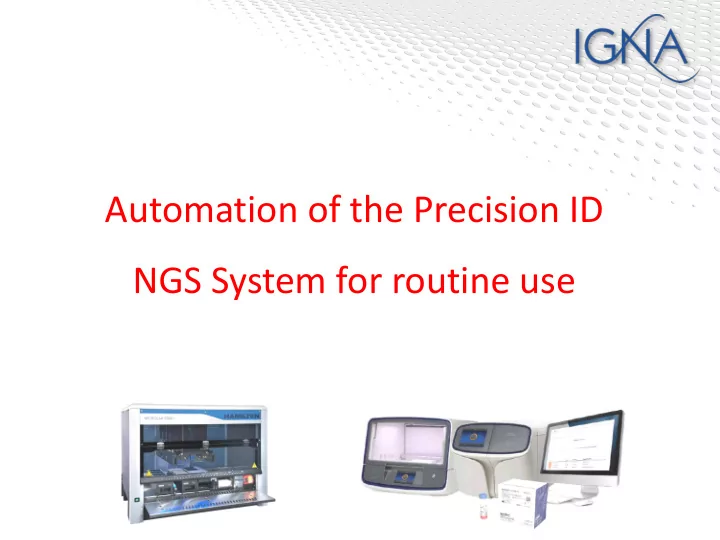
Automation of the Precision ID NGS System for routine use Collaboration and Aim Collaboration Aim Develop a fully automated procedure for SNP, STR and Sequencing analyses with the Precision ID NGS System and the Ion Torrent
Develop a fully automated procedure for SNP, STR and Sequencing analyses with the Precision ID NGS System and the Ion Torrent Technology from Thermo Fisher Scientific, and with the MicroLab STAR Line from Hamilton
PCR Setup and Amplification Librairies Preparation qPCR Setup and Libraries Quantification Libraries Normalization and Pooling Template Preparation Sequencing Data Analysis
Partial Digestion of Amplicons Ligation of Barcodes/ Adapters to Amplicons Libraries Purification Clonal Amplification Beads Enrichment Loading Chip
PCR Setup and Amplification Librairies Preparation qPCR Setup and Libraries Quantification Libraries Normalization and Pooling Template Preparation Sequencing Data Analysis
PCR Setup and Amplification Librairies Preparation qPCR Setup and Libraries Quantification Libraries Normalization and Pooling Template Preparation Sequencing Data Analysis
Manual
(PCR setup)
Manual Manual
(PCR setup)
Automatic Automatic Manual Automatic
PCR Setup and Amplification Librairies Preparation qPCR Setup and Libraries Quantification Libraries Normalization and Pooling Template Preparation Sequencing Data Analysis
– Precision ID Identity Panel, 1 amplification per sample ð 1 library per sample – Precision ID Ancestry Panel, 1 amplification per sample ð 1 library per sample
– Precision ID GlobalFilerTM NGS STR Panel v2, 1 amplification per sample ð 1 library per sample
– Precision ID mtDNA Control Region Panel, 2 amplifications per sample ð 1 or 2 libraries per sample – 3 analyses methods:
PCR Setup and Amplification Librairies Preparation qPCR Setup and Libraries Quantification Libraries Normalization and Pooling Template Preparation Sequencing Data Analysis
– PCR mix dispensing – Samples dispensing
SNP, STR mtDNA (3 methods) From 1 to 88 samples From 1 to 48 samples From 49 to 88 samples
Amplification 1 Amplification 2 Amplification 1 Amplification 2
PCR Setup and Amplification Librairies Preparation qPCR Setup and Libraries Quantification Libraries Normalization and Pooling Template Preparation Sequencing Data Analysis
Libraries Preparation Libraries qPCR setup Libraries Normalization & Pooling
but STR libraries must be prepared separately
PCR Setup and Amplification Librairies Preparation qPCR Setup and Libraries Quantification Libraries Normalization and Pooling Template Preparation Sequencing Data Analysis
Samples worklist Adapter/barcode worklist
by the program
PCR Setup and Amplification Librairies Preparation qPCR Setup and Libraries Quantification Libraries Normalization and Pooling Template Preparation Sequencing Data Analysis
Samples worklist Samples file for 7500
automatic dilution factor determination for each library
that there are no two different samples with the same barcode)
PCR Setup and Amplification Librairies Preparation qPCR Setup and Libraries Quantification Libraries Normalization and Pooling Template Preparation Sequencing Data Analysis
Data file from 7500
– 200 hair analysed with the semi-automated precedure – 229 hair analysed with the automated precedure
conservative method (7.5 to 150 mtDNA copies/amplification and 26 PCR cycles)
full traceability and without error risk
using the Precision ID mtDNA Control Region panel and the Ion Torrent technology, higher than with the conventional procedure
Thierry Jurado Chantal Roth Claire Bartholini Matt Phipps Gareth Stead Lionel Ausset Jörg Breitling Fabio Grasso
Speaker was provided travel and hotel support by Thermo Fisher Scientific for this presentation, but no remuneration When used for purposes other than Human Identification or Paternity Testing the instruments and software modules cited are for Research Use Only. Not for use in diagnostic procedures. Thermo Fisher Scientific and its affiliates are not endorsing, recommending, or promoting any use or application of Thermo Fisher Scientific products presented by third parties during this seminar. Information and materials presented or provided by third parties are provided as-is and without warranty of any kind, including regarding intellectual property rights and reported results. Parties presenting images, text and material represent they have the rights