WDCA19-0008: Short-Term Rentals Photo: August 26, 2019 STR Workshop - - PowerPoint PPT Presentation

wdca19 0008 short term rentals
SMART_READER_LITE
LIVE PREVIEW

WDCA19-0008: Short-Term Rentals Photo: August 26, 2019 STR Workshop - - PowerPoint PPT Presentation

WDCA19-0008: Short-Term Rentals Photo: August 26, 2019 STR Workshop Discussion Background & context Overview of public engagement Staff recommendations Next steps 1 What is a Short-Term Rental? Short-term rentals (STRs)


slide-1
SLIDE 1

1

Discussion

  • Background & context
  • Overview of public engagement
  • Staff recommendations
  • Next steps

WDCA19-0008: Short-Term Rentals

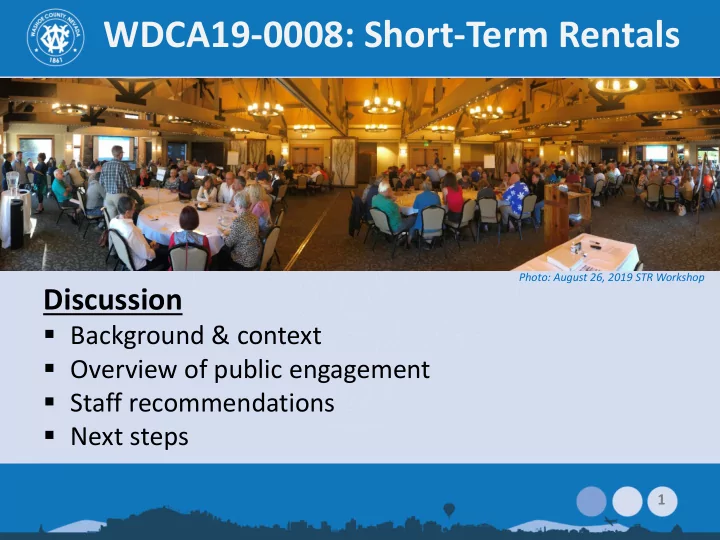
Photo: August 26, 2019 STR Workshop

slide-2
SLIDE 2

2

  • Short-term rentals (STRs) are:

– A type of temporary lodging operated out of private residences (ex. single-family homes/condos) – Commonly available through property management companies and online booking services – Also referred to as vacation rentals – Booked for fewer than 28 days

What is a Short-Term Rental?

slide-3
SLIDE 3

3

  • Starting point:

– STRs exist in unincorporated Washoe County – Room tax being collected (WC receives 1/13th or average ~$125k annually; not part of project scope) – No STR-specific County standards exist – Hearing more from community about impacts

  • Board direction:

– Short-term rental use allowed; do not ban – County-wide ordinance – Establish standards and permitting process

Board Direction in Feb. 2019

slide-4
SLIDE 4

4

Project Baseline

  • 500-1000+ STRs in

unincorporated Washoe County

  • Varies greatly by season
  • Majority in Incline Village/

Crystal Bay (est. >90%)

IV/CB Detail

slide-5
SLIDE 5

5

  • Complex, controversial issue
  • MANY perspectives exist
  • Consensus unlikely; compromise is necessary
  • Learn from other jurisdictions
  • Identify STR impacts and if/how to address
  • Standards likely to evolve over time
  • Enforcement of standards is critical
  • Privileged use

Project Baseline

slide-6
SLIDE 6

6

Adopt simple, fair and enforceable regulations for short-term rentals that balance competing interests and maximize voluntary compliance.

Mission Statement

slide-7
SLIDE 7

7

  • July 2019: small-group stakeholder input

sessions and initial agency outreach

  • Aug. 2019: three public workshops; 250-300+

attendees

  • Aug. – Sept. 2019: online public survey; 569

respondents (~70% neighbor; ~20% STR)

  • Numerous other meetings held and comment

letters received

  • 21-day public comment period on draft code

Public Engagement: Process

slide-8
SLIDE 8

8

  • Top areas of concern: occupancy limits, permitting

process, noise and parking

  • General support to regulate STRs: drastic

variation in how much to regulate

  • Desire for separate IV/CB standards
  • Standards should be enforced
  • Perception that STRs are a commercial use
  • Existing rules are sufficient and better renter

education will reduce conflict

Public Engagement: Results

slide-9
SLIDE 9

9

  • Use is residential; does not change whether

tenancy is long-term or short-term

  • Impacts are a matter of thresholds for #
  • ccupants

–Lower #: similar impacts as long-term residential –Higher #: mitigation may be required

Residential Use

slide-10
SLIDE 10

10

Tiered Permitting System

  • Tier 1: 10 occupants or fewer; standard STR permit
  • Tier 2: 11-20 occupants; discretionary permit
  • Tier 3: 21 or more occupants; only in areas where

hotels/motels allowed; commercial standards apply

STR Permit: Similar to privileged license

  • Revoke without Board action; renew annually; no

guarantee of renewal

Proposed Code: Highlights (1)

slide-11
SLIDE 11

11

Safety and Inspections

  • Safety minimums must be met: defensible space,

smoke/CO detectors, extinguishers, egress, well- maintained fireplaces/outlets/hot tubs/deck railings, etc.

  • Annual inspections: by building inspectors and fire

staff (no duplication of services); helps to ensure vetted sleeping areas

  • Must be passed prior to STR permit issuance

Proposed Code: Highlights (2)

slide-12
SLIDE 12

12

Sidebar: Host Compliance Services

  • 24/7 complaint hotline and address identification

General Standards

  • Local agent able to respond 24/7 in 30 minutes
  • 1 STR per parcel; only rent to 1 group at a time
  • Ads prohibited unless STR permit issued
  • Ads must include specific permit information
  • No parties/events
  • External display of STR permit #, occ. limit, complaint #
  • Min. STR liability insurance; educational material

Proposed Code: Highlights (3)

slide-13
SLIDE 13

13

Occupancy Limits

  • Based on IPMC, IBC and square footage

– Bedroom with 1 occupant: min. 70 sq. ft. (ex. 10’ x 7’) – Bedroom with 2+ occupants: min. 100 sq. ft. (ex. 10’ x 10’), plus 50 sq. ft. per additional occupant – Other sleeping areas: min. 200 sq. ft. per

  • ccupant
  • May be further limited by parking or self-limitation

Proposed Code: Highlights (4)

slide-14
SLIDE 14

14

Noise

  • Quiet hours: 10 p.m. – 7 a.m.
  • Decibel-monitoring devices for problem STRs

Parking

  • No STR parking on-street; must be developed onsite

(including to TRPA standards, if applicable)

  • One parking space for every 4 proposed occupants

Trash

  • Meet trash standards already in place
  • Bear-prone areas: wildlife-resistant carts or bear shed

Proposed Code: Highlights (5)

slide-15
SLIDE 15

15

Permit Fees

  • Cost-neutral approach: set fees to cover running/

enforcement of program

  • Re-assess after 12-18 months
  • Fee recommendations will be released early 2020

Proposed Code: Highlights (6)

slide-16
SLIDE 16

16

Enforcement, Fines and Penalties

  • Three-pronged enforcement approach:

– Proactively pursue licensing compliance using Host Compliance – Inspections at permit issuance and annually – 24/7 complaint hotline

  • Fines on scaled system; higher than current fines
  • Three violations in 12 months = revocation and 1-yr

cooling off period

Proposed Code: Highlights (7)

slide-17
SLIDE 17

17

Findings (1 required to be made for approval)

  • Consistency with Master Plan
  • Promotes purpose of Development Code
  • Response to Changed Conditions
  • No adverse effects

Recommendations

  • Recommend approval of proposed changes
  • Remove reference to business impact statement

(Exhibit A-1, Pg. 2)

  • Authorize Chair to sign resolution

Recommendations

slide-18
SLIDE 18

18

I move that, after giving reasoned consideration to the information contained in the staff report and received during the public hearing, the Washoe County Planning Commission recommend approval of WDCA19-0008, to amend Washoe County Code Chapter 110 (Development Code) within Articles 302, 304, 306, and 410, and with new Articles 319 and 809 created as identified in Exhibit A and with the additional changes discussed this

  • evening. I further move to authorize the Chair to sign the

resolution contained in Exhibit A on behalf of the PC and to direct staff to present a report of this Commission’s recommendation to the Board of County Commissioners within 60 days of today’s date. This recommendation for approval is based on all four findings within Washoe County Code Section 110.818.15(e).

Recommended Motion
slide-19
SLIDE 19

19

  • January 7: Planning Commission hearing
  • February/March (tentative): County Commission

hearings & adoption

  • Grace period & outreach
  • Program launch
  • Updates posted to www.washoecounty.us/str

Next Steps

slide-20
SLIDE 20

20

Planning & Building Division

  • Kelly Mullin, Senior Planner
  • Mojra Hauenstein, Director
  • Trevor Lloyd, Planning Manager
  • Chad Giesinger, Planning Manager
  • Dan Holly, Plans Examiner Supervisor

North Lake Tahoe Fire Protection District

  • Ryan Sommers, Chief
  • Jennifer Donohue, Interim Fire Marshal

Truckee Meadows Fire Protection District

  • Charles Moore, Chief

Questions?

District Attorney’s Office

  • Nathan Edwards, DDA

Washoe County Sheriff’s Office

  • Chief Deputy Greg Herrera
  • Mary-Sarah Kinner, Govt. Affairs

Liaison

Washoe County Health District

  • James English, EHS Supervisor

Reno-Sparks Convention & Visitors Authority

slide-21
SLIDE 21

21

ADDITIONAL INFO

slide-22
SLIDE 22

22

  • STRs may add value to a community by:

– Offering alternative housing opportunities for seasonal employees – Supplementing limited lodging options, especially in Incline Village/Crystal Bay – Providing economic benefits to local businesses – Generating additional room tax monies for local & regional entities – Additional income for homeowners

Benefits of STRs

slide-23
SLIDE 23

23

  • Common concerns about STRs include:

– Quality of life impacts to the surrounding neighborhood (ex. noise, parking, trash) – Safety concerns for renters and neighbors (ex. fire safety, structural safety, etc.) – Reduction in availability of long-term housing

  • ptions for local residents

– Potential conflict with area CC&Rs

Impacts/Concerns