
SLIDE 1
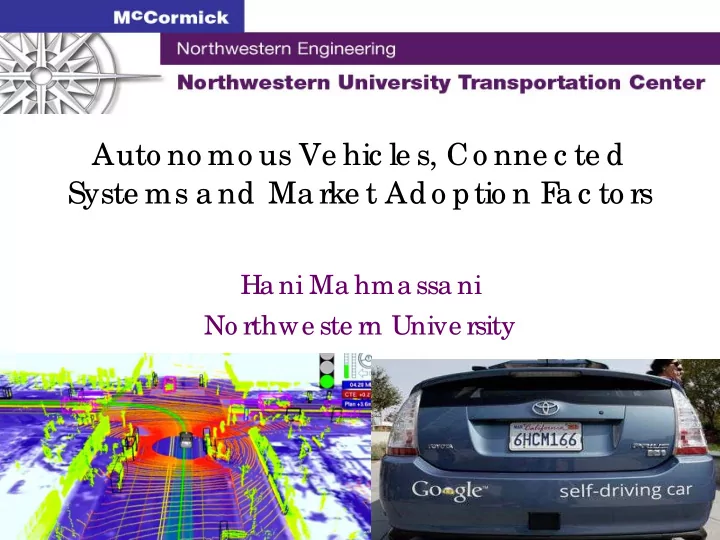
Auto no mo us Ve hic le s, Co nne c te d Syste ms a nd Ma rke t Ado ptio n F a c to rs
Ha ni Ma hma ssa ni No rthwe ste rn Unive rsity
Auto no mo us Ve hic le s, Co nne c te d Syste ms a nd Ma rke t Ado - - PowerPoint PPT Presentation
Auto no mo us Ve hic le s, Co nne c te d Syste ms a nd Ma rke t Ado ptio n F a c to rs Ha ni Ma hma ssa ni No rthwe ste rn Unive rsity WHAT IS A DRIVERLESS CAR? Four Levels of Automation Kornhauser, 2014 Implications of Each Level: User,
Ha ni Ma hma ssa ni No rthwe ste rn Unive rsity
Kornhauser, 2014
Kornhauser, 2014
Connected SYSTEMS: Add USERS (Travelers) OPERATORS
VEHICLE TO VEHICLE COMMUNICATION VEHICLE TO INFRASTRUCTURE COMMUNICATION
Fully manual Level 0 Fully automated Level 4 Isolated Receive
Peer-to-Peer (Neighbor) Connected systems (internet of everything) Ad-hoc networks Autonomous Vehicles Smart Highways Cooperative Driving Coordinated
Connected
INTELLIGENCE RESIDES ENTIRELY IN VEHICLE
INTELLIGENT VEHICLE-HIGHWAY SYSTEMS INTELLIGENT TRANSPORTATION SYSTEMS Vehicles Highway infrastructure Buses, trains, multimodal services Urban mobility FOCUS: THE USER CONNECTED SYSTEMS
Mobility as an APP in seamless connected environment
ITS 0.9 ITS 1.0 ITS 2.0 = CS 2.0
Compilation by Pendyala & Bhat, 2014
– California, Nevada, Florida
– Policy guidance on licensing, safety, testing
– Safety – Mobility – Efficiency (time saving, constraint reduction)
Age
100% 0%
Age
Age
Age Time value for parents Safety value for parents Time value for children Safety value for self Cohort Effect: Increasing trust Cohort Effect: Increasing need
TIME CONSTRAINED MONEY CONSTRAINED
High Value Can Afford HIGH PROPENSITY Just as well… LOW PROPENSITY GADGET? TOY? CONVENIENCE? SAFETY?
Role for Policy? Discounts, Incentives Payment plans…
HEALTH CONSTRAINED MONEY CONSTRAINED
High Value Can Afford HIGH PROPENSITY Stay healthy! LOW PROPENSITY TIME VALUE? CONVENIENCE? SAFETY?
Role for Policy? Discounts, Incentives Family plans Payment plans…
– Evident safety benefits – Potentially large fuel savings (just in driving mode, not including network aspects)