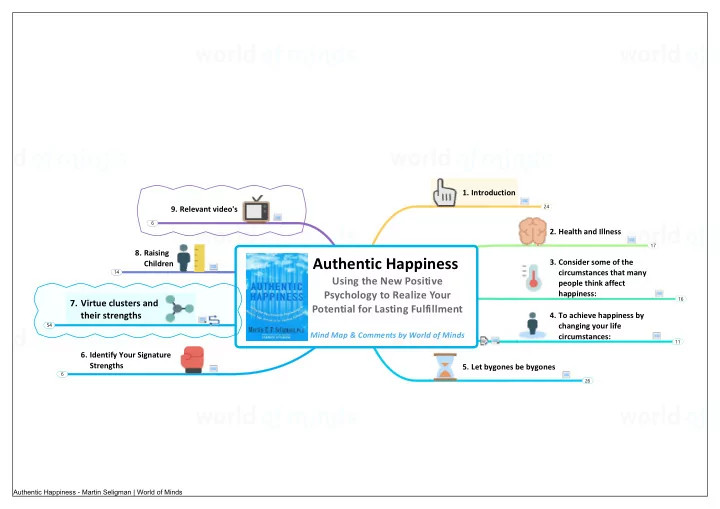
SLIDE 12 Authentic Happiness
Using the New Positive Psychology to Realize Your Potential for Lasting Fulfillment
Mind Map & Comments by World of Minds
1.1. In this book Martin E. P. Seligman, the founder of "positive psychology" explains why happiness matters. He recapitulates and takes issue with the flawed deterministic assumptions that guided much of twentieth century psychology. He is careful to emphasize the importance of your individual control over your feelings and thoughts. 1.2. The idea that people actually are in control of their fate marks a departure from Freudianism and behaviorism. Seligman argues, instead, for an understanding of character and virtue rooted in early Greek philosophy. 1.3. He offers guidance on how you can change your way of thinking to change how you feel - and, thereby, get on the road to achieving long-term happiness for yourself and for others, especially your children. 1.4. This mind map is about what happiness is and how to achieve it. 1.5. Take-Aways
- 1. Psychology has focused too much on misery and not enough on being happy.
- 2. Happiness is healthy. Happy people live longer and have fewer diseases.
- 3. Helping other people is the single most important element in long-term happiness.
- 4. People largely can control their happiness level. For example, exercise creates happiness.
- 5. People have different endowments of "signature strengths." To achieve happiness, develop and
practice your strengths, instead of trying to correct weaknesses.
- 6. Religious traditions agree that certain fundamental virtues
are good and healthy and lead to happiness: Wisdom courage love justice Temperance spirituality
- 7. Money has almost no correlation with happiness. Health has little and physical
pleasures do not produce lasting happiness.
- 8. Marriage is the external factor most frequently associated with happiness.
- 9. People tend to adjust to most external circumstances, so great news (winning the lottery) or bad
news (being paralyzed) has little effect on long-term happiness.
- 10. To make your children happy, raise them to embrace positive emotions.
- 2. Health and Illness
2.1. Twentieth century psychology concentrated on mental disease, and made considerable progress defining a range of illnesses However, psychology has had very little to say about the good life. Only recently has research shown that it is possible to pursue and increase happiness. Happiness is not an intangible or nebulous concept. Its consequences are measurable. One study of nuns, a very homogenous, controlled population, found that the most cheerful women lived much longer than the less cheerful. 2.2. However, happiness is not what many people think it is For example, it is not the consequence of health and wealth. 2.3. Instead, happiness comes from exercising six virtues that all major religious and philosophical traditions identify as fundamental to a good life: Wisdom - including learning prudence and creativity. Courage - including fortitude perseverance and confidence. Love - including both giving and receiving love. Justice - including fairness, citizenship and leadership. Temperance - including humility, discretion and self-control and . Spirituality transcendence - including gratefulness and a love of beauty. 2.4. The Happiness Equation People have unique individual virtues and strengths. To some extent, your personality and, thus, your set range of happiness are inherited. In fact, about half of any element of personality depends on genetic heritage. Most people do have a set range of happiness, and despite extremes
- f good or bad fortune, they tend to return soon to their set range.
- 3. Consider some of the
circumstances that many people think affect happiness: 3.1. Money Wealth matters less than you might expect. People in wealthy countries (particularly democracies that allow a degree of personal freedom) tend to be somewhat more satisfied than people in poor or totalitarian countries, but even extreme poverty has little corelation with unhappiness. Strikingly, people whose main goal is money tend to be very unhappy. 3.2. Marriage Being married correlates strongly with happiness. National Opinion Research Center surveys find that roughly 40%
- f married people, but only 25% of unmarried people, are "very happy." This correlation may not indicate causality.
It’s quite possible that happy people are simply more likely to get married. 3.3. Sociability More social people tend to be happier. Very happy people spend more time with others. However, causality is again questionable; perhaps, others simply prefer to spend time with happy people. 3.4. Bad feelings Women experience more negative and more positive emotions. Only a very small negative correlation exists between pleasant and unpleasant emotions. 3.5. Youth Young age does not correlate with happiness. In fact, older people are somewhat more satisfied with life than younger people. 3.6. Health Even terminally ill people have roughly the same life satisfaction as healthy people. Severe health problems cause less unhappiness than you might expect. Happiness does seem to drop when people have five or more serious health problems. 3.7. Education, weather, race and gender These factors do not have more than a slight correlation with happiness. Interestingly, African-Americans and Hispanics are less inclined to depression than Caucasians, but they are not happier than Caucasians. 3.8. Religion Religious people are happier and more satisfied than irreligious people. One study found that people from the most conservative religions (Orthodox Judaism, fundamentalist Christianity and Islam) are happier than people from more liberal religions (for example, Reform Judaism and Unitarianism).
- 4. To achieve happiness by
changing your life circumstances: 4.1. Marry 4.2. Help others 4.3. Make friends 4.4. Think positively 4.5. Adopt a conservative religion and 4.6. Live in a reasonably prosperous democracy 4.7. However In terms of becoming happy Statistically it does not help to: Earn more money Improve your health Get more education or Move to a better climate
- 5. Let bygones be bygones
5.1. People who think about problems from the past find it harder to be happy. The only psychologically healthy approach to past offenses is forgiveness, which is healthy as well as noble. 5.2. Consider the five-step REACH approach to forgiveness: Recall Remember the offense. Breathe slowly and visualize it. Empathize Try to put yourself in the offenders’ shoes and understand their actions. Commit Make a public commitment to forgiveness. Altruism Remember when you received undeserved forgiveness, and forgive. Hold Do not release forgiveness or relapse into vengefulness. 5.3. Pessimists tend to think that bad things are permanent and
- inevitable. Optimists believe the opposite
Optimists may not be right, but they are happier - and it’s worth being optimistic if only for the sake of being happy. 5.4. To build optimism, defeat negative thoughts by: Checking the evidence Put the facts on the side of optimism. Consider the alternatives - Instead of seizing the most negative possible explanation, consider positive alternatives that may be equally plausible. Look closely at implications Even if the facts indicate that something bad has happened, the implications may not be so awful. Seek other effects and outcomes. Believe what is useful If a conclusion is useless or counterproductive, especially if it is based on judgment or opinion, discard it. Pick a more useful and constructive idea. 5.5. Comedian Dave Allen Https://www.youtube.com/watch?v=eIPp4AJ554A
- 6. Identify Your Signature
Strengths 6.1. Talents are innate and automatic. 6.2. Strengths are the result
A strength is a psychological trait valued in many cultures and embodied in role models. They are supported with such social institutions as rituals, stories and proverbs and are categorized in six basic virtue clusters. Strengths, such as integrity, valor, originality and kindness, are not the same thing as talents, such as perfect pitch, facial beauty or lightning fast sprinting speed. To cultivate happiness, focus on building your strengths instead of shoring up your weaknesses.
their strengths 7.1. Wisdom and knowledge Curiosity and interest Inquisitive people find the world appealing and novel. They constantly attempt to investigate and discover more about it. Love of learning People who love to gain knowledge and understanding find opportunities everywhere. Judgment and critical thought This strength involves analyzing and weighing information and carefully assessing the evidence. Ingenuity and common sense Ingenious people are creative, practical, unconventional and willing to 'think outside the box'. People skills Social intelligence calls upon the ability to "read" people and respond to their feelings, moods and dispositions. Perspective Among other things, this involves distinguishing between the important and unimportant. 7.2. Courage Valor The brave are physically and morally valiant. Moral and physical courage are not the same, but in both cases people overcome fear and do what is right. Valor is not fearlessness. The valiant feel fear, but in spite of it, they face the danger. Perseverance Those who continue to strive complete what they
- begin. However, they are realistic and they do not
allow the perfect to be the enemy of the good. Integrity True honor involves not only speaking the truth but also living the truth, being genuine and having no affectations. 7.3. Love Kindness Caring people are generous and outgoing, eager to find ways to help others. As a matter of fact, helping others is a tremendous overall causative factor in being happy. Loving and being loved It may be easier to love than to be loved. This kind of love is not a romantic feeling, but rather is the capacity for strong, close relationships. 7.4. Justice Citizenship and teamwork This strength enables people to be loyal and committed, and to work hard on behalf of others. It involves respect for legitimate authority, but not blind obedience. Fairness This strength involves the just and equitable treatment of others regardless of your personal feelings or prejudices.. Leadership The good leader even-handedly mediates relations between groups, accepts responsibility for mistakes and is a peacemaker who plans for future. 7.5. Temperance Self-control Restraining your appetites and desires is
- important. This is not merely a matter of
knowing what is right, but of doing it. Prudence and caution Discretion does not mean delaying action until action is impossible, but waiting until all the needed evidence is in before making a decision. Humility Unassuming people think little of themselves and do not feel that they merit special attention. 7.6. Transcendence Love of beauty This strength bespeaks sensitivity to excellence, skill and loveliness in every area of achievement. Gratitude A sense of appreciation is an extension of the love of beauty, an expression of appreciation for the excellence of others. Hope People with positive expectations are optimistic and think of the future, anticipating that good things will occur and planning for them. Spirituality Closely correlated with happiness, spirituality involves understanding where one fits in the universe and acting in accord with that understanding. Forgiveness Pardoning is one of the most important strengths, because without it one dwells in bitter memories of the past. Forgiveness leads to positive emotions rather than negative ones. Playfulness The lighthearted have a sense of humor and events rest easily on their shoulders. They laugh and help others to be cheerful. Passion Ardent people involve themselves entirely in the things they do.
Children 8.1. Cultivating positive emotions is especially important in raising children. 8.2. Six techniques for building positive emotions in children include: Sleep with your children When kids sleep with their parents they feel more secure. Play games of synchrony Respond to a child’s actions by doing the same thing as the child. This almost invariably leads to laughter. Say yes and no Say yes more often than no. Certainly sometimes it is important to say no, but say it as infrequently as possible. Punish and praise Praise should outweigh punishment, but when punishment is necessary it should occur. Children need punishment and discipline. Minimize sibling rivalry This is less of a problem when parents lavish attention and affection on their kids. Minimize rivalry by bringing children together, respecting their strengths and making them to some extent responsible for each other. Make the most of bedtime This is a special time when you can build a close and positive relationship with a child, by using stories, conversation and the like.
9.1. Mihaly Csikszentmihalyi has contributed pioneering work to our understanding of happiness, creativity, human fulfillment and the notion of "flow" — a state of heightened focus and immersion in activities such as art, play and work. [www.ted.com/talks/mihaly_csikszentmihalyi_flow_the_secret_to_happiness ] 9.2. Robert Waldinger is the Director of the Harvard Study of Adult Development, one of the most comprehensive longitudinal studies in history. [www.ted.com/talks/robert_waldinger_what_makes_a_good_life_lessons_from_the_longest_study_on_happiness ] 9.3. Harvard psychologist Dan Gilbert says our beliefs about what will make us happy are often wrong — a premise he supports with intriguing research, and explains in his accessible and unexpectedly funny book, Stumbling on
- Happiness. [www.ted.com/talks/dan_gilbert_the_surprising_science_of_happiness ]
9.4. Can happiness be bought? To find out, author Benjamin Wallace sampled the world's most expensive products, including a bottle of 1947 Chateau Cheval Blanc, 8 ounces of Kobe beef and the fabled (notorious) Kopi Luwak coffee. [www.ted.com/talks/benjamin_wallace_the_price_of_happiness#t-856856] 9.5. Sometimes called the "happiest man in the world," Matthieu Ricard is a Buddhist monk, author and photographer. [www.ted.com/talks/matthieu_ricard_the_habits_of_happintess ] 9.6. Shawn Achor is the CEO of Good Think Inc., where he researches and teaches about posive psychology. [www.ted.com/talks/shawn_achor_the_happy_secret_to_better_work ]
Authentic Happiness - Martin Seligman | World of Minds