Audi udio W o Webc ebcas ast May 14, 2015 9:30 a.m. CT Before - - PowerPoint PPT Presentation

audi udio w o webc ebcas ast
SMART_READER_LITE
LIVE PREVIEW

Audi udio W o Webc ebcas ast May 14, 2015 9:30 a.m. CT Before - - PowerPoint PPT Presentation

Audi udio W o Webc ebcas ast May 14, 2015 9:30 a.m. CT Before you cast your vote on Management Resolution Item 3 Advisory Vote to Approve Executive Compensation , please review the Executive Compensation Overview, as well as the more


slide-1
SLIDE 1

Audi udio W

  • Webc

ebcas ast

May 14, 2015 9:30 a.m. CT

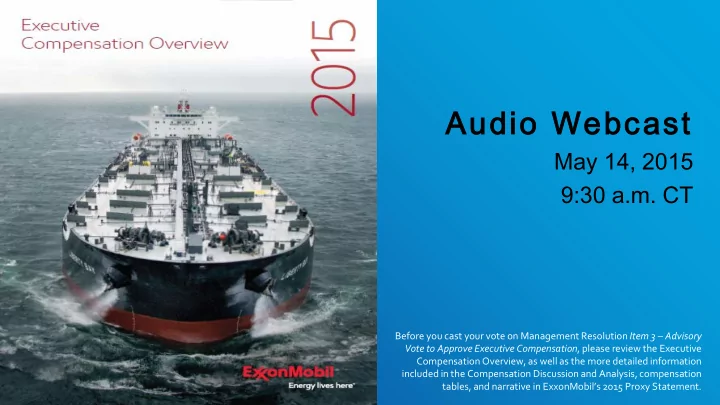
Before you cast your vote on Management Resolution Item 3 – Advisory Vote to Approve Executive Compensation, please review the Executive Compensation Overview, as well as the more detailed information included in the Compensation Discussion and Analysis, compensation tables, and narrative in ExxonMobil’s 2015 Proxy Statement.

slide-2
SLIDE 2

2

Reported Pay is Total Compensation reported in the Summary Compensation Table, except for years 2006 to 2008, where the grant date value of restricted stock as provided under current SEC rules is used to put all years of compensation on the same basis. Realized Pay is compensation actually received by the CEO during the year, including salary, current bonus, payouts of previously granted Earnings Bonus Units (EBU), net spread on stock option exercises, market value at vesting of previously granted stock-based awards, and All Other Compensation amounts realized during the year. It excludes unvested grants, change in pension value, and other amounts that will not actually be received until a future date. Amounts for other companies include salary, bonus, payouts of non-equity incentive plan compensation, and All Other Compensation as reported in the Summary Compensation Table, plus value realized on option exercise or stock vesting as reported in the Option Exercises and Stock Vested table. It excludes unvested grants, change in pension value, and other amounts that will not actually be received until a future date, as well as any retirement-related payouts from pension or nonqualified compensation plans. Unrealized Pay is calculated on a different basis from the grant date fair value of awards used in the Summary Compensation Table. Unrealized Pay includes the value based

  • n each compensation benchmark company’s closing stock price at fiscal year-end 2013 of unvested restricted stock awards; unvested long-term share and cash

performance awards, valued at target levels; and the “in the money” value of unexercised stock options (both vested and unvested). If a CEO retired during the period,

  • utstanding equity is included assuming that unvested awards, as of the retirement date, continued to vest pursuant to the original terms of the award.

Compensation Benchmark Companies consist of AT&T, Boeing, Caterpillar, Chevron, Ford, General Electric, IBM, Johnson & Johnson, Pfizer, Procter & Gamble, United Technologies, and Verizon. For consistency, CEO compensation is based on compensation as disclosed in the Summary Compensation Table of the proxy statements as of April 15, 2015. Please also read the footnotes contained throughout the Executive Compensation Overview for additional definitions of terms we use and other important information. See also the Factors Affecting Future Results and Frequently Used Terms available through the Investors page of our website at www.exxonmobil.com. Statements regarding future events or conditions are forward-looking statements. Actual future results, including project plans, schedules, and results, as well as the impact of compensation incentives, could differ materially due to changes in oil and gas prices and other factors affecting our industry, technical or operating conditions, and

  • ther factors described under the heading “Factors Affecting Future Results” in our most recent Form 10-K.

The term “project” can refer to a variety of different activities and does not necessarily have the same meaning as in any government payment transparency reports.

Ca utio na ry Sta te me nt a nd De finitio ns
slide-3
SLIDE 3

9:30am Shareholder Engagement ............................. Jeff Woodbury, Vice President, Investor Relations and Secretary

Key Focus Areas Basis for Compensation Decisions

Financial and Operating Performance Strategic Business Results Long-Term Business Performance

CEO Compensation ...................................... Randy Powers,

Manager, Compensation, Benefit Plans and Policies

Annual Bonus Program Equity Incentive Program

Determination of Equity Award Levels Vesting Periods that Far Exceed Most Industries ExxonMobil Program vs. Formula-Based Pay 10:10am Q&A 10:30am Webinar Concludes

Ag e nda

slide-4
SLIDE 4

4

2014 Sha re ho lde r E ng a g e me nt

  • Say-On-Pay Results: 89.8 percent “For”
  • Multiple conference calls with institutional shareholders preceding shareholder meeting
  • Webcast on May 14, 2014, available to all shareholders
  • Executive Compensation Overview brochure issued to all shareholders
slide-5
SLIDE 5

5

K e y F

  • c us Are a s
  • Level

vel of S Stock

  • ck A

Awards: ds: New illustration of how the Compensation Committee determined the CEO’s stock-based award level

  • Stock
  • ck Holdi

ding R ng Requi uirem ement ent: Vesting periods of up to 10 years or longer require that executives hold their equity compensation through commodity price cycles

  • Annu

nnual B Bonu

  • nus: Formula linked to annual earnings, consistently applied for 13 years;

individual awards determined and differentiated based on performance

  • CEO’s

s Combi bined R ned Realized a zed and d Unrea ealized P ed Pay: y: Market orientation at the 39th percentile

  • No C

Contr tracts ts: : No employment contracts, severance agreements, or change-in-control arrangements

  • Common
  • n P

Progr

  • gram

ams: All U.S. executives, more than 1,000 including the CEO, participate in common programs (the same salary, incentive, and retirement programs)

slide-6
SLIDE 6

Ba sis fo r Co mpe nsa tio n De c isio ns

slide-7
SLIDE 7

7

  • Earnings of $32.5 billion in 2014 compared with $32.6 billion in 2013. Five-year annual

average of $36.3 billion in earnings

  • Distributed $23.6 billion to shareholders in dividends and share purchases in 2014, for a

distribution yield of 5.4 percent. Distributed $342 billion in dividends and share purchases since the beginning of 2000. Dividends per share increased for the 32nd consecutive year

  • Industry-leading return on average capital employed (ROCE) of 16.2 percent, with a five-

year average of 21 percent

  • Strong environmental results and best-ever safety performance supported by effective risk

management

F ina nc ia l a nd Ope ra ting Pe rfo rma nc e

For more information concerning ROCE, see pages 44 and 45 of the Summary Annual Report included with the 2015 Proxy Statement

slide-8
SLIDE 8

8

Stra te g ic Busine ss Re sults

Upst stream eam

− Increased proved reserves by 1.5 billion oil- equivalent barrels − Completed eight major projects with working interest production capacity of more than 250 thousand oil-equivalent barrels per day − Initiated commissioning activities at the Kearl Expansion in Canada and Banyu Urip in Indonesia − Successfully drilled the first ExxonMobil- Rosneft Joint Venture Kara Sea exploration well in the Russian Arctic − Progressed a large and diverse portfolio of LNG opportunities in North America, Australia, and Africa

Downst nstream eam

− Commissioned the Clean Fuels Project at our joint venture refinery in Saudi Arabia − Completed a lube basestock expansion in Singapore and a lubricant plant expansion in Tianjin, China

Chemical cal

− Started construction of a major expansion at

  • ur Texas facilities, including a new world-scale

ethane steam cracker and polyethylene lines − Progressed construction of a 400-thousand- tonnes-per-year specialty elastomers project in Saudi Arabia with our joint venture partner − Started construction on a new 230-thousand- tonnes-per-year specialty polymers plant in Singapore

slide-9
SLIDE 9

9

L

  • ng -T

e rm Busine ss Pe rfo rma nc e

(1) Employees and contractors. Includes XTO Energy Inc. data beginning in 2011. (2) Workforce safety data from participating American Petroleum Institute companies (2014 industry data not available at time of publication). (3) Competitor data estimated on a consistent basis with ExxonMobil and based on public information. For more information concerning ROCE, see pages 44 and 45 of the Summary Annual Report included with the 2015 Proxy Statement.

Saf afet ety i is a a cor

  • re

e val alue ue for

  • r E

ExxonM

  • nMobi
  • bil, and

and not nothi hing ng rec ecei eives es mor

  • re

e at attent ention f

  • n from
  • m managem

management ent.

  • Best-ever performance in 2014.
  • Safety results are a leading indicator of business

performance. ExxonMobi

  • nMobil’s pr

prov

  • ven

en bus busines ness m model

  • del del

deliver ers indus ndustry-leadi eading R ng ROCE.

  • Disciplined investments through the business cycle

position the Company for long-term performance.

  • Strength of integrated portfolio, project management,

and technology application.

slide-10
SLIDE 10

10

(4) Competitor data estimated on a consistent basis with ExxonMobil and based on public information. BP excludes impact of GOM spill and TNK-BP divestment. For more information on Free Cash Flow, see page 45 of the Summary Annual Report included with the 2015 Proxy Statement. (5) Competitor data estimated on a consistent basis with ExxonMobil and based on public information. Total shareholder distributions divided by market capitalization. Shareholder distributions consist of cash dividends and share buybacks. For more information, see page 45 of the Summary Annual Report included with the 2015 Proxy Statement.

L

  • ng -T

e rm Busine ss Pe rfo rma nc e

ExxonMobi

  • nMobil’s s

super uperior

  • r c

cas ash h flow

  • w pr

pres eser erves es c capac apacity f for

  • r

inv nves estment ents and and shar harehol eholder der di distribut butions

  • ns.
  • Generated $117 billion of free cash flow since beginning of 2010.
  • Reflects strong business performance and disciplined capital

allocation approach. ExxonMobi

  • nMobil m

mai aint ntai ains ns indus ndustry-leadi eading s ng shar harehol eholder der di distribut butions

  • ns t

thr hrough

  • ugh the

he bus busines ness c cycle. e.

  • Dividends per share up 10 percent per year over past 10 years.
  • Distributed 46 cents of every dollar from operating cash flow

and asset sales generated from 2010 to 2014.

slide-11
SLIDE 11

11

(6) Annualized returns assuming dividends are reinvested when paid. (7) BP, Chevron, Royal Dutch Shell, and Total weighted by market capitalization. Shareholder return data for Total available from 1992. (8) AT&T, Boeing, Caterpillar, Chevron, Ford, General Electric, IBM, Johnson & Johnson, Pfizer, Procter & Gamble, United Technologies, and Verizon weighted by market capitalization.

L

  • ng -T

e rm Busine ss Pe rfo rma nc e

ExxonMobi

  • nMobil l

leads eads the he indus ndustry i in n tot

  • tal

al shar harehol eholder der r ret etur urn n (TSR) in n al all per perfor

  • rmanc

ance e per periods

  • ds.
  • The most relevant TSR comparison is across companies in

the same industry of comparable size and scale. ExxonMobi

  • nMobil gener

generat ated ed super uperior

  • r r

ret etur urns ns t thr hrough

  • ugh a

a range ange of

  • f ec

econom

  • nomic env

environm

  • nment

ents and and bus busines ness c cycles es.

slide-12
SLIDE 12

CE O Co mpe nsa tio n

slide-13
SLIDE 13

13

Re po rte d Pa y

(1) Interest rate changes: from 3.5% for 2011 to 2.5% for 2012; to 3.5% for 2013; to 3.0% for 2014. (2) In 2013, the change in pension value was negative (-$6.24 million), but under SEC reporting rules, a negative change in pension value must be shown in the Summary Compensation Table as zero. * No change in number of equity awards granted for all three years.

Pay ay gr grant anted t ed to E

  • ExxonM
  • nMobi
  • bil

CEO in n 2014 2014 inc ncreas eased ed les ess t than han 1 1 per percent ent v ver ersus 2013 2013 and and 4 4 per percent ent ver ersus us 2012, 2012, w whi hile e the s he stoc

  • ck gr

grant ant pr price e inc ncreas eased about ed about 1 1 per percent ent and and 9 9 per percent ent res espec pectivel ely.

  • Primary cause of fluctuating

pension accrual is change in the applicable interest rates.

  • Actual pension value realized

will be dependent on salary, bonus, and interest rate at retirement.

slide-14
SLIDE 14

14

Re a lize d Pa y vs. Re po rte d Pa y

(3) Reported pay values shown correspond to the companies with the highest, median, and lowest realized pay values. *Exercised last stock options granted in 2001 that would have expired in 2011. No stock options granted since 2001.

ExxonM

  • nMobi
  • bil C

CEO’s r real ealized ed pay pay av aver eraged aged 46 46 per percent ent of

  • f

repor eported pay ed pay ov

  • ver

er hi his tenur enure. ExxonM

  • nMobi
  • bil C

CEO’s r real ealized ed pay pay rank anked ed 8t 8th h am among

  • ng the

he com

  • mpens

pensat ation benc

  • n benchm

hmar ark com

  • mpani

panies es.

  • The median of the benchmark

companies is almost $21 million and the highest is almost $81 million.

slide-15
SLIDE 15

15

Re a lize d Pa y a nd Unre a lize d Pa y

Nonqualified deferred compensation as reported for some benchmark companies may include executive contributions.

ExxonM

  • nMobi
  • bil C

CEO’s real ealized ed pay pay is bel below

  • w the m

he medi edian an of

  • f

the c he com

  • mpens

pensat ation

  • n

benc benchm hmar ark c compani

  • mpanies

es for

  • r

mos

  • st of
  • f hi

his t tenur enure. e. ExxonM

  • nMobi
  • bil C

CEO’s c combi

  • mbined

ned real ealized ed and and unr unreal ealized pay ed pay is at at t the 39t he 39th h per percent entile e of

  • f

the he com

  • mpens

pensat ation benc

  • n benchm

hmark com

  • mpani

panies es.

  • With pension value and

nonqualified deferred compensation included, the

  • rientation is between the 38th

and 74th percentiles, depending on the method of quantifying pension values.

* 39 percent of ExxonMobil CEO’s realized pay in 2011 was from the exercise of stock options that were granted in 2001 and would have expired in 2011. No stock options have been granted since 2001.

slide-16
SLIDE 16

16

Sc a le a nd Sc o pe o f E xxo nMo b il

(4) Financial data estimated based on public information. Market capitalization is as of December 31, 2014. (5) Trailing twelve months (TTM); excludes excise taxes and other sales-based taxes, if applicable. (6) Excludes General Electric due to lack of comparability resulting from how assets are quantified and reported for its financial business. (7) Trailing twelve months (TTM).

The he Compens

  • mpensat

ation C

  • n Com
  • mmi

mittee ee pl plac aces es t the he mos

  • st emphas

emphasis on

  • n

indi ndividual dual per perfor

  • rmanc

mance and e and bus busines ness r res esul ults i in n det deter ermini ning c ng com

  • mpens

pensat ation

  • n

le levels ls.

  • Size and complexity of

ExxonMobil are considered among several factors

slide-17
SLIDE 17

E xxo nMo b il I nc e ntive Pro g ra m

slide-18
SLIDE 18

18

Annua l Bo nus Pro g ra m

Bonus Program Formula

* The purpose of the two-thirds adjustment is to mitigate the impact of commodity price swings on short-term earnings performance.

Performance Factors that Determine Annual Bonus

  • The bonus program is determined by

annual earnings.

  • The bonus program differentiates for

individual performance; similar to how equity awards are differentiated.

  • Half of the annual bonus is delayed until

cumulative earnings per share (EPS) reach a specified level, further aligning the interests of executives with sustainable long-term growth in shareholder value. The annual bonus is subject to recoupment in the case of a material negative restatement of ExxonMobil’s financial or operating results.

The bonus he bonus pr progr

  • gram

am f for

  • rmul

mula has a has been been appl applied ed cons

  • nsistent

ently in n eac each of h of t the l he las ast 13 13 year ears, inc ncludi uding ng year ears i in n whi hich h ear earni nings ngs dec declined. ned.

slide-19
SLIDE 19

19

Performance Assessment Process

The performance of each executive is assessed annually through a well-defined process. – Applies to the CEO and over 1,700 other executives worldwide across multiple business lines and staff functions. – Performance assessments are distributed across five quintiles with an average assessment of about the 50th percentile. – Each performance quintile corresponds to an award level. The award levels are widely differentiated between the highest and lowest performers at each pay grade. The Committee grants a top category award to the CEO only if the Company leads on key metrics over periods of time comparable to the investment lead times

  • f the business.

Within this framework, the Compensation Committee determined that the CEO continues to demonstrate performance represented by the top category in the award matrix based on the strategic initiatives and performance metrics.

E xxo nMo b il E q uity Pro g ra m

slide-20
SLIDE 20

20

De te rmina tio n o f E q uity Awa rd L e ve ls

(1) Competitor data estimated on a consistent basis with ExxonMobil and based on public information. For more information concerning ROCE, see pages 44 and 45 of the Summary Annual Report included with the 2015 Proxy Statement. (2) BP, Chevron, Royal Dutch Shell, and Total. Data for Total 1999 through 2014 only.

slide-21
SLIDE 21

21

  • Expected to perform at the highest level or they are replaced
  • Performance must be high in all key performance areas to receive an overall superior

evaluation

  • Outstanding performance in one area will not cancel out poor performance in another
  • Officers do not have employment contracts, severance agreements, or change-in-control

arrangements

  • The Company has a long history of applying this standard of performance with

consistency

– Made possible by a deep bench of qualified talent for senior positions generated by a disciplined management development and succession planning process – Process allows for ever-increasing performance levels uninterrupted by separations and retirements, resulting in continuity of leadership and industry-leading business performance

Highest Performance Standards for 21 Executive Officers, Including the CEO

De te rmina tio n o f E q uity Awa rd L e ve ls

slide-22
SLIDE 22

22

Sto c k Ho lding Re q uire me nt

  • Sixty-five percent of the CEO’s 2014 reported compensation is in restricted stock units –

50 percent vests in 10 years from grant date or retirement, whichever is later (i.e., will not vest until 2024), and the other 50 percent vests in five years

  • Inability to monetize equity compensation early results in executives experiencing the

impact of commodity price cycles much like the experience of long-term shareholders

  • Reinforces strong retention of experienced executives, which contributes to competitive

advantage

(1) Includes shares granted to the CEO between 2002 and 2005 before his appointment to CEO. (2) Assuming retirement at age 65 in 2017, 50 percent of shares granted in 2002 will vest at retirement in a 15-year vesting period. The vesting period for 50 percent of shares granted in 2003 is 14 years; 2004 is 13 years; 2005 is 12 years; 2006 is 11 years; and 2007 is 10 years. (3) Average vesting period of 2014 formula-based programs.

Vesting Periods that Far Exceed Most Industries

ExxonMobi

  • nMobil’s ex

extended ended ves esting ng per periods

  • ds bet

better er r ref eflec ect and and al align gn with t h the t he time f e frames ames ov

  • ver

er whi hich h bus busines ness dec decisions

  • ns

af affec ect l long

  • ng-ter

erm s shar harehol eholder der val alue i ue in n our

  • ur i

indus ndustry.

slide-23
SLIDE 23

23

Potential Misalignment of Formula-Based Pay with Long-Term Shareholder Experience

Potential unintended consequences of an alternate formula-based program:

  • Compensation that is misaligned with the gains or

losses incurred by long-term shareholders through the use of steep payout factors

  • A focus on short-term results at the expense of

long-term sustainable growth in shareholder value

  • Undermining the critical importance of sustainable

risk management strategies

  • A shorter payout period due to the practical

inability to forecast events much beyond the typical three-year vesting period

  • Undermining of the executive retention strategy
  • Compensation paid out or realized that differs

significantly from grant values

The E he ExxonM

  • nMobi
  • bil met

method hod of

  • f gr

grant anting equi ng equity or

  • r

st stock ck-bas based ed aw awar ards ds w will res esul ult i in n ex exec ecut utives es seei eeing a ng a one

  • ne-for
  • r-one
  • ne change

hange in n compens

  • mpensat

ation

  • n

thr hrough

  • ugh stoc
  • ck pr

price e that hat c coi

  • inc

ncides des w with t h the he ex exper perienc ence of e of the he long

  • ng-ter

erm s shar harehol eholder der.

E xxo nMo b il E q uity Pro g ra m

slide-24
SLIDE 24

24

Potential Misalignment of Formula-Based Pay with ExxonMobil’s Business Model

  • Approximately 70 percent of

cumulative stock-based awards granted over the illustrated time period for the ExxonMobil program will remain unvested and at risk during employment, versus approximately 30 percent for the alternate program

  • After retirement, the

ExxonMobil senior executive will continue to have grants unvested and at risk of forfeiture for 10 years

The he ExxonM

  • nMobi
  • bil des

design gn of

  • f gr

grant anting ng and and ves esting s ng stoc

  • ck-bas

based aw ed awar ards ds bet better er al aligns gns w with t h the l he long

  • ng-ter

erm inv nves estment ent l lead ead times mes and and risks of

  • f our
  • ur bus

busines ness.

Annual investment required and cash flow generated by a typical ExxonMobil project. ExxonMobil equity program: 50 percent of an annual grant of restricted stock or restricted stock units vests in 10 years or retirement, whichever is later, and the other 50 percent vests in five years. Hypothetical alternate program: ● Percent of target shares that pay out are shown in Chart 17 and depend on ExxonMobil’s relative three-year TSR rank versus our primary competitors: BP, Chevron, Royal Dutch Shell, and Total. ● TSR ranking has been determined by a Monte Carlo simulation that applies equal probability to each rank position. The Monte Carlo simulation method is consistent with U.S. GAAP accounting principles for valuing performance stock awards.

E xxo nMo b il E q uity Pro g ra m

slide-25
SLIDE 25

25

The Compensation Committee on multiple occasions has carefully analyzed alternative methods

  • f granting stock-based awards and recognizing business performance and, for the reasons

mentioned above, believes that a formula-based plan would not deliver the desired results for ExxonMobil or its shareholders. The Committee believes that the current ExxonMobil equity program still best serves the long- term interests of shareholders and more effectively achieves the following:

  • Account

untabi bility: Holds senior executives accountable for many years, extending well beyond retirement date, with long vesting periods;

  • Alig

Alignment: Links financial gains or losses of each executive to the experience of the long- term shareholder and aligns strongly with the ExxonMobil business model;

  • Per

Performance and and R Res esults: Keeps executives focused on delivering industry-leading results; and,

  • Re

Rete tenti tion: Supports continuity of leadership by encouraging a career orientation.

E xxo nMo b il E q uity Pro g ra m

slide-26
SLIDE 26

26

Vo te ‘ F OR’ I te m 3:

Adviso ry Vo te to Appro ve E xe c utive Co mpe nsa tio n

  • ExxonMobil’s compensation program supports a business model that has weathered volatile

commodity prices and industry business cycles for many years.

  • Our compensation program has contributed to a culture of performance, integrity, reliability,

and consistency.

  • The Company has taken additional steps to address questions raised by shareholders

including, on multiple occasions, careful consideration of alternative methods of granting stock-based awards.

  • Our compensation program is designed to ensure that executives maintain an unwavering

focus on the long-term performance of the business and the interests of shareholders.

  • We believe ExxonMobil’s business model and supporting compensation program will continue

to serve shareholders well in the future.

Y O U R O U R V O V O T E T E I I S I S I M P O P O R T A N A N T : P L E A S E A S E E V O V O T E ‘ T E ‘ F O F O R ’ ’ I T E M T E M 3 3 A D A D V I V I S O R Y Y V O V O T E T O T E T O A P P R A P P R O V E E X E C E E X E C U T I V E C O M P E P E N S A T I O N

slide-27
SLIDE 27

27

  • Item 4 – Independent Chairman
  • Item 5 – Proxy Access Bylaw
  • Item 6 – Climate Expert on Board
  • Item 7 – Board Quota for Women
  • Item 8 – Report on Compensation for Women
  • Item 9 – Report on Lobbying
  • Item 10 – Greenhouse Gas Emissions Goals
  • Item 11 – Report on Hydraulic Fracturing

The Board recommends you vote AGAINST the following proposals:

Sha re ho lde r Pro po sa ls

slide-28
SLIDE 28

Que stio ns?

slide-29
SLIDE 29