Atmospheric Emissions of Sulfur Hexafluoride (SF 6 ): A Challenge for - - PowerPoint PPT Presentation

atmospheric emissions of sulfur hexafluoride sf 6 a
SMART_READER_LITE
LIVE PREVIEW

Atmospheric Emissions of Sulfur Hexafluoride (SF 6 ): A Challenge for - - PowerPoint PPT Presentation

Atmospheric Emissions of Sulfur Hexafluoride (SF 6 ): A Challenge for the Future . James W. Elkins 1 , Geoff S. Dutton 1,2 , Bradley D. Hall 1 , Dale F. Hurst 1,2 , Fred L. Moore 1,2 , Debra J. Mondeel 1,2 , J. David Nance 1,2 , James H. Butler 1 ,


slide-1
SLIDE 1

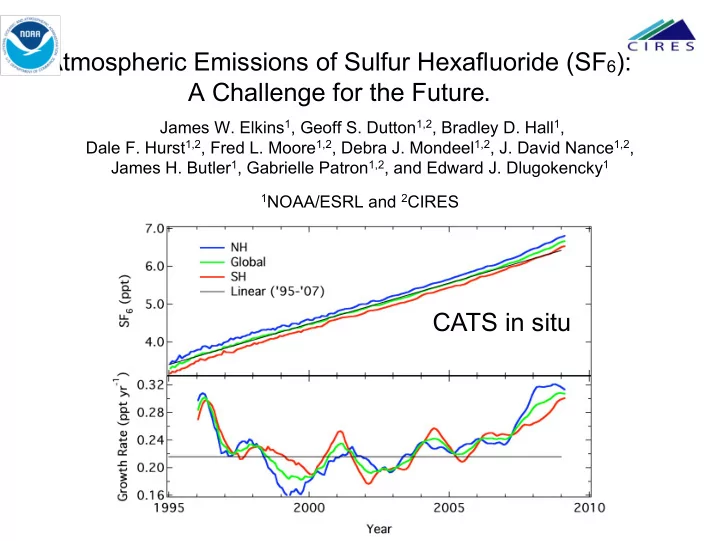
Atmospheric Emissions of Sulfur Hexafluoride (SF6): A Challenge for the Future.

James W. Elkins1, Geoff S. Dutton1,2, Bradley D. Hall1, Dale F. Hurst1,2, Fred L. Moore1,2, Debra J. Mondeel1,2, J. David Nance1,2, James H. Butler1, Gabrielle Patron1,2, and Edward J. Dlugokencky1

1NOAA/ESRL and 2CIRES

CATS in situ

slide-2
SLIDE 2

What is SF6?

  • Made from F2 and S8, as made by discoverers Henri

Moissan and Paul Lebeau in 1901

  • SF6 is an excellent dielectric, used in high voltage

circuit breakers, switch boxes, transmission lines, above 35 kW.

  • It is highly electophilic. It quenches sparks very

quickly and has low thermal conductivity. The big plus is that it allows electronic devices to be built smaller.

  • Atmospheric scientists have used SF6 as a tracer of

air masses and mean age of the air mass in the stratosphere.

SF6 chemical mode S8 chemical model

+ 24 F2 (g) =

400 kV SF6 Circuit Breaker Hybrid Switchgear

slide-3
SLIDE 3

Emissions and Uses of SF6

  • The U.S. EPA has made significant progress in reducing

emissions (680 metric tons, >10% of sales, equal to getting 3.1 million cars off the road) in a 10 year old program to reduce SF6 emissions by industry. (SF6 Gas Emission Reduction Partnership from Electric Power Systems went from 15.2% in 1999 to 5.5% in 2007).

  • Uses:
slide-4
SLIDE 4

Challenges for the Future

  • As population increases electrical use will increase.

We will need some type of dielectric for power distribution.

  • There is no known substitute for SF6 as a dielectric.
  • The atmospheric lifetime is long, and it does matter

what the value (300 or 3200 years). Need more measurements at higher levels (mesosphere) in the atmosphere.

  • A new national power grid that conserves energy

(smart grid) and one based on direct current (DC) may help reduce emissions of SF6. Less power lost,

  • ne less wire, more solar and wind compatible, and

doesn’t have to overated by 40% for power increase

slide-5
SLIDE 5

Tropospheric Sounding with the NSF/NCAR HIAPER GV aircraft during HIAPER Pole-to-Pole Observations (HIPPO) in January 2009 (Prog. Scientist: Steve Wofsy, Harvard)

Highest Lowest

See Elkins & Moore et al. Miller et al. posters

slide-6
SLIDE 6

Global Networks that Measure SF6

  • NOAA CCGG

flasks ( , >40 stations)

  • NOAA HATS

flasks ( , 9 stations)

  • NOAA HATS

CATS in situ ( , 6 stations)

  • NOAA HATS

Airborne projects ( )

  • AGAGE ()
slide-7
SLIDE 7

Northern Vortex Southern Vortex SF6 Loss above 45 km In the Mesosphere Region of Measured SF6 Loss

Tropopause

Maybe the atmospheric Lifetime is shorter than 3200 yr.

slide-8
SLIDE 8
  • SF6 loss rate (1/t) is estimated as 2 times the integral over the northern vortex of the measured

fractional loss, times the mass density, divided by total atmospheric mass. SF6 atmospheric lifetime (t) calculated from: Linear extrapolation t = 595 ± 105 years Error includes in quadrature: ± 35 years for statistical uncertainty in SF6 measurements. ± 65 years for residuals of smooth fit to flight profiles. ± 76 years for uncertainty in the vortex size.

Constant extrapolation t = 747 years

* Vortex size used is an average between Manney's estimate for this year and Waugh's climatological mean. * The above assumptions only leave room for unmeasured loss. Thus, the above measured lifetimes represent an upper limit. Fractional Loss of SF6 x Density of Air (kg/m3)

slide-9
SLIDE 9

Emissions determination from Hall et al., poster

U.S. EPA Estimates Of Voluntary Reductions

Geller et al. [1996]

Hurst et al. [2006] 600 +/- 200 mt yr-1 US & Canada

slide-10
SLIDE 10

Summary

  • From 1996 to 2006, atmospheric SF6 has growth at a

linear rate. Recently, the growth rate has increased from emissions in N.H., and most likely Asia.

  • The consequences to the growth rate of atmospheric

SF6 resulting from the worldwide recession will require

  • The atmospheric lifetime is uncertain, and may be

shorter than the current conventional lifetime of 3200

  • yrs. More balloon measurements as high as the

mesosphere are needed.

  • A new DC power grid may reduce fossil fuel

emissions, and may have also a beneficial effect in reducing emissions of SF6.

slide-11
SLIDE 11

Back-up Slides

slide-12
SLIDE 12

Semi-hemispheric differences (CCGG)

slide-13
SLIDE 13