SLIDE 1
Website: www.tecnologiadepantanosartificiales.com In Mexico: 9933114552. In the United States: 936-828-6180 Email: jhabvalaf@tecnologiadepantanosartificiales.com
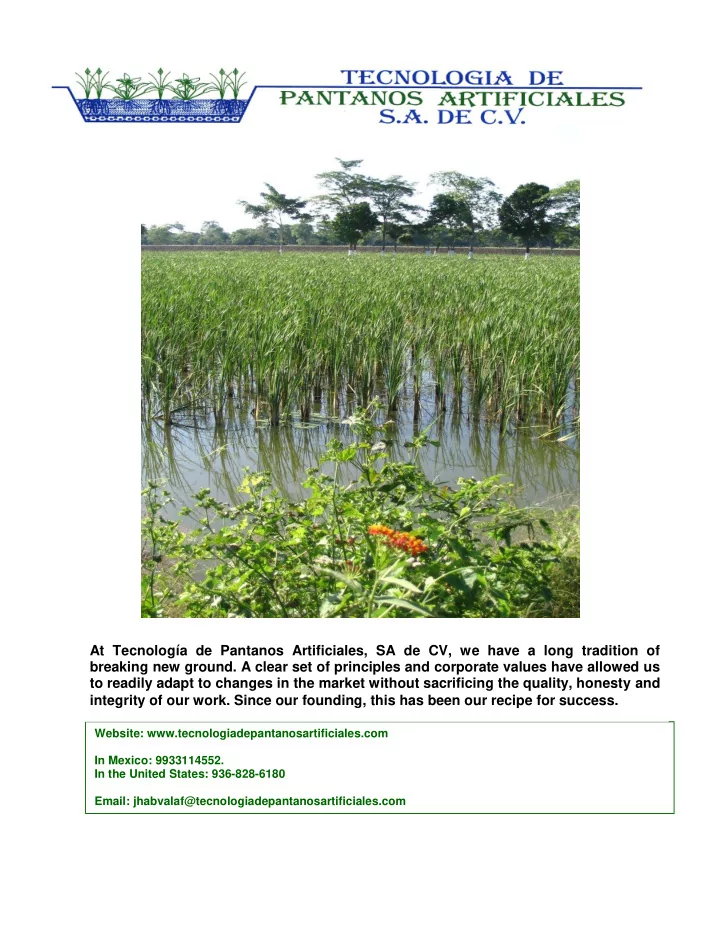
At Tecnología de Pantanos Artificiales, SA de CV, we have a long tradition of breaking new ground. A clear set of principles and corporate values have allowed us to readily adapt to changes in the market without sacrificing the quality, honesty and integrity of our work. Since our founding, this has been our recipe for success.
SLIDE 2
It is a company founded in 1999, combining the works and assets of Impulsora Nacional de Tecnología, S.A. de C.V., as well as the Center for Research Studies of the Southeast, A.C., institution that provides it with scientific support. Our company to achieve its objectives optimally, has specialized staff that collaborates with leading international companies in its field and has had as its main mission to participate in the development of Mexico in various aspects of which two stand out: Public Finance Consulting and The wastewater Treatment Tecnología de Pantanos Artificiales, S.A. de C.V. (TPA), provides specialized services for Economic and Financial Consulting: State and municipal collection, administrative modernization and cadastral systematization for governments. Our required services are provided with more efficient solutions to today's problems faced by businesses and governmental entities. These solutions are a combination of economic, financial, engineering, social, cultural and ecological factors, and therefore multidisciplinary work is the general way we proceed with all of our studies and consulting.
SLIDE 3 Our company to achieve its objectives optimally, has specialized staff that collaborates with leading international companies in its field and has had as its main mission to participate in the development of Mexico in various aspects of which two stand out: For most of their adult lives, the people at TPA, have implemented sustainable solutions for water pollution problems in different parts of the World, through the design and construction of artificial wetlands that meet International Standards, are very efficient, and have very low costs of maintenance and operation. The technology we promote is very robust, and our treatment plants have operated with virtually no maintenance and often no operation for long periods of time. Furthermore, the habitat lost is recovered as a sustainable space. We offer sustainable cutting-edge technology for complete waste water treatment
- f any kind, including contaminated lakes and rivers through constructed
wetlands of different types. Firdaus Jhabvala, our senior partner, has designed, and built, in Mexico Constructed Wetland treatment plants. Our stellar plant at Macultepec in the State
- f Tabasco, Mexico, is the largest of its type anywhere, and receives raw sewage
and turns out quality effluent. In Mexico, we have worked with governments of nine states (Campeche, Chiapas, Guanajuato, Michoacán, Oaxaca, Quintana Roo, Tabasco, Tamaulipas, and Tlaxcala) and a larger number of municipalities to develop projects in the area of water, public finance, administration, and planning. We work in any capacity that the client requires, including diagnoses of existing treatment plants, the design of new treatment plants, and partnerships for transferring technology. TPA works very closely with all institutions interested in defending the Ecology, and especially with one of Mexico’s premier universities in the area of Ecology, Juarez University of Tabasco. TPA has constructed sanitation plants that have removed approximately 98% of the polluting materials found in the wastewater received by the facility. TPA was founded by Dr. Firdaus Jhabvala, who holds patents for subsurface and free water
SLIDE 4 flow wetlands. (Patent Numbers 200096 and 248616 granted by the Mexican Institute
- f Industrial Property). TPA’s technology has been certified by Mexico’s National oil and
gas firm, PEMEX, and TPA is considered a Scientific and Technological firm by CONACYT, Mexico’s National organizer of Science and Technology.
SLIDE 5
SLIDE 6
SLIDE 7 Treatment plants built by TPA in Mexico with Natural Technology:
Santa Cruz Quilehtla, State of Tlaxcala, México, 1995
Quilehtla is a small community of 6,000 people east of Mexico City in the Central
- Highlands. The community wanted a simple wastewater treatment system that required
little or no maintenance, was inexpensive to build, and had no machinery and the least number of movable parts. The requirements at Quilehtla are common in many small communities all over the World. The Quilehtla treatment plant began in late 1993 with the development of diagnostic and executive project was approved in 1994 and construction began with the goal of reducing pollution in the Zahuapan River basin. The Constructed Wetland was designed to treat 380 m³/day of wastewater generated by approximately 5,000 inhabitants. The design of the treatment plant consists of modified Imhof tanks for primary treatment, subsurface flow constructed wetlands for advanced secondary treatment, and reed beds for digesting the sludge produced in the tanks. This is a totally passive system. This system was built with local labor and 90% of local materials. No energy is required for treatment, only to locate sewage pretreatment section of the plant. The treated water is used for irrigation purposes. The Plant uses scoria as substrate material, which increases the wetland’s porosity percentages of conductivity in comparison with gravel. The operating cost is only 10 US cents/m3. The results are spectacular with little operational, human and mechanical stress, due to the fact that nature works tirelessly to treat wastewater.
SLIDE 8 Effluent from the Constructed Wetland
The Treatment plant at Quilehtla removes 94.30% of the BOD, significantly decreases Biological Oxygen Demand (BOD) by 94.10%, and Total Suspended Solids (TSS) by 97.50 %.
Constructed Wetland of El Carmen Tequexquitla, Tlaxcala, 1998
El Carmen Tequexquitla, located in the eastern region of the state of Tlaxcala, has a population of almost 20,000 inhabitants. The sewage used to drain into the Totolcingo Lake, one of the last reservoirs of reasonably clean water left in the Mexican Highlands. The design of the constructed wetland was for a capacity of 1,728 m3/day, and consists
- f Pretreatment, Settling Tank, Sludge Digestion, Biofilter, Wetland Cells and Sand
Filters.
SLIDE 9
The results are outstanding, because with this type of system BOD removal went from 600mg/l in the Influent to 6 mg/l in the Effluent, and TSS was reduced by 99.01%, standards of good tertiary treatment.
Simple to Operate and Maintain Operating cost is just 6 US cents/m3 Requires minimal use of electricity
SLIDE 10
Constructed Wetland of Cuitzeo del Porvenir, Michoacán, 2000
Cuitzeo del Porvenir is a town nestled on the shores of Lake Cuitzeo. The Treatment
Plant has Pretreatment, Clarifier, Sludge Cells, and Free Water Wetland Cells, with a capacity of 1,728 m3/day. BOD Influent: 349 mg/l de DBO BOD Effluent: 29 mg/L The operating cost is only 3 US cents/m3.
SLIDE 11 Macultepec, the Largest Complete Wetland Treatment Plant of its Kind
Macultepec is a small town with 60,000 inhabitants spread around it located in the State
- f Tabasco of Mexico. The municipal sewer had been discharging untreated sewage
into the nearby Centla Wetlands Biosphere Reserve, a biologically diverse area that is home to more than 550 species of flora and fauna.
Integral Sanitation Strategy: Treatment consists of a primary sedimentation tank, a
reed bed for treatment of solids, and surface flow constructed wetland, plus a UV Disinfection Unit. Ecological Objectives: Defend Nature, no use of chemicals, and zero electricity use in processing the waste water. Time for Construction: 1 year. Investment: 2.9 million US Dollars (including the cost of land and the final design). = $ 48.33 per capita. Total Life Cycle Cost (50 years) per m3: 2.94 US Cents.
Cost of Operation, Maintenance, Repair and Replacement (OMRR) represents 2% of
the annual investment. Flow Capacity= 10,800 m3/day Influent BOD = 350 mg/L Effluent BOD: 18 mg/L
SLIDE 12
Ecological Education Program implemented in 2004
The first step towards the sustainability of our resources is to change the attitude and culture of present-day education.
Guided Tour of the Wastewater Treatment Plant in Macultepec with students from different schools.
High School No. 37 Juarez University of Tabasco
SLIDE 13
Diverse Schools and Colleges
SLIDE 14
¿Why should you choose Constructed Wetland Technology for Clean Wastewater?
High Productivity and Efficiency with great Simplicity. Has very low investment, operation and maintenance costs. No chemicals, biological additives or electricity for Treatment. Eliminates odor problems, mosquitoes and Total Sludge Disposal, not just Sludge Transfer. Can be operated by members of the community for its simplicity. Creates a new environment for local flora and fauna. Does not cause more air pollution as with conventional mechanical treatment technologies. Can be combined with most existing Treatment Plants. A flexible size and can be installed anywhere without much additional work to collect the wastewater. Allows use of materials and labor from the region for both its operation and construction. No movable parts or large structures.
SLIDE 15
Our Staff:
Firdaus Jhabvala. Firdaus is dedicated to wastewater treatment and water technology in general. He has written and published in the field of wastewater treatment with wetlands, and holds two patents in the field. He has designed treatment plants for private companies and public institutions in several parts of Mexico. Firdaus has a PhD from the University of Pennsylvania in Economics, and has advised the Mexican government, as well as many state and municipal agencies on financial matters, and links Water Issues to Financial Topics. Firdaus also specializes in developing strategies for financing of infrastructure projects, which are often essential to the realization of many water supply and wastewater treatment and reuse infrastructure. Eric M. Kofoed. Eric holds a Ph.D. in Molecular and Cell Biology, University of California, Berkeley, 2012. His degree was in Biological Sciences from the prestigious Reed College, Portland, Oregon, 1999. He has worked in a dozen countries and is a specialist in biological, genetic and ornithological research. Darío Vásquez Antonio. Expert in Social Development. With a Doctorate in Planning from the Technological Institute of Oaxaca, Dario has a life of working with communities in the Southeast part of Mexico on issues related to water. Josefina Osorio Avalos. Administration. Josefina has a Masters in Applied Economics for Business from the University of the Vale of Mexico, 2002. Her areas of work and interest include Studies in the Economics of Water, Planning, Accounting, and Finance. José Ledesma Rosique. Jose has a degree in Industrial Chemical Engineering from the Technological Institute of Villahermosa, 1979. Jose has extensive experience with the technology of Constructed Wetlands, having participated in all aspects of the plants in Macultepec and in Cuitzeo. Jose has experience in the areas of Environmental Safety Planning, Safety Inspections and Environmental Protection, Environmental Audits, Environmental Diagnostics Development, and Environmental Management. Farida Jhabvala Romero. Farida has a degree in Biology from Reed College, Portland, Oregon, 2000. Her main areas of work are in the areas of research in biology, technology and society. Farida is a Public Health Specialist and reports on social issues for Bilingual Radio out of San Francisco, and National Public Radio in the United States. Jesus Jaime Cervantes Cervantes. Legal and Tax Specialist. Jesus has a Bachelor of Business Administration and a Bachelor of Law from the University of Guadalajara, 1975 and 1985. Héctor Osorio Avalos. Hector is an Electrical Engineer from the Universidad Juarez Autonoma de Tabasco, 1991. He has worked extensively as Electrical Planner and as an Analyst of Unitary Prices.
SLIDE 16 Main Studies and Wastewater Projects: Executive Project for a Wastewater Treatment Plant with Constructed Wetlands, Santa Anita Huiloac, Tlaxcala (1993). Study and Management Plan for the Illusions Lagoon in Villahermosa, Tabasco (1993-1994). Executive Project for a Wastewater Treatment Plant with Constructed Wetlands for up to 500 m³/day in the Municipality of Santa Cruz Quilehtla, Tlaxcala (1993-1995). Executive Project for a Wastewater Treatment Plant with Constructed Wetlands for up to 1,728 m³/day, Municipality of El Carmen Tequexquitla, Tlaxcala (1997-1998). Executive Project for a Wastewater Treatment Plant with Constructed Wetlands capable of 6,912 m³/day, Municipality of Comalcalco, Tabasco (1999- 2000). Executive Project for a Wastewater Treatment Plant with Constructed Wetlands with a capacity of 3,456 m³/day in the Municipality of San José Iturbide, Guanajuato (1999-2000). “Constructed Wetlands: Alternatives for treatment of waste water", presented at the Universidad Iberoamericana, Mexico, D. F., 2001. "Municipal Health Planning", presented at the First Meeting of Healthy Municipalities, Tlaxcala, 2000 at the site of the Wastewater Treatment Plant of El Carmen Tequexquitla, Tlaxcala, 2000. "Executive Project for the Design and Construction of the Wastewater Treatment Plant with capacity of 1,728 m³/day in Cuitzeo, Michoacan. 2000- 2001." "Executive Project of the Wastewater Treatment Plant of the metropolitan area
Construction, commissioning and Operation of the Wastewater Treatment Plant of Villa Union, Tabasco, 2004-2005. Diagnosis and Rehabilitation of the Wastewater Treatment Plant at Cuitzeo, Michoacan, 2010.
SLIDE 17
"Executive Project for the Design and Construction of the Wastewater Treatment Plant Residential subdivision Los Bosques en Nacajuca, Tabasco. Mexico, 2016." "Executive Project for the Design and Construction of the Wastewater Treatment of Frontera City, Municipality of Centla, Tabasco. Mexico, 2017." "Executive Project for the Design and Construction of the Wastewater Treatment of Emiliano Zapata City, Municipality of Emiliano Zapata, Tabasco. Mexico, 2017." Cost-Benefit Study of measures to lessen the Impact of Climate Change in the Metropolitan Area of San Salvador" to the United Nations, 2011.