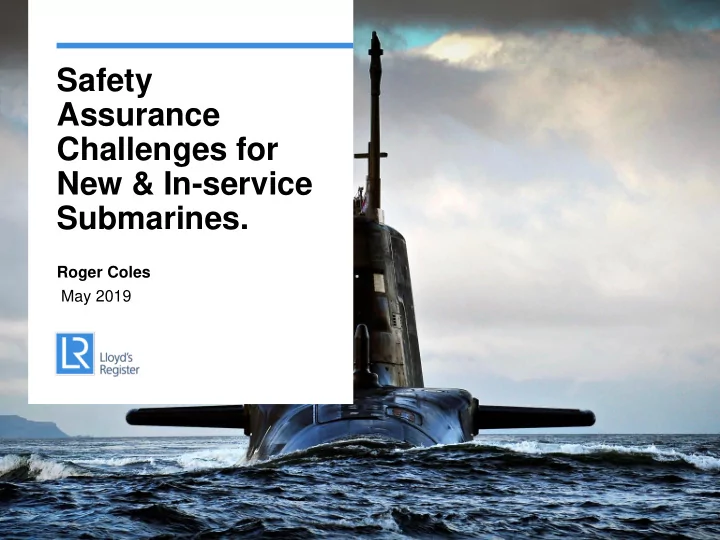
Roger Coles May 2019
Assurance Challenges for New & In-service Submarines. Roger - - PowerPoint PPT Presentation
Safety Assurance Challenges for New & In-service Submarines. Roger Coles May 2019 Introduction High value assets in a hostile environments Acceptable Risk Level Design Build In-Service Assurance Owners Responsibility
Introduction
Lloyd's Register
- High value assets in a hostile environments
- Acceptable Risk Level
- Design Build In-Service Assurance
- Owners Responsibility
- Assurance and Compliance
- Rule Based Assurance
- Goal Based Assurance
Basic Differences
Lloyd's Register
- Stealth Power
- Submarines Stability
- Closed Atmosphere
- Defect Tolerance
- Weight Watchers
- System Integration
Ex Structure Ballast Tk Integrity Auxiliary Ballast Blow St-By/Buoyancy/Atmos
Supporting Safety Roles
Main Ballast Blow Surface/Stability/Control HP Air Supply Supply/Atmosphere Ex Structure Drainage Buoyancy System Control Pressure Hull WT Integrity SW Systems WT Integrity Main Propulsion Thrust Available Ventilation Sys Atmosphere Air Purification System Atmosphere Snort Induction System Power Supply Trim-Bilge-Ballast Buoyancy/Stability Control Main Hydraulic System Hydroplane/Steering Power Hydraulic Actuation Hydroplane/Steering Control Platform Systems Ops Control/Management Pressure Hull Propulsion & Manoeuvring Loads PH & Structural Bhd Withstand Dive Pressures SW & FW Services Systems Support Trim-Compensation Depth & Pitch Control Battery Services Back-up Energy source Diesel Generator Emgy Power Source
MOVE
Reserve of Buoyancy & Main Ballast Blow Ability To Surface & Remain On Surface Provide Acceptable Level of Stability Capable Of Being Controlled Minimise Hazards With Catastrophic Consequence Navigate Environment At Sea When Dived Or Surfaced Port Exit / Entry
Safety Goals Safety Function
Anchor Surface Submarine Boat Transfers Dive Submarine Surface Transit Under Ice Loss of Propulsion Emergency Flood/Fire Loss of Steering Control Alongside
Submarine Operations
Navigation in Confined Waters
The Inter Connection and Dependency Operations - Goals - Functions– Roles - Systems
Build Quality
Lloyd's Register
- Consequence of failure drive higher build quality
- Quality cannot be INSPECTED into a product
- Supplied product is the foundation of build quality
- Quality can be BUILT into the product
- Verification supported by well defined solutions
- Solutions that reflect product risk category
- Product & Build Quality key to through life reliability & availability
- SQEP Independent verification provides Assurance
Ship Rule Base Assurance
- Developed over many years
- Ship Rules demanded by industry to protect assets
- Built on a vast knowledge & experience base
- Provide a well established & robust compliance framework
- Ship Rules work across the shipping industry
- Readily adopted by naval ships
- Share common features & compliance demands
- Exist in large numbers so good knowledge & experience base
- Resource pressure on standards
Lloyd's Register
Submarine Rule Base Assurance?
- Submarines a small sector
- Submarines value as a weapon is its unknown capability
- Secrecy dilemma:
Absence of shared knowledge to support regulation but sharing knowledge undermines secrecy & security
- Submarine differ from ships
- Rule set constraints
- Rule compliance assumes responsibility for safety levels
- Adopt the practices & resources developed for Rule sets
Lloyd's Register
- Rule Sets are a reactive process
- Cannot write a rule for every eventuality
- Requires significant in-house expertise
- Submarine industry is a small sector with limited expert
resource
- Ship Rules tend to ‘catch all’ minimum safety levels
- Ship Rule would require clarifications & modifications to
be effective
- Prescriptive rules only address known risks
- Prescriptive rules restrict innovative design, materials and
methods
Can we use Ship Standards
- Compliance with prescriptive standards doesn’t address
every safety risk
- Ship standards set minimum safety requirements
- Whole boat transverse issues apply to every design level
- Higher quality requirements driven by higher risk
- Components and System Design Level considerations
- Modifications or additions is an acknowledgement a rule
does not address the requirements
- Suitable if fully comply with design, transverse issues and
quality requirements
- A cost effective solutions for the designer & builder
Lloyd's Register
- The Naval Submarine Code a goal based
framework.
- With processes for defining technical areas
for application to any submarine.
- The Code derived from the Naval Ship Code.
- LR is a founding member of INSA
Regulation for a Goal Based Approach
Lloyd's Register
Why do we need the Naval Submarine Code (NSubC)? Designed to provided an equivalence to commercial regulation by providing over arching safety framework. IMO Flag States Classification NSubC Naval Authorities Assurance International Convention Regulation Material State
Goal Based Assurance Model
Lloyd's Register
Overall Safety Goal Area Safety Goal Functional Objectives Performance Requirements Qualitatively Defined Requirements to meet Objectives Impact on Primary Concerns Standards Plan Technical File Verification Activities Justification & Guidance Identify Responsibilities
Navy
Safety Management System Regulatory Framework Concept of Operations System requirements
Aim Goal Objectives Design Intent Design Solutions Build Assurance
Transv. Materials Risk Structures Piping Ship systems Engines Gears Electrical Atmosphere Control Escape Navigation Fire
Risks to be mitigated in each area Identify & Justify Technical Standards applied to Performance Requirements & ConOpS Submarine Assurance Certificate
Goal Based Design to Build Assurance Model
Lloyd's Register
Build Assurance Design Intent Design Solutions
Design Authority
Design Specification
Design Authority/Recognised Organisation
Justified Technical Standards
Design Authority
Design Justification
Naval Administration
Compliance
Owner
Concept of Operation Statement
Recognised Organisation
Design Verification
Design Authority
Design Requirements
Risk Category Requirements
Recognised Organisation
Assurance Framework Mapped to Components
Lloyd's Register
Pressure Hull Valve
System
Pressure and Piping System components
- Performance Requirements
- Construction and
Installation
- Compressed Air and gas
systems
- Control supervision and
monitoring
Materials
Rules for Materials
- General
- Testing Procedures
- Rolled steel plate sections
and bars
- Steel forgings
- Approval of welding
consumables
Component
Pressure and Piping System components
- Performance Requirements
- Assessment
- Materials
- Carbon and alloy steel
components
- Pipe supports
- Pressure vessels
Functions
Propulsion and manoeuvring
Transverse
Whole Boat
- Transverse
- Survivability
- Product Verification
- Categorisation
Pressure Vessel
Functions
Watertight integrity
Transverse
Whole Boat
- Transverse
- Survivability
- Product Verification
- Categorisation
System
Pressure and Piping System components
- Performance Requirements
- Construction and Installation
- Trim and Compensating
System
- Sea Water Cooling Systems
- System Testing, Integration
and Trials
Component
Pressure and Piping System components
- Performance Requirements
- Assessment
- Materials
- Copper and copper alloy piping
components
- Valves
- Testing
Materials
Rules for Materials
- Approved Works
- Testing Procedures
- Copper Alloys
- Corrosion Prevention
System
Pressure and Piping Systems
- Performance Requirements
- Construction and Installation
- Compressed Air & Gas
Systems
- Control supervision and
monitoring
- System Testing, Integration
and Trials
Component
Pressure and Piping System Components
- Performance Requirements
- Assessment
- Materials
- Carbon and low alloy steel
piping and components
- Pressure Vessels
- Testing
Functions
Propulsion and Manoeuvring
- Propulsion
- Manoeuvring
Regulations
Whole Boat
- Transverse
- Risk
- Survivability
- Product Verification
- Categorisation
Materials
Rules for Materials
- General
- Testing Procedures
- Steel Castings
- Steel Pipes & Tubes
System Compressor
Functions
Propulsion and Manoeuvring
- Propulsion
Regulations
Whole Boat
- Transverse
- Survivability
- Product Verification
- Categorisation
System Pump
Materials
Rules for Materials
- General
- Testing Procedures
- Copper Alloys
Component
Pressure and Piping System Components
- Performance Requirements
- Assessment
- Materials
- Copper and copper alloy
piping and components
- Pumps
System
Pressure and Piping Systems
- Performance Requirements
- Construction and Installation
- Sea water cooling systems
- Control supervision and
monitoring
- System Testing, Integration
and Trials
Summary
Lloyd's Register
The iterative nature of a goal based approach when applied in a common industry manner will:
- Provide risk categories for components & systems
- Identify available standards and regulation that consistently
provide solutions
- Provide common and consistent solution that could be
developed and shared as submarine standards
- Allow a common risk assessment & safety case
approaches to be adopted and reduce variation across the industry.
- Allow Naval Administration legislation and statutory
requirements to be addressed
- Build a submarine assurance approach that uses standards
were appropriate and goals where necessary
Owners perspective
Owner’s perspective - 1
- Safe to operate depends on
– Design – Condition – Operation – Changes
- Assessment at any stage depends on knowledge
- Knowledge depends on documentation to provide
corporate memory
Owner’s perspective - 2
- Much data disappears if it is not recognised, recorded
and collated as it is produced
- Data capture needs to start at the start of design right
through to disposal
- You don’t know you needed it until it is the vital last piece
in the jigsaw
- Documentation/data management must be defined and
managed from the start
- The owner needs an experienced friend to ensure that
all this is done
What am I being given? –The Design Process
- Safety Case
- Tests
- Trials
- Demonstrations
- Operability
- Survey
- Documentation
What have I got? - Validation
- Safety case
- Supplied Product Verification
- New Build Verification
- Tests
- Trials
- Periodic Survey
- Maintenance
- Refit
- Maintain Documentation
Safety Case
- Traditional
– Inflexable – Assumes everything works as new – Is difficult to run ‘what iffs’
- Goal Based
– Can be flexible – Allows for manipulation at lowest level – Can be extended if circumstances change – Copes with multiple degradation of systems – More easily updated – INSA provides authority for the approach
23/05/2019
Do I allow this boat to continue running? – Through life management
- Performance assessment
– Survey – Defects – Tests – Trials – Accumulation
- Update Safety Case
- Material state – records/documentation
- Professional judgement – Owner’s responsibility, cannot be
delegated or diluted
The role of the Owner’s friend
- Identify gaps within Naval Administrations regulatory
structures and can be a powerful tool for Regulators, allowing robust risk management processes to be implemented.
- Incorporate different elements such as risk, product
verification and existing standards.
- Reduce the burden of maintaining large standards portfolios.
- Allows the right questions to be asked.
- Be a key tool for builders, maintainers and Naval operators
today to provide effective support for submarines.
Lloyd's Register
The story so far
Conclusions
- The ship rules culture does not map to Submarines
- Goal based suits the needs of a Submarine
- Goal Based has many benefits
- Owner is always ultimately responsible for safety
- Class Societies are able to provide help to advise,
maintain, verify, certify through a goal based framework
- The designer becomes an active owner of the
design specifications and safety requirements
Lloyd's Register
- Address risks and consequences
- Provide technical solutions to satisfy safety objectives
- Allows for innovation
- Verifies Procurement Build & Maintenance activities through-life
- Provide a compliance route
- Provide certification and record maintenance
Lloyd's Register 23
Thank you
Roger Coles
LR Submarine Programme Manager
Naval Centre of Expertise
2nd Floor, The Sion, Crown Place, Nailsea Bristol BS48 1RB T +44 (0) 1275 515000 M +44 (0) 7764430644 E roger.coles@lr.org www.lr.org/marine