
SLIDE 1
1
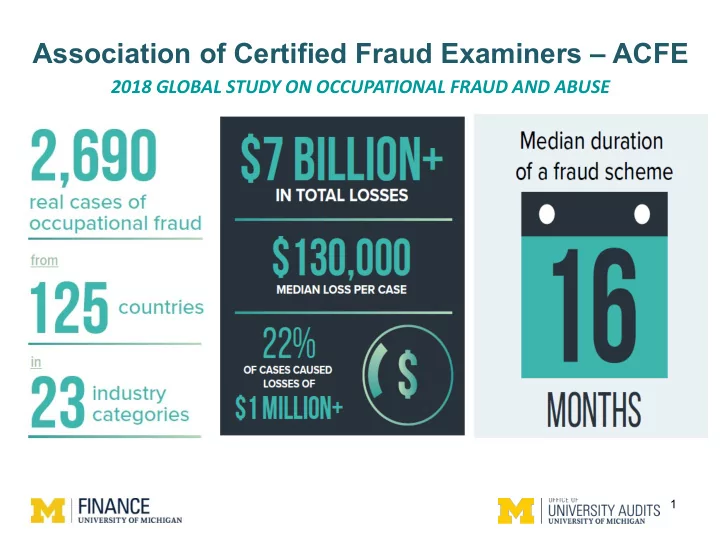
Association of Certified Fraud Examiners ACFE 2018 GLOBAL STUDY ON - - PowerPoint PPT Presentation
Association of Certified Fraud Examiners ACFE 2018 GLOBAL STUDY ON OCCUPATIONAL FRAUD AND ABUSE 1 Key Findings 2 The Red Flags of Fraud Understanding and recognizing the behavioral red flags displayed by fraud perpetrators can help
1
2
3
4
5
6
December 12, 2018
It is estimated that the typical organization loses 5% of revenues to fraud each year1. Fraud can happen anywhere and unfortunately, it happens at the University of Michigan. Below are some examples of cases that have been investigated
and what controls you have in place to prevent it or detect it in a timely way.
An employee used the PCard to pay for personal expenses.
How was this discovered? The employee did not submit the expenses through Concur. Email notifications/reports about unsubmitted expenses were not received by the supervisor or the department manager. Expenses were identified by Procurement Services reviewing expenses over 90‐ days old. How did it turn out? The employee was terminated.
What important control was missing? No default approver was listed for the employee in Concur. If a default approver had been listed, the supervisor would have received an email about unsubmitted expenses and they would have been identified faster. The correct department manager was not listed in the system, so the burst reports on unsubmitted expenses were not received by the right person.
An employee processed customer refunds to their own credit card.
How was this identified? A customer called to inquire about an expected refund that had not yet been received. The employee who typically handles refunds was out, so the call was handled by a co‐worker. What happened? The employee is on administrative leave while a DPSS investigation is in progress. What important control was missing? The approval of refunds was verbally delegated to the employee performing the refunds and no compensating oversight control was in place to detect the fraud. This was a trusted employee, who was a “friend” of the supervisor. The employee was targeting older credit balances that customers may have forgotten.
A faculty advisor to a student group was being paid by the group to video its events.
Why was this a problem? Students from the group called the hotline because of a conflict of interest
felt obligated to use him for video services. What was the result? The faculty advisor was required to stop providing videography services to this group. Why is this a critical example? This is an abuse of power situation. Without a hotline, there may have been no place the students felt comfortable raising their concerns. The perception of a conflict can create problems. Real and potential conflicts of interest must be disclosed, discussed, and managed.
An employee was not reporting time off on their university timesheet to save vacation days.
How was this discovered? Coworkers noticed discrepancies between actual attendance and time reports and called the hotline. So what? Theft of time from the university might seem small at an individual or department level, but from a university‐wide perspective, the loss may be significant. Why is this a critical example? A supervisor’s sloppiness can allow a fraud to continue. A supervisor with local knowledge about what was truly worked and who can attest to the accuracy
can be run centrally to identify this fraud. Any suspicious activity should be reported to University Audits (734) 647‐7500 or to the Compliance Hotline at 1‐866‐ 990‐0111 or compliance hotline.umich.edu. Callers to the Compliance Hotline can remain anonymous. Departments that will likely be involved in a fraud investigation include DPSS, HR, OGC, University Audits, and Risk Management.
1 From the ACFE’s 2018 Global Fraud Study, Report to the Nations on Occupational Fraud and Abuse.
December 12, 2018
Below are some statistics about the Compliance Hotline. It is important to note that not all reports to the hotline are about fraud. Some are other forms of misconduct, but all are reviewed. It is also important to note that not all fraud is reported through the Hotline. Sometimes reports are made directly to units (e.g., Procurement Services, University Audits, DPSS, HR, OGC). These and many other departments work together to safeguard university personnel and assets.
100 200 300 400 500 600 700 FY 2012 FY 2013 FY 2014 FY 2015 FY 2016 FY 2017 FY 2018
Number of Hotline Reports
fiscal year 2012‐2018
Location
FY 2016 FY 2017 FY 2018 Ann Arbor Campus 41 101 246 Dearborn Campus 2 2 5 Flint Campus 7 21 22 Michigan Medicine/Medical School 249 375 321 Total 299 499 594
Method of Reporting
FY 2016 FY 2017 FY 2018 Internet 176 351 404 Phone 122 148 190 Other 1 Total 299 499 594
Anonymous/Non‐ anonymous
FY 2016 FY 2017 FY 2018 Anonymous 94 364 206 Non‐anonymous 205 135 388 Total 299 499 594