Associated. Module 1: Part I Read the following required reading: - - PowerPoint PPT Presentation

associated
SMART_READER_LITE
LIVE PREVIEW

Associated. Module 1: Part I Read the following required reading: - - PowerPoint PPT Presentation

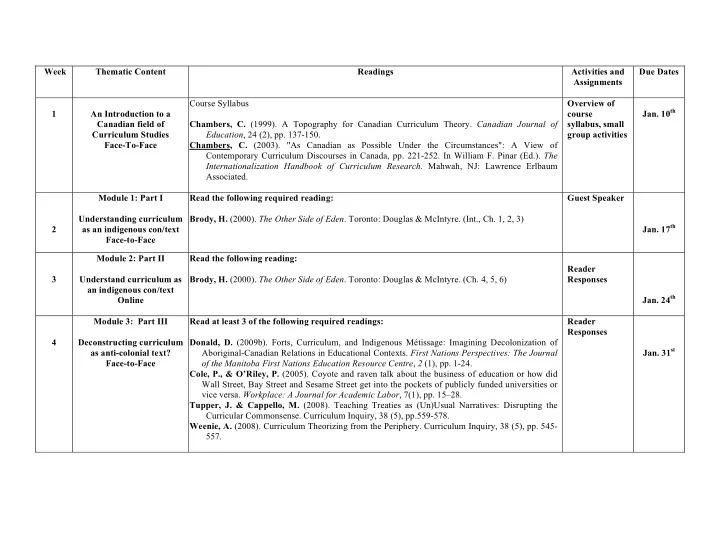
Week Thematic Content Readings Activities and Due Dates Assignments Course Syllabus Overview of Jan. 10 th 1 An Introduction to a course Canadian field of Chambers, C. (1999). A Topography for Canadian Curriculum Theory. Canadian Journal


slide-1
SLIDE 1

Week Thematic Content Readings Activities and Assignments Due Dates 1 An Introduction to a Canadian field of Curriculum Studies Face-To-Face Course Syllabus Chambers, C. (1999). A Topography for Canadian Curriculum Theory. Canadian Journal of Education, 24 (2), pp. 137-150. Chambers, C. (2003). "As Canadian as Possible Under the Circumstances": A View of Contemporary Curriculum Discourses in Canada, pp. 221-252. In William F. Pinar (Ed.). The Internationalization Handbook of Curriculum Research. Mahwah, NJ: Lawrence Erlbaum Associated. Overview of course syllabus, small group activities

  • Jan. 10th

2 Module 1: Part I Understanding curriculum as an indigenous con/text Face-to-Face Read the following required reading: Brody, H. (2000). The Other Side of Eden. Toronto: Douglas & McIntyre. (Int., Ch. 1, 2, 3) Guest Speaker

  • Jan. 17th

3 Module 2: Part II Understand curriculum as an indigenous con/text Online Read the following reading: Brody, H. (2000). The Other Side of Eden. Toronto: Douglas & McIntyre. (Ch. 4, 5, 6) Reader Responses

  • Jan. 24th

4 Module 3: Part III Deconstructing curriculum as anti-colonial text? Face-to-Face Read at least 3 of the following required readings: Donald, D. (2009b). Forts, Curriculum, and Indigenous Métissage: Imagining Decolonization of Aboriginal-Canadian Relations in Educational Contexts. First Nations Perspectives: The Journal

  • f the Manitoba First Nations Education Resource Centre, 2 (1), pp. 1-24.

Cole, P., & O’Riley, P. (2005). Coyote and raven talk about the business of education or how did Wall Street, Bay Street and Sesame Street get into the pockets of publicly funded universities or vice versa. Workplace: A Journal for Academic Labor, 7(1), pp. 15–28. Tupper, J. & Cappello, M. (2008). Teaching Treaties as (Un)Usual Narratives: Disrupting the Curricular Commonsense. Curriculum Inquiry, 38 (5), pp.559-578. Weenie, A. (2008). Curriculum Theorizing from the Periphery. Curriculum Inquiry, 38 (5), pp. 545- 557. Reader Responses

  • Jan. 31st
slide-2
SLIDE 2

5 Module 4: Part I How might we understand educational relationships among society, school, curriculum and the child? Online Read the following required readings: Dewey, J. (1902/1990). The Child and the Curriculum, pp. 181-209. Chicago: University of Chicago Press. Dewey, J. (1922/2009). Education as Engineering. Journal of Curriculum Studies, 41 (1), pp. 1-5. Egan, K. (2003). What is Curriculum? Journal of the Canadian Association of Curriculum Studies, 1 (1), pp. 9-16. Egan, K. (2003). A Retrospective on “What is Curriculum?” Journal of the Canadian Association of Curriculum Studies, 1 (1), pp. 17-24. Reader Responses

  • Feb. 7th

6 Module 5: Part II How might we understand educational relationships among society, school, curriculum and the child? Face-to-Face Required: Dewey, J. (1902/1990). The School and Society, pp. 6-178. Chicago: University of Chicago Press. Optional Readings: Doll, W. J.R., (2006). Method and Its Culture: An Historical Approach. Complicity: An International Journal of Complexity and Education, 3 (1), pp. 85-89. Reader Responses

  • Feb. 14th

No Classes Study Week

  • Feb. 20th

7 Module 7 How might we understand curriculum studies in relation to Ecojustice? Online Read at least one of the following required readings: Howard, P. (2011). Living as Textual Animals: Curriculum, Sustainability and the Inherency of

  • Language. Journal of the Canadian Association of Curriculum Studies, 9 (1), pp. 83-114.

Ng-A-Fook, N. (2010). An/other Bell Ringing in the Sky: Greenwashing, Curriculum, and

  • Ecojustice. Journal for the Canadian Association of Curriculum Studies, 8 (1), pp. 41-67.

Pente, P., V. (2009). The Hidden Curriculum of Wilderness: Images of Landscape in Canada. Journal for the Canadian Association of Curriculum Studies, 7 (1), pp. 111-134. Reader Response Curriculum Scholar Paper Due

  • Feb. 28th

8 Module 8 How have Canadian curriculum scholars taken up life writing as a methodological to research? Face-To-Face Read at least 2 articles from the following Transnational Curriculum Inquiry Journal Issue: http://ojs.library.ubc.ca/index.php/tci/issue/current Read at least 1 article from the following optional readings: Ng-A-Fook, N. (2012). Navigating M/other-Son Plots as a Migrant Act: Autobiography, Currere, and Gender. In Stephanie Springgay and Deborah Freedman (Eds.), M/othering a bodied

  • curriculum. Toronto, Ontario: University of Toronto Press.

Ng-A-Fook, N. (2011, July). Provoking A Canadian Curriculum Theory Project: A Question of/for Currere, Denkbild and Aesthetics. Media: Culture: Pedagogy, 15 (2), (pp. 1-26). Reader Responses

  • Mar. 6th
slide-3
SLIDE 3

9 Module 9 How might we research curriculum as a racialized text here in Canada? Online Read at least 3 of the following required readings: Aoki, T. (1983). Experiencing Ethnicity as a Japanese Canadian Teacher: Reflections on a Personal

  • Curriculum. Journal of Curriculum Inquiry, 13 (3), pp. 321-335.

Ibrahim, A. (2008). The New Flaneur: Subaltern cultural studies, African youth in Canada and the semiology of in-betweenness. Cultural Studies, 22 (2), pp. 234-253. Montgomery, K. (2005). Imagining the Antiracist State: Representations of racism in Canadian history textbooks. Discourse: studies in the cultural politics of education, 26 (4), pp. 427- 442. Stanley, T. (1999). A letter to my children: Historical memory and the silences of childhood, (pp. 34-33). In Judith P. Robertson (Ed.), Teaching for a Tolerant World, Grades K-6: Essays and

  • resources. Urbana, Ill.: National Council of Teachers of English.

Reader Responses

  • Mar. 13th

10 Module 10 How might we draw upon psychoanalysis to study history, sexuality and gender within the curriculum? Online Read at least three of the following required readings: Britzman, D. (2010). On the madness of lecturing on gender: a psychoanalytic discussion. Gender and Education, 22 (6), pp. 633–646. Farley, L. (2010). “The Reluctant Pilgrim:” Questioning Belief After Historical Loss. Journal for the Canadian Association of Curriculum Studies, 8 (1), pp. 6-40. Gilbert, J. (2004). “Let us say yes to who or what turns up”: Education as Hospitality. Journal for the Canadian Association of Curriculum Studies, 4 (1), pp. 25-34. Mayes, C. (2009). The psychoanalytic view of teaching and learning, 1922–2002. Journal of Curriculum Studies, 41(4), pp. 539–567. Reader Responses

  • Mar. 20th

11 Module 11 Deconstructing the explicit, implicit, and null curricula in Harry Potter? Face-to-Face Required Readings:

Rowling, J. K. (1997/2004). Harry Potter and the Philosopher’s Stone. London, U.K.: Bloomsbury.

Reader Responses

  • Mar. 27th
slide-4
SLIDE 4

12 Module 12 How might we provoke curriculum theorizing anew? Face-to-Face Draft of Paper Due (no readings) Drafts of Final Papers Due. Bring a copy to class. Online Community Report due. April 3rd 13 Online Final Paper Due (no readings). Must post on VC and e-mail a copy to professor. Take time to read some of your peers final papers and comment

  • n them.

April 10th