Assessment Agency: National institute for strategic policy analysis - - PowerPoint PPT Presentation

assessment agency
SMART_READER_LITE
LIVE PREVIEW

Assessment Agency: National institute for strategic policy analysis - - PowerPoint PPT Presentation

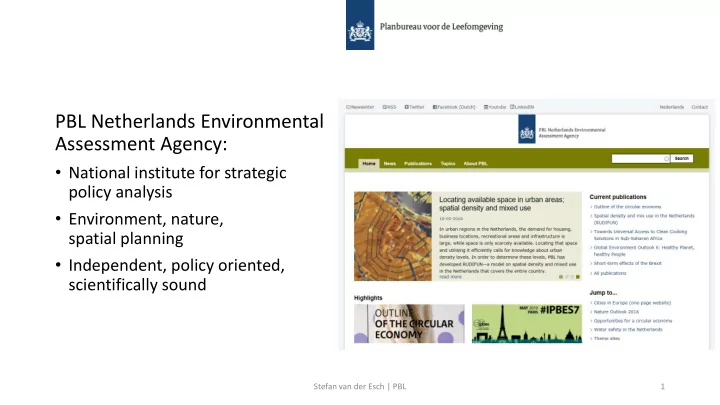
PBL Netherlands Environmental Assessment Agency: National institute for strategic policy analysis Environment, nature, spatial planning Independent, policy oriented, scientifically sound Stefan van der Esch | PBL 1 Outline


slide-1
SLIDE 1

PBL Netherlands Environmental Assessment Agency:

  • National institute for strategic

policy analysis

  • Environment, nature,

spatial planning

  • Independent, policy oriented,

scientifically sound

Stefan van der Esch | PBL 1

slide-2
SLIDE 2
  • Policy cycle
  • Stages determine data needs
  • Use of earth observation data in

policy development

  • Examples: land subsidence and

the Global Land Outlook

  • Portals
  • Missing links
  • What would we like to know?

Outline

Stefan van der Esch | PBL 2 Permission via UNCCD Secretariat, Global Land Outlook 1

slide-3
SLIDE 3

Policy cycle

Stefan van der Esch | PBL 3

Rijksoverheid webportaal Communicatie

slide-4
SLIDE 4

Stefan van der Esch | PBL 4

PBL

slide-5
SLIDE 5
  • Deforestation and REDD
  • Air quality
  • Climate and climate change
  • Land use and land use change
  • Crop yield predictions
  • Early warning and emergency

responses

Uses in policy

Stefan van der Esch | PBL 5 Permission via UNCCD Secretariat, Global Land Outlook 1

slide-6
SLIDE 6

Land subsidence

Steps:

  • Satellite data
  • Processing and combining
  • Causes, effects, consequences
  • Scenarios/extrapolation (future

problem) – models

  • Goals, ambitions (political)
  • Response inventory
  • Response evaluation
  • Costs action/inaction
  • Policy decisions on measures
  • Implementation
  • Evaluation and monitoring

Stefan van der Esch | PBL 6

slide-7
SLIDE 7

Stefan van der Esch | PBL 7

  • PBL: outlook component
  • Wageningen University,

Utrecht University, EC Joint Research Centre

Global Land Outlook

slide-8
SLIDE 8
  • Where (in the world) is land

condition changing?

  • By how much?
  • Is management or climate

driving that change?

  • What are future impacts?
  • What options do we have?
  • How effective are they?

Global Land Outlook

Stefan van der Esch | PBL 8

slide-9
SLIDE 9

21-02-2019 Stefan van der Esch | PBL 9

JRC; Global Land Outlook; World Atlas of Desertification

slide-10
SLIDE 10

21-02-2019 Stefan van der Esch | PBL 10

Schut et al., 2015

slide-11
SLIDE 11

Soil organic carbon

Stefan van der Esch | PBL 11

Situation in 2010 Projected change to 2050 Historic loss: most losses in agricultural production areas

  • > also most potential for

restoration?

slide-12
SLIDE 12

Stefan van der Esch | PBL 12

slide-13
SLIDE 13

…and others

Portals

Stefan van der Esch | PBL 13

slide-14
SLIDE 14

Takeaways:

  • Use for policy is most often not direct
  • Demands (speed, resolution,

repetition, accuracy) change dependent on phase in policy cycle

  • Attribution (determining causes of
  • bserved change) is where it often

gets difficult. But necessary to identify effective response options.

  • Talk to science-policy organizations.

Missing links?

  • Land management
  • Soils, land degradation, forest

degradation

  • Livestock, yields
  • Water quality, rivers?
  • People, economics, distribution

(e.g. land tenure)

  • Ocean floor

Stefan van der Esch | PBL 14

slide-15
SLIDE 15

Stefan van der Esch | PBL 15