Assessing Risk and Managing Crises 1 What is a Crisis? Time of - - PowerPoint PPT Presentation

assessing risk and managing crises
SMART_READER_LITE
LIVE PREVIEW

Assessing Risk and Managing Crises 1 What is a Crisis? Time of - - PowerPoint PPT Presentation

MODULE 2 Assessing Risk and Managing Crises 1 What is a Crisis? Time of intense difficulty or danger Exhaustion of individuals: Coping skills Self-esteem Social support Power Module 2 : Assessing Risk and Managing


slide-1
SLIDE 1

Assessing Risk and Managing Crises

1
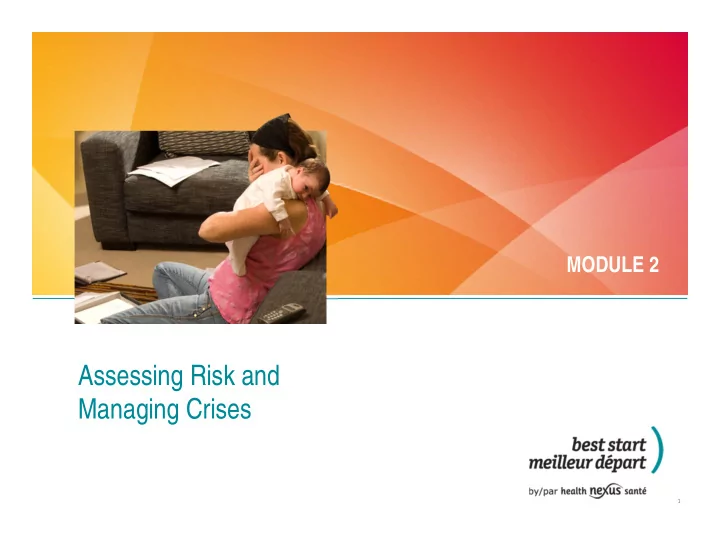
MODULE 2

slide-2
SLIDE 2

Module 2: Assessing Risk and Managing Crises

What is a Crisis?

  • Time of intense difficulty or danger
  • Exhaustion of individual’s:

–Coping skills –Self-esteem –Social support –Power

2

slide-3
SLIDE 3

Module 2: Assessing Risk and Managing Crises

Emotional Crisis

  • Frequently occurs in the context of mental illness
  • Can overwhelm the whole family
  • May include suicide or harm ideation

3

slide-4
SLIDE 4

Module 2: Assessing Risk and Managing Crises

Module Goals

  • Understanding the implications of a crisis on clients and their

families.

  • Assessing the client and if the client is at risk for harming self
  • r others.
  • Facilitating short-term help until additional assistance and

resources can be accessed.

4

slide-5
SLIDE 5

Module 2: Assessing Risk and Managing Crises

Module Content

  • Key Messages for Service Providers
  • Case Example
  • Assessing the Client
  • Intrusive Thoughts
  • Suicidal Ideation and/or Harm Ideation regarding Children
  • Responding to Clients
  • Creating a Plan for Their Safety and Care

5

slide-6
SLIDE 6

Module 2: Assessing Risk and Managing Crises

Key Messages for Service Providers

  • If the client is emotional and not in crisis

–Ask about stressors that affected the client’s emotions –Ask about additional risk factors for depression and anxiety –Use a validated screen to assess the symptoms

6

slide-7
SLIDE 7

Module 2: Assessing Risk and Managing Crises

If the Client Is in Crisis

  • Stay calm and get the client to talk
  • Assess if there is an immediate safety concern to the client or

the child(ren)

–Is there suicidal or infant harm ideation? –Is there a plan of action or high impulsivity?

  • Make a plan with the client that ensures:

–The client’s own safety –The children’s safety –How to address the cause of the crisis

  • Ensure there is adequate follow-up.
slide-8
SLIDE 8

Module 2: Assessing Risk and Managing Crises

Case Example

8

Lila is a single mother of a 6 week-old baby. She has been diagnosed with postpartum depression and has a history of general anxiety disorder but is not on any medications at present . When you arrive for a scheduled visit, Lila’s home is a mess. The baby is crying. Lila is crying, too. She tells you her monthly financial allowance has not arrived this week and she is almost out of

  • diapers. She cries harder and starts to hyperventilate. You try to calm

her down, but she is almost hysterical and tells you the baby would be better off without her.

slide-9
SLIDE 9

Module 2: Assessing Risk and Managing Crises

Assessing the Client

  • Risk factors for depression or anxiety
  • An existing mental illness
  • Signs of depression or anxiety
  • Signs of impulsive behaviour
  • Intrusive thoughts
  • Suicidal ideation and/or harm ideation regarding the children

9

slide-10
SLIDE 10

Module 2: Assessing Risk and Managing Crises

Consider Screening

  • The Edinburgh Postnatal Depression Scale (EPDS)
  • The 4-item Patient Health Questionnaire (PHQ-4)

10

slide-11
SLIDE 11

Module 2: Assessing Risk and Managing Crises

Intrusive Thoughts

  • Are negative and usually repetitive
  • Can come out of nowhere
  • Typically focus on health and safety concerns related to

baby/children, but can also center on thoughts about self, or the partner

  • Often appear in the form of thoughts or images, e.g., “What if I

drop my baby when I go down the steps?”, "I can picture myself driving off the road with my baby in the car.“

  • Can be indirect or passive (seeing the baby slip out of the

individual’s hands), or they can imply intention (thinking about throwing the baby on the floor)

11

slide-12
SLIDE 12

Module 2: Assessing Risk and Managing Crises

12

Intrusive Thoughts

  • Will make her/the individual feel like she/he is a bad parent; will

make her/him feel guilty and ashamed

  • May or may not be accompanied by compulsive behaviors (e.g.

excessive checking)

  • Can be a symptom of postpartum depression, obsessive-

compulsive disorder, or they may occur in the absence of a diagnosis.

slide-13
SLIDE 13

Module 2: Assessing Risk and Managing Crises

Suicidal Ideation and/or Harm Ideation regarding Children

Statements you may hear:

  • “I am going to kill myself.”
  • “I can’t take it any more.”
  • “My family would be better off without me.”
  • “I can see terrible things happening to my child.”
  • “I would save my child pain and suffering if he/she was not

alive or living with me."

13

slide-14
SLIDE 14

Module 2: Assessing Risk and Managing Crises

Suicidal Thoughts

Are often:

  • A plea for help
  • A desperate attempt to escape problems and distressing

feelings May be a sign of:

  • Mental illness

14

slide-15
SLIDE 15

Module 2: Assessing Risk and Managing Crises

Responding To Clients Who Are Expressing Thoughts of Suicide

  • Let the client know you care and want to help
  • Express empathy in a non-judgemental way
  • Engage the client in a conversation
  • Ask about suicide and a plan of action
  • Explore the risk
  • Let the client know that thoughts of suicide do not have to be

acted on

  • Engage the client in developing a plan for safety
slide-16
SLIDE 16

Module 2: Assessing Risk and Managing Crises

Examples of Helping and Empathic Statements

  • It sounds like you are feeling so badly that you do not

wish to be here or live anymore. I would like to help you. Would you tell me more about what you are feeling?

  • Having thoughts of self harm or suicide can be common

when someone is very stressed or receiving bad news. Your health is important to us and I would like to make sure that you feel safe. Would you tell me more about what thoughts you are having?

  • It sounds like you are frightened that you may act on your

scary thoughts about the baby. Can you tell me more about your thoughts and how they make you feel?

16

slide-17
SLIDE 17

Module 2: Assessing Risk and Managing Crises

Explore…

If the client responds yes to having (direct or indirect) thoughts

  • f self-harm or suicide, ask for more information:
  • Have you thought of doing it?
  • Have you decided how you would do it?
  • Have you decided when you would do it?
  • Have you taken any steps to get the things you would need to

carry out your plan?

  • Are you currently using alcohol or drugs (prescribed

medications or recreational drugs like pot)?

17

slide-18
SLIDE 18

Module 2: Assessing Risk and Managing Crises

Explore ….

If the client responds no to having thoughts of self-harm or suicide, ask:

  • Do you wish you were dead?
  • When you go to sleep, do you often wish you would not wake

up?

  • Are you doing anything that might result in your harming

yourself or dying (e.g., smoking more, binge drinking)

  • Are you not doing things that you would normally do to protect

yourself from harming yourself or dying (e.g., not wearing a seatbelt, having unprotected sex)

  • Have you harmed yourself now or in the past (e.g., cut, burned)

18

slide-19
SLIDE 19

Module 2: Assessing Risk and Managing Crises

Listen to the Reasons for Dying and Living

  • Ambivalence (mixed feelings) about suicide
  • First, reasons for dying, e.g., “Right now, you can’t keep living

because…”

  • Second, reasons for living, e.g., “What would you most look

forward to if the immediate pain and problems could be solved?” Or: “What stops you from harming yourself / taking your life at this time?”

19

slide-20
SLIDE 20

Module 2: Assessing Risk and Managing Crises

Explore for Infanticide Ideation

Have you had any negative thoughts or images about harming your baby/child:

  • If yes:

–Have you made any plans to harm your baby/child or are they just ideas? –Can you give me more details? –Do these thoughts disturb you?

Have you attempted to harm your baby/child or failed to protect him?

  • If yes:

–When did this happen? –Can you tell me more about it?

slide-21
SLIDE 21

Module 2: Assessing Risk and Managing Crises

Key Messages When Responding to Clients in Crisis

  • Stay calm and get the client to talk
  • Assess if there is an immediate safety concern to the client or

the child(ren)

–Is there suicidal or harm ideation? –Is there a plan of action or high impulsivity? –Are there other behaviours that my harm the client or the child?

  • Create a safety plan with the client
  • Call child protection services if there is a concern about the

child(ren)’s safety

21

slide-22
SLIDE 22

Module 2: Assessing Risk and Managing Crises

Creating a Plan for Safety and Care

Aims:

  • Keep the client and children safe
  • Establish a safety contact person who can stay with the client

if needed

  • Facilitate the client’s assessment by a healthcare provider
slide-23
SLIDE 23

Module 2: Assessing Risk and Managing Crises

Possible Contents of a Safety Plan

  • Contact a health care provider for further assessment
  • Keep themselves and their child(ren) safe – not act on their

thoughts until additional help and support is available.

  • Agree to not use alcohol or recreational drugs or to take no

more than the correct dosage of prescribed medications

23

slide-24
SLIDE 24

Module 2: Assessing Risk and Managing Crises

Key Messages for Creating a Safety Plan

  • Don’t leave the client alone while they are in crisis
  • Make a plan with the client that ensures:

–The client’s safety –The child(ren)’s safety

  • Ensure there is adequate follow-up
slide-25
SLIDE 25

Module 2: Assessing Risk and Managing Crises

Best Start: Ontario’s Maternal, Newborn and Early Child Development Resource Centre Health Nexus www.beststart.org and www.healthnexus.ca

This ready-to-use workshop has been prepared with funds provided by the Government of Ontario. The information herein reflects the views of the authors and is not officially endorsed by the Government of Ontario. The resources and programs cited throughout the workshop are not necessarily endorsed by the Best Start Resource Centre or the Government of Ontario. December 2012

25