
SLIDE 1
Assessing Wildlife Responses to Highway Wildlife Crossing Designs
TRB 2018 Learning from Natural Experiments: Evidence Based Decisions
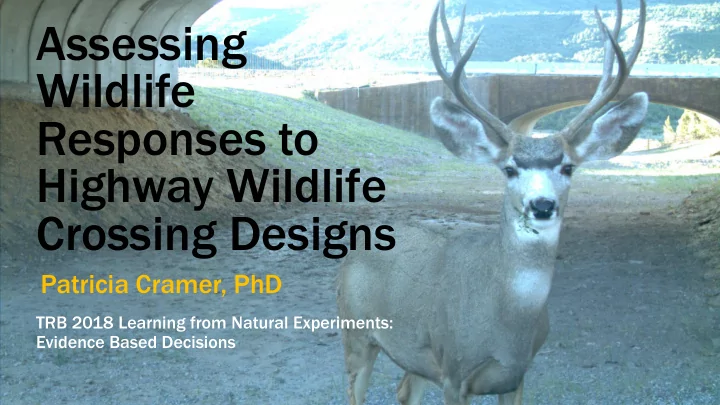
Assessing Wildlife Responses to Highway Wildlife Crossing Designs - - PowerPoint PPT Presentation
Assessing Wildlife Responses to Highway Wildlife Crossing Designs Patricia Cramer, PhD TRB 2018 Learning from Natural Experiments: Evidence Based Decisions Thank You to Research Sponsors Overview Wildlife, Roads, Vehicles Addressing
TRB 2018 Learning from Natural Experiments: Evidence Based Decisions
▪ Wildlife, Roads, Vehicles – Addressing Safety and Ecological
Issues
▪ What Was Learned About the Process of Researching Wildlife
Along Transportation Corridors
The Problem – Safety, Wildlife Deaths, and Habitat Fragmentation Why Research was Needed Study Design, Methods Findings – and the Value of Results New Approaches to Wildlife Movements and Roads Information and Lessons Learned
Motorists at Risk of Collision Animals Killed Habitat Fragmentation Animals Avoid Road Areas Ecological Effects – De-icing Salts, Air pollution, Sound Pollution
Wildlife Need to Leave Home – Especially Large Carnivores Map: Path of Connecticut Puma
2,897 kilometers
Puma - Connecticut
Thelma’s Amazing Journey over 30 km each way out and back
Slide courtesy of T. Edwards Photo credit: B. Borman
Desert Tortoise - Arizona
US 89
Slide Courtesy of Jeff Gagnon AZGFD
Transportation Planning Human Side Wildlife Side
Photographer Unknown Photo credit: J. Barichvich & L. Smith
Otter - Florida
White- Tailed Deer, Montana Mule Deer, Utah Desert Tortoise , Utah
Photo credit: A. McLuckie
Mule Deer on Overpass, Colorado
Wildlife Use of Structures Include Wildlife in Transportation Planning
Patricia Cramer Robert Hamlin
crossing sites;
including height, width, length, and material;
structures and landscape variables;
Methods hods
19 Structures, 2 Cameras Each Structure Right-of-way Cameras Pre-Construction Cameras WVC – Crash and Carcasses Success Rates Movement-per day Statistics ANOVA, Linear Regression, Mixed
Pre-Construction Monitoring
Original Bridges, Habitat, ROW on 93 and CR 370
Control Cameras
ROW on CR 370
Post-Construction Monitoring
19 Structures
Pre-construction ROW cameras recorded white-tailed deer With a 64 % success rate for moving over US 93 , repellency = 8% With a 63% success rate for moving over CR 370, repellency = 5% These values became the performance measures with which we evaluated the subsequent wildlife crossing structures.
Min inimum imum su succ ccess ess rat ate = 60% % Repellency pellency rat ate e 10% % or
less. ss.
Top 9 Most Successful Wildlife Crossing Structures based on white-tailed deer success rate
Wil ildl dlife e Crossi rossing Str tructur ure
Success ess Repel el- lency cy Pa Parallel el Tot
Move veme ment nts Success ess Rate (%) Rate e of Repel el- lency cy (%) Pa Parallel el Rate e (%) Dawns Crossing Bridge 5204 65 94 5363 97 1 2 Bass Creek Fishing Access Culvert 3257 118 21 3396 96 3 1 Bear Creek South Bridge 2554 30 113 2697 95 1 4 Sweathouse Creek Bridge 2419 61 102 2582 94 2 4 Blodgett Creek Bridge 1037 25 36 1098 94 3 3 Kootenai Creek Bridge 2470 150 97 2717 91 5 4 Big Creek Bridge 2769 237 317 3323 83 7 10 McCalla Creek North Bridge 2058 142 265 2465 83 6 11 Mill Creek Bridge 1036 117 283 1436 72 8 20
Study Found: Bridges and Large Culverts work best for White-tailed Deer Dimensions: Width most important
Usage Rates Success Rate Rate of Repellency Parallel Rate Success per Camera day Explanatory Variables Structure Type Structure Height Structure Width Structure Length Structure Openness Fence, Guardrail, Humans, Grass, Forbs, Shrubs, Trees, Bare Ground, Water, Fecal Pellets
Generalized Linear Models were Used to Analyze Relationships
for rates related to structure types
variables
explanatory variables
Chapter 3 Statistical Test Results Green Boxes Show Strong Evidence of Relationship Light Green Boxes Show Uncertain Evidence
As Openness Increases, Success Rate Increases
10 20 30 40 50
width
0.00 0.25 0.50 0.75 1.00 1.25
success rate
bridge culvert
type
MDT: Success rate
versus Width
The Wider the Structure, the Greater Success Rate
White-Tailed Deer Success Rate Compared with Length of Structure
30 40 50 60
length
0.0 0.2 0.4 0.6 0.8 1.0
success rate
culvert bridge
type
MDT: Success rate
versus Length
The Longer the Structure, the Lower The Success Rate
fishing
bridge culvert
type
0.0 0.2 0.4 0.6 0.8 1.0
success rate
success rate success rate
MDT: Success rate
versus Type
P-value-0.005 Extremely strong relationship that bridges have higher success rates than culverts, except for Largest Culvert -
Bridg idges es Work
ed Better er Than an Culv lver erts s for
ite-Tailed ailed Deer er
Wildlife crossing structures should be designed with high
bridges than with culverts. Length should be minimized Width (span) should be maximized and Height should be maximized
These ese st studies udies help lp design sign the mo most st co cost st effectiv ective e st structure ructures
The Study helped establish
recommendations
monitoring
Montana Oregon Utah Colorado Consistent strong scientific methods allow comparisons and application across states
Recommendations
Locations Allows Comparisons for National Standards
Wildlife Crossings and Mitigation for Multiple Species and Make Roads Safer for Motorists
Never doubt that a small group of thoughtful committed individuals can change the world. Indeed that is the only thing that ever has. Margaret Mead