Assessing Our Revised General Education Program Dr. Clifton - - PDF document

assessing our revised general education program
SMART_READER_LITE
LIVE PREVIEW

Assessing Our Revised General Education Program Dr. Clifton - - PDF document

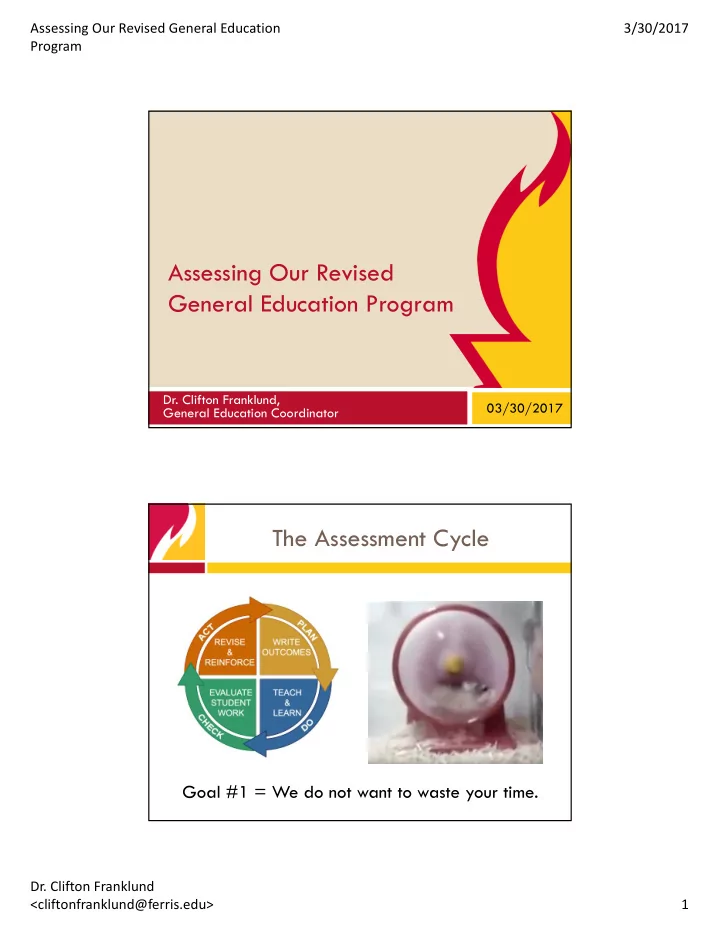
Assessing Our Revised General Education 3/30/2017 Program Assessing Our Revised General Education Program Dr. Clifton Franklund, 03/30/2017 General Education Coordinator The Assessment Cycle Goal #1 = We do not want to waste your time. Dr.


slide-1
SLIDE 1

Assessing Our Revised General Education Program 3/30/2017

  • Dr. Clifton Franklund

<cliftonfranklund@ferris.edu> 1

Assessing Our Revised General Education Program

  • Dr. Clifton Franklund,

General Education Coordinator 03/30/2017

The Assessment Cycle

Goal #1 = We do not want to waste your time.

slide-2
SLIDE 2

Assessing Our Revised General Education Program 3/30/2017

  • Dr. Clifton Franklund

<cliftonfranklund@ferris.edu> 2

What is Assessment Really About?

Assessment is the systematic basis for making inferences about the learning and development of

  • students. It is the process of defining, selecting,

designing, collecting, analyzing, interpreting, and using information to increase students’ learning and

  • development. Erwin 1991

Assessment is the systematic collection, review, and use

  • f information about educational programs undertaken

for the purpose of improving student learning and

  • development. Palomba and Banta 1999

Assessment involves the use of empirical data on student learning to refine programs and improve student learning. Allen 2004

The Key to Sustainable Assessment

slide-3
SLIDE 3

Assessing Our Revised General Education Program 3/30/2017

  • Dr. Clifton Franklund

<cliftonfranklund@ferris.edu> 3

Garbage In à Garbage Out

Course-level data must be uniform and open to validation

The Plan

Gather course-level assessment data for all General Education classes Simplify, standardize, and automate documentation Use TracDat as a permanent and secure repository for all raw data De-identify, aggregate, analyze, and report findings publicly Evaluate, discuss, and use the data to improve the program

slide-4
SLIDE 4

Assessing Our Revised General Education Program 3/30/2017

  • Dr. Clifton Franklund

<cliftonfranklund@ferris.edu> 4

Standardize Learning Outcomes

CUL1: Interpretation – Students will be able to demonstrate an increased ability to interpret cultural works and practices, including but not limited to art, music, literature, language, history, philosophy and religion, as part of a broader culture and justify those interpretations with an understanding of the interpretive process. CUL2: Self-Awareness – Students will be able to articulate an understanding of themselves as part of culture(s) with rich historical perspectives and gain increased self-understanding through works of culture(s). CUL3: Analysis – Students will be able to develop justify and improve value distinctions (including aesthetic and ethical) in perception, craft and/or life choices. CUL4 Process-Awareness, Participation – Students will be able to explain the processes contexts and motivations behind the production of cultural works and practices, and when appropriate be able to participate in their creation.

Standardized Measures

Fourteen different types of assignments Exams Products Performances Pre-determined definitions Scoring Analysis Criteria of ”success”

slide-5
SLIDE 5

Assessing Our Revised General Education Program 3/30/2017

  • Dr. Clifton Franklund

<cliftonfranklund@ferris.edu> 5

Standard Pedagogies

Twelve defined pedagogies are defined Includes many “high-impact” practices Not meant to imply the superiority of any method Will track use over programs and time

Standardized Data Collection

36 Excel workbooks are available 4 for each competency 4 for training purposes SCORE – for exams PREPOST – for pre-test/post-test NORM – for standardized exams RUBRIC – for products and performances

slide-6
SLIDE 6

Assessing Our Revised General Education Program 3/30/2017

  • Dr. Clifton Franklund

<cliftonfranklund@ferris.edu> 6

TracDat Assignments

Assignments for data reporting are emailed Copy and paste the workbook summary Complete a few other fields Attach the workbook and submit The entire process can be done in one cup of coffee

Standardized Analysis

All analyses and reports will be reproducible All datasets will be “FERPAnated” All de-identified datasets, analyses, and reports will be under version control and publicly available We will be using the Open Science Framework https://osf.io/bax9i/

slide-7
SLIDE 7

Assessing Our Revised General Education Program 3/30/2017

  • Dr. Clifton Franklund

<cliftonfranklund@ferris.edu> 7

Standardized Reporting

General Education assessment reports will be formatted as journal articles

Multiple Integrated Opportunities for Faculty Evaluation and Input

Assessment IS when the faculty evaluate, critique, discuss, and act upon the reported data Reports will be made publicly for feedback Disqus is embedded in the HTML reports Comments are implemented in OSF Pull requests can be made using GitHub

slide-8
SLIDE 8

Assessing Our Revised General Education Program 3/30/2017

  • Dr. Clifton Franklund

<cliftonfranklund@ferris.edu> 8

The End Result

TracDat will be populated with a large number of standardized reports Meta-analysis of this dataset will be used to answer a variety of questions All faculty will have access to the data, analysis code, and reports A feedback cycle is built into data reporting to allow contextualization of results.

Program Assessment

This process could be adapted to other academic programs Workbooks would need to be modified One point person to send out assignments Advantage = easy and standardized Disadvantage = must agree to be standardized

slide-9
SLIDE 9

Assessing Our Revised General Education Program 3/30/2017

  • Dr. Clifton Franklund

<cliftonfranklund@ferris.edu> 9

Accessing TracDat Now

You should all have access If not – contact me and I’ll help get that sorted General Education Your program

Questions or Comments?