Asbestos Waste Just How Big? Approx. 200 million tonnes produced - - PowerPoint PPT Presentation

asbestos waste just how big
SMART_READER_LITE
LIVE PREVIEW

Asbestos Waste Just How Big? Approx. 200 million tonnes produced - - PowerPoint PPT Presentation

Asbestos Waste Just How Big? Approx. 200 million tonnes produced since 1900* Total contaminated waste = 4 billion tonnes (based on 5% asbestos) In 2011, NZ sent 2.5 million tonnes of waste to landfill At current NZ rates 1625 years of


slide-1
SLIDE 1

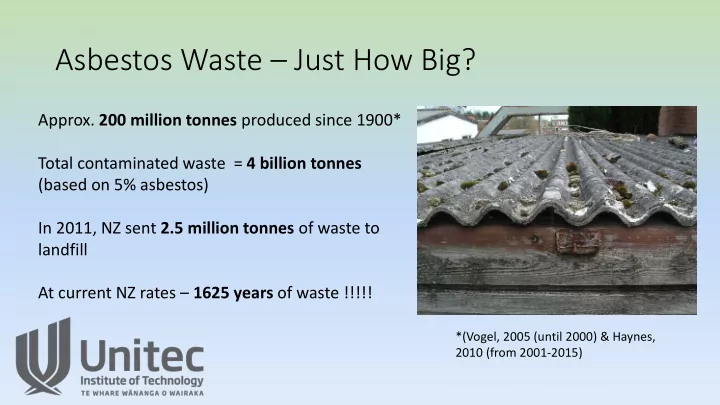
Asbestos Waste – Just How Big?

  • Approx. 200 million tonnes produced since 1900*

Total contaminated waste = 4 billion tonnes (based on 5% asbestos) In 2011, NZ sent 2.5 million tonnes of waste to landfill At current NZ rates – 1625 years of waste !!!!!

*(Vogel, 2005 (until 2000) & Haynes, 2010 (from 2001-2015)

slide-2
SLIDE 2
slide-3
SLIDE 3
slide-4
SLIDE 4
slide-5
SLIDE 5

Cook Islands

slide-6
SLIDE 6

Asbestos Remediation in the Cook Islands

A long-term solution for making schools safe

Dr Terri-Ann Berry

slide-7
SLIDE 7

Purpose

To challenge the current choices of long-term disposal options for asbestos contaminated materials (ACM)

slide-8
SLIDE 8

Key Points

  • 1. The global use of asbestos
  • 2. The current situation with asbestos use and disposal in the Cook

Islands

  • 3. The long term disposal options for ACMs
slide-9
SLIDE 9

Why Use Asbestos?

  • Fibrous silicate-based minerals – serpentine & amphibole (LaDou et al. 2010)
  • ACBM - Strong, heat and fire resistant, electrical insulators (Godish, 1989)
slide-10
SLIDE 10

Health Issues from Asbestos

Dangerous microscopic fibres

  • Asbestosis
  • Lung cancer
  • Mesothelioma
  • Long latency period (up to 50 years)

(Haynes, 2010)

slide-11
SLIDE 11

International Ban Asbestos Secretariat

55 countries have banned all forms of asbestos (out of 196)

Algeria Czech Republic* Iceland Malta* Serbia Argentina Denmark Ireland Mozambique Seychelles3 Australia Egypt Israel Netherlands Slovakia* Austria Estonia Italy New Caledonia Slovenia Bahrain Finland Japan Norway South Africa Belgium France Jordan2 Oman Spain Brunei Gabon Korea (South) Poland Sweden Bulgaria Germany Kuwait Portugal* Switzerland Chile Greece* Latvia Qatar Turkey Croatia Honduras Lithuania* Romania United Kingdom Cyprus* Hungary* Luxembourg Saudi Arabia Uruguay

National Asbestos Bans,

Kazan-Allen, 2014.

slide-12
SLIDE 12

Global Use of Asbestos

Data adapted from Vogel. 2005. Note: 1975 consumption for USA based on 1980 data.

Increasing use in developing countries

(Dooley, 2012)

slide-13
SLIDE 13

The Cook Islands

  • 15 islands spread over 2 000 000km2
  • Rarotonga is the largest with 15 000 permanent residents
slide-14
SLIDE 14

Asbestos Use in the Cook Islands

SPREP survey estimated that 3% of the houses plus a significant number of public buildings (inc. schools) contained ACM (SPREP, 2015) = 89 houses

slide-15
SLIDE 15

Asbestos Use in Schools

Avatea and Nikao Maori schools selected for reconstruction but contaminated materials and soil found on site. Find solutions for removal and disposal (currently no legislation or policy) to protect health as children most vulnerable (Cooney & Conway,

2013)

slide-16
SLIDE 16

School Priority

Priority given to removal from schools but ACM still entering country and other buildings affected

Rarotonga Nikao Maori School Avatea School

slide-17
SLIDE 17

Disposal Solutions

International Landfill Local Landfill Sea Disposal Geotextile Cladding Sealing, enclosing or encapsulation Asbestos contaminated soil

Four Main Options

(Tomasicchio et al. 2010)

slide-18
SLIDE 18

Enclosing, Sealing or Encapsulation

Advantages Disadvantages Very little disturbance to the area Requires careful labelling Least potential to cause harm to human health Public opposition Successful model observed (Tomasicchio, 2010) Additional long-term hazardous waste High level of skill, knowledge and expertise required Expensive (capping of soil) Requires on-going maintenance

Enclosing – erection of airtight barrier Sealing/encapsulation – protective surface coating or internal solidification

slide-19
SLIDE 19

Sea Disposal

Advantages Disadvantages Reduces human health risk Establishing suitable area within EEZ No on-going maintenance Dependent on permit Reduces pressure on landfill Questionable permanency

  • f location

Long-term storage solution Public opposition

Cook Islands EEZ covers 1 800 000 km2

slide-20
SLIDE 20

Miss Mataroa

“If It’s Not Japanese Whale Hunters, It’s Asbestos”

Posted on Monday, January 14th, 2013 at 4:35 am.Written by asbestosnet Cited From: If It's Not Japanese Whale Hunters, It's Asbestos - Asbestos.net http://www.asbestos.net/news/if-its-not-japanese-whale-hunters-its- asbestos/#ixzz3fipa0Qg9

slide-21
SLIDE 21

Landfill

Advantages Disadvantages Removes future risk to human health Current landfill close to capacity No on-going maintenance required No current specialist hazardous waste disposal Requires strict removal procedure to protect human health Labour intensive

http://www.cookislandsnews.com/item/ 30315-separating-rubbish-is-only-a- start/30315-separating-rubbish-is-only- a-start

slide-22
SLIDE 22

International Landfill

Advantages Disadvantages Reduces human health risk Requires strict removal procedure to protect human health No on-going maintenance Labour intensive Provides longer-term disposal solution High cost for transportation Specialise hazardous waste disposal Potential quarantine issues Overall reduction in number of disposal sites Temp storage required prior to shipping Reliance on external parties

slide-23
SLIDE 23

Cost

Rank 2

Public Health

Rank 1

Sustainability

Rank 5

Public Opinion

Rank 3

Longevity

Rank 4

Which Factors Affect Decision?

slide-24
SLIDE 24

Cost Sustainability Public Opinion Public Health Longevity

  • 1. Capping
  • 2. Landfill
  • 3. Sea disposal
  • 4. International
  • 1. International
  • 2. Landfill
  • 3. Sea disposal
  • 4. Capping
  • 1. Sea disposal
  • 2. International
  • 3. Landfill
  • 4. Capping
  • 1. Sea disposal
  • 2. International
  • 3. Landfill
  • 4. Capping
  • 1. International
  • 2. Landfill
  • 3. Sea disposal
  • 4. Capping

Rank 1 Rank 3 Rank 2 Rank 4 Rank 5

Which Option?

slide-25
SLIDE 25

Best Option?

Option Public Health (5) Cost (4) Public Opinion (3) Longevity (2) Sustainability (1) Total Capping 20 4 12 8 4 48 Landfill 15 8 6 4 3 36 International 10 16 3 2 2 33 Sea disposal 5 12 9 6 1 33

Where the lowest number suggests the best option

Where value = rank x order of preference (according to each factor affecting decision)

slide-26
SLIDE 26

Conclusions

  • Enclosing, sealing or encapsulation may provide a good short term

solution

  • Removal and storage for later disposal recommended (at a cost of
  • approx. $340 000)
slide-27
SLIDE 27
slide-28
SLIDE 28
slide-29
SLIDE 29
slide-30
SLIDE 30

References

  • Abrams, F., (2015). Schools are facing an asbestos timebomb. Retrieved from

http://www.theguardian.com/education/2015/may/19/school-asbestos-buildings-unable-get-rid.

  • Basel Convention (1992) Retrieved from http://www.basel.int/Portals/4/Basel%20Convention/docs/text/BaselConventionText-

e.pdf

  • Connell, D.W. (2005). Basic concepts of environmental chemistry. 2nd Edition. Taylor & Francis Group, LLC, USA.
  • Cooney & Conway, (2013). The danger of asbestos in schools. PR Newswire, 22 Jan 2013, Academic OneFile.
  • Dooley, E.E. (2012). More scientists call for an end to asbestos. Environmental Health Perspectives, 120 (9), a348-a349
  • Godish, D. (1989). Asbestos exposure in schools. Journal of School Health, 59 (8), p362.
  • Haynes, R.C. (2010). A worn-out welcome: renewed call for a global ban on asbestos. Environmental Health Perspectives, 118 (7),

a298.

  • Haynes, D. (2011). An asbestos free pacific: a regional strategy and action plan. Apia, Samoa: Secretariat of the Pacific Regional

Environment Programme. Retrieved from http://www.sprep.org/2011sm22/pdfs/eng/Officials/WP_8_2_8_Att_1_Draft%20Asbestos%20Strategy.pdf.

  • International Ban Asbestos Secretariat (2014). Retrieved from http://ibasecretariat.org/alpha_ban_list.php.
  • LaDou, J., Castleman, B., Frank, A., Gochfield, M., Greenberg, M., Huff, J., Kant Joshi, T., Landrigan, P.J., Lemen, R., Myers, J.,

Soffritti, M., Soskolne, C.L., Takahashi, K., Teitelbaum, D., Terracini, B and Watterson, A. (2010). The case for a global ban on

  • asbestos. Environmental Health Perspectives, 118 (7), 897-901.
slide-31
SLIDE 31

References (cont.)

  • Noumea Convention, (1986). Retrieved from https://www.sprep.org/legal/noumea-convention.
  • Pacific Guardians.org. (2014). Niue To Ship 20 Containers Of Asbestos To Nz For Disposal. Retrieved from

http://pacificguardians.org/blog/2014/04/25/niue-to-ship-20-containers-of-asbestos-to-nzfor-disposaI/.htmI.

  • SPREP. (2011). An asbestos-free Pacific: a regional strategy and action plan. Apia Samoa: Secretariat of the Pacific Regional

Environment Programme.

  • SPREP (2015). Survey of the regional distribution and status of asbestos contaminated construction material and best practice
  • ptions for its management in Pacific Island countries.
  • Tomasicchio, G. R., D'Alessandro, F., & Musci, F. (2010). A multi-layer capping of a coastal area contaminated with materials

dangerous to health. Chemistry and Ecology, 26(S1), 155-168.

  • UK Landfill Directive (2010). Draft guidance on – pb13563-landfill-directive-100322.pdf. (n.d) Retrieved from

https://www.gov.uk/government/uploads/system/uploads/attachement_data/file/69347/pb13563-landfill-directive-100322.pdf.

  • Vogel, L. (2005). Asbestos in the world, HESA Newsletter, June 2005, 27, 7-21. Retrieved from

https://www.etui.org/.../file/Special+report+Asbestos+in+the+world.pdf

  • Waigani Convention (2001). Retrieved from http://www.sprep.org/legal/waigani-convention.
  • Worksafe. (2013). Methods of demolition. From http://www.business.govt.nz/worksafe/informationguidance/all-guidance-

items/best-practice-guidelines-for-demolition-in-new-zealand/methods-of-demolition

  • Worksafe (n.d) Disposal of asbestos waste (information sheet. Retrieved June 17, 2015, from

http://www.business.govt.nz/worksafe/informatino-guidance/all-guidance-items/asbestos-factsheets/disposal-of-asbestos-waste