Articulating Impact in Your You might like to think about importance - - PowerPoint PPT Presentation

articulating impact in your
SMART_READER_LITE
LIVE PREVIEW

Articulating Impact in Your You might like to think about importance - - PowerPoint PPT Presentation

5/10/2014 Why are OLT grants important? Share with the person next to you one reason that OLT grants are important Articulating Impact in Your You might like to think about importance to one of the following: The higher education


slide-1
SLIDE 1

5/10/2014 1

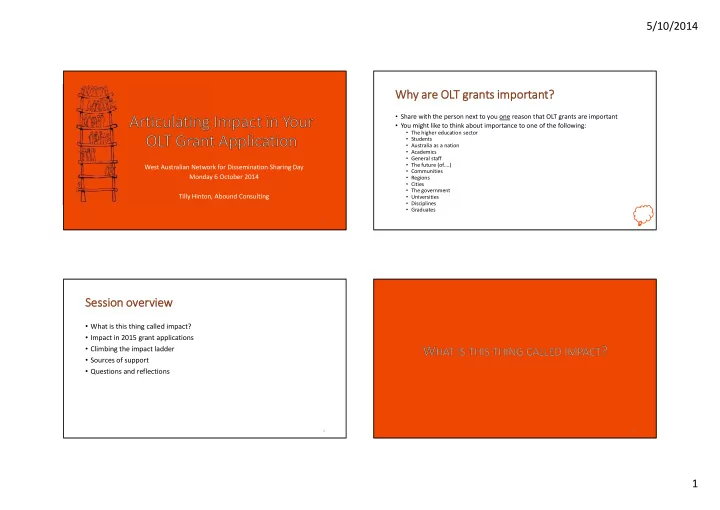
Articulating Impact in Your OLT Grant Application

West Australian Network for Dissemination Sharing Day Monday 6 October 2014 Tilly Hinton, Abound Consulting

1

Why are OLT grants important?

Ⅻ Share with the person next to you one reason that OLT grants are important Ⅻ You might like to think about importance to one of the following:

Ⅻ The higher education sector Ⅻ Students Ⅻ Australia as a nation Ⅻ Academics Ⅻ General staff Ⅻ The future (of.) Ⅻ Communities Ⅻ Regions Ⅻ Cities Ⅻ The government Ⅻ Universities Ⅻ Disciplines Ⅻ Graduates

Session overview

Ⅻ What is this thing called impact? Ⅻ Impact in 2015 grant applications Ⅻ Climbing the impact ladder Ⅻ Sources of support Ⅻ Questions and reflections

3

WHAT IS THIS THING CALLED IMPACT?

4

slide-2
SLIDE 2

5/10/2014 2

Impact = the difference that a project makes in its sphere of influence, both during and after the funding period

5

Definitions*

Ⅻ Deliverable/output = a product or resource Ⅻ Dissemination = the planned process of understanding potential adopters and engaging with them throughout the life of the project, to facilitate commitment to sustained change Ⅻ Outcome = a change or benefit that the project is designed to bring about, preferably described in a form that is measurable or for which evidence can be provided Ⅻ Transfer = the processes undertaken to maintain momentum and impact beyond the funded life of the project and beyond the project team

* (see full definitions in Innovation and Development Grant Application Instructions p.46)

6

Whats the difference between impact and

  • utcomes?

Ⅻ Changes and benefits during the project = outcome Ⅻ All changes and benefits, during and after = impact

7

Impact some recent history

2002 DEST report concludes that more could be done to ensure the investment in past grants programmes produces benefits for the quality of teaching and learning across the sector 2004 In a report for the AUTC, Hicks concludes It is currently difficult to pass judgment about the outcomes of these projects with respect to the impact. How much dissemination is enough? Over what period? With what impact? 2005 McKenzie and Southwell reports both concur that for the Carrick Institute/ALTC dissemination should be viewed as something greater than merely spreading the word about a project 2011 D-Cubed project finds a range of ways that projects had disseminated their projects; finds gaps in terms of reportable changes and benefits 2011 Alison Johns emphasises the need for enhancing an expectation of impact in all programs and ensuring value for money 2012 Inaugural secondment focusses on research impact (the Influence Factor Project) 2013 Secondment concludes that expectations of impact need to be embedded into routine OLT work, made an explicit expectation for applicants and projects 2014 Application instructions extensively address impact expectations

8

slide-3
SLIDE 3

5/10/2014 3

Impact for the OLT

Impact is now a major theme in application instructions for Innovation and Development Grants and Fellowships. In the context of grants: All Innovation and Development Grants are required to project and plan for positive and substantial impact (changes and benefits) for students, staff, institutions and the higher education sector, as appropriate to the scale and scope of the project. (Innovation and Development Grant Application Instructions, p. 12)

9

IMPACT IN 2015 INNOVATION AND DEVELOPMENT GRANT APPLICATIONS

10

Quick references for new applications*

Ⅻ The grant is provided for the purpose of achieving the deliverables, outcomes and impact of the project for which it is approved (p. 42) Ⅻ Incorporate an Impact Plan and strong dissemination strategy (p. 12 and Appendix 6) Ⅻ Two assessment criteria Project Approach and Project Evaluation explicitly address impact (pp. 12 and 13) Ⅻ The aim expressed in the online form focusses on impact (p. 22) Ⅻ Evaluation needs to contribute to establishing the impact of the project, and its value to other higher education institutions (p. 13) Ⅻ The reference group needs to give constructive advice on conduct and direction of the project, and to ensure the project has maximum impact (p. 40) Ⅻ Letters of support need to reference impact (p. 35) Ⅻ Key element in progress and final reports (p. 38) Ⅻ Remember: Your plan is an indication, not a promise. (see Appendix 6)

* Page numbers refer to the Innovation and Development Grant Application Instructions for 2015

11

Application components (p. 28)

EOI Full Proposal Online form Yes Yes Application Maximum five pages Maximum 20 pages, and responding to all criteria as per section 4 Project Impact plan n/a, description of impact instead Yes, within the 20-page limit Budget and budget justification n/a Yes, within the 20-page limit, and using the budget template (refer Appendix 8) Timeline n/a, indication of expected timeframe Yes, within the 20-page limit Brief bios and experience of team members including involvement in OLT/ALTC projects n/a Yes, maximum one page per team member as appendix to the application Design specs, if relevant n/a If relevant, maximum one page, as appendix to the application Letter of support from DVC (A)

  • r equivalent at lead and partner

institutions n/a Maximum two pages per letter, as appendices included in application
slide-4
SLIDE 4

5/10/2014 4

Appendix Six Questions

  • 1. What indicators exist that there is a climate of readiness for change in

relation to your intended project?

  • 2. Completion of the matrix
  • 3. What are your strategies for engaging with stakeholders throughout the

project?

  • 4. How will you enable transfer, that is ensuring that your project remains

impactful after the funding period?

  • 5. What barriers may exist to achieving change in your project?
  • 6. How will you keep track of the projects impact? What analytics may be

useful?

  • 7. How will you maintain relevant project materials for others to access

after the project is completed?

13

Appendix Six Matrix

Anticipated changes at: NB: these are approximations & text is not expected in every cell Project completion Six months post-completion Twelve months post- completion Twenty-four months post- completion 1 2 3 4 5 6 7

14

Elements of the Plan

Ⅻ Impact Plan = matrix + responses to the questions in Appendix 6 Ⅻ Responses can be in any sequence, so long as there are clear headings Ⅻ The plan is incorporated into your application Ⅻ The matrix doesnt need every box filled in, and remember what you write is likely to change throughout the project life Ⅻ Think about mechanisms to achieve the anticipated impacts these should appear throughout your application

15

CLIMBING THE IMPACT LADDER

16

slide-5
SLIDE 5

5/10/2014 5

Your project

Identify a small/narrow impact your project could create. Identify a large/broad impact your project could create.

17

Snapshot findings from a sample of completed ALTC/OLT projects

Prevalent: Ⅻ Impacts for the project team members themselves (IMPEL Rung 1) Ⅻ Distributing information about projects (IMPEL Rung 3) Elusive: Ⅻ Instances or evidence of changes in academic practice (IMPEL Rungs 4 7): [the project] probably [has had] a large but invisible influence Ⅻ Student impacts (IMPEL Rungs 2 and 4-7): it's almost impossible to say. I'd like to say it [] had an effect but it's a drop in the pond of many things having an effect Timing: Ⅻ Changes usually take considerable time to emerge

18

Scope of the IMPEL model

Ⅻ Model incorporates research findings, stakeholder perceptions and funding body culture/imperatives Ⅻ Understanding of impacts was built primarily from self-reporting by project leaders, who didnt anticipate this in advance Ⅻ Model concerned with funded learning and teaching development programs, specifically for the Australian Government

19 20

slide-6
SLIDE 6

5/10/2014 6

How the model works

Ⅻ Moves from narrow impact (ie. on ones own practice or profile) to broad impact (ie. on all relevant staff and students) Ⅻ Not all projects will anticipate nor achieve impacts at every IMPEL rung Ⅻ Anticipated impacts are mapped against rungs of the IMPEL model, and the timing point/s they are expected to occur (completion, 6, 12 and 24 months)

21

The changes the project brings about for members of the project team. For example: Ⅻ Recognition of project participants contributions to learning and teaching through promotion and awards

22

The changes for students that project team members make directly (in teaching/support/etc). For example: Ⅻ Project team members students report benefits of being more networked through an online tool Ⅻ Changes to curriculum by project team members equip students to feel more work-ready

23

The lasting contributions to knowledge that the project makes, which may lead to serendipitous adoption or adaptation beyond the projects intended reach. For example: Ⅻ Special issues of journals that further explore themes of the grant Ⅻ Publications from a grant cited fifty-eight times in other publications Ⅻ An updated online resource to support robust curriculum planning for teaching of Australian literature Ⅻ Materials used to promote teaching quality to international prospective students and partner universities Ⅻ Cascading influence through engagement with the early childhood sector and relevant government departments Ⅻ Receipt of national and international awards recognising

  • utstanding practice along with sustained high rates of

downloads, views and linking

24

slide-7
SLIDE 7

5/10/2014 7

Changes for students that happen because opportunistic adopters within participating institutions adopt or adapt ideas from the project. For example: Ⅻ Education students supported to develop resilience, a factor in retaining staff in the teaching profession

25

Changes for students that happen because of systemic adoption or adaptation of project ideas at one or more participating institutions. For example: Ⅻ Online graduate attributes system deeply embedded across an entire school Ⅻ Almost three quarters of a million dollars of industry and philanthropic funds secured for the lead institution to further the work started by the grant Ⅻ University-wide academic leadership program with

  • ngoing funded based on the success of the grant

project

26

Changes that happen because opportunistic adopters beyond participating institutions adopt or adapt ideas, leading to changes for their students. For example: Ⅻ Professional development delivered to an estimated 20%

  • f science academics in Australia

Ⅻ An estimated 2,500 students benefited from active learning materials in undergraduate science programs

27

Changes for students that happen because of systemic adoption or adaptation of project ideas at a broad level, beyond the participating institutions. For example: Ⅻ Report cited as key evidence for a wage increase across the profession Ⅻ Changes to professional accreditation requirements ensuring students are better equipped for study and employment

28

slide-8
SLIDE 8

5/10/2014 8

29

Ⅻ teams academic knowledge Ⅻ educational practice Ⅻ legitimacy and profile Ⅻ career progression Ⅻ research and project management expertise Ⅻ curriculum Ⅻ resources Ⅻ support Ⅻ classroom activities Ⅻ learning environment Ⅻ publications Ⅻ citations by

  • thers

  • nline

materials Ⅻ repositories Ⅻ individual academics or teaching teams Ⅻ Individual professional staff

  • r teams

Ⅻ people shifting their thinking and therefore their practice Ⅻ peak body change Ⅻ policy change Ⅻ management change Ⅻ budget, funding, workload allocations Ⅻ incentive schemes Ⅻ accreditation requirements Ⅻ wide-scale change

Prompts for the seven IMPEL rungs

SOURCES OF SUPPORT

30

Ⅻ Web page - www.olt.gov.au/impact Ⅻ Application instructions - http://www.olt.gov.au/grants-and- projects/innovation-and-development Ⅻ Your Institutional Contact Officer Ⅻ The OLT Ⅻ Within your project team Ⅻ Your prospective external evaluator Ⅻ Your prospective Reference Group members Ⅻ D-Cubed Materials - http://www.olt.gov.au/dissemination

31

Your closing reflections

Ⅻ Identify something youll incorporate into your application writing process about impact

and questions

32

slide-9
SLIDE 9

5/10/2014 9

Tilly Hinton https://independent.academia.edu/HintonTilly tilly@aboundconsulting.com.au

33