Arsenic Geology 20th in Abundance in Earths Crust Typically - - PDF document

arsenic geology
SMART_READER_LITE
LIVE PREVIEW

Arsenic Geology 20th in Abundance in Earths Crust Typically - - PDF document

CEE 680 Lecture #53 5/2/2019 Print version Updated: 2 May 2019 Lecture #53 Redox Chemistry: Arsenic II, Geochemistry (Stumm & Morgan, Chapt.8 ) Benjamin; Chapter 9 David Reckhow CEE 680 #53 1 Arsenic Geology 20th in Abundance in


slide-1
SLIDE 1

CEE 680 Lecture #53 5/2/2019 1

Lecture #53 Redox Chemistry: Arsenic II, Geochemistry

(Stumm & Morgan, Chapt.8 )

Benjamin; Chapter 9

David Reckhow CEE 680 #53 1

Updated: 2 May 2019

Print version

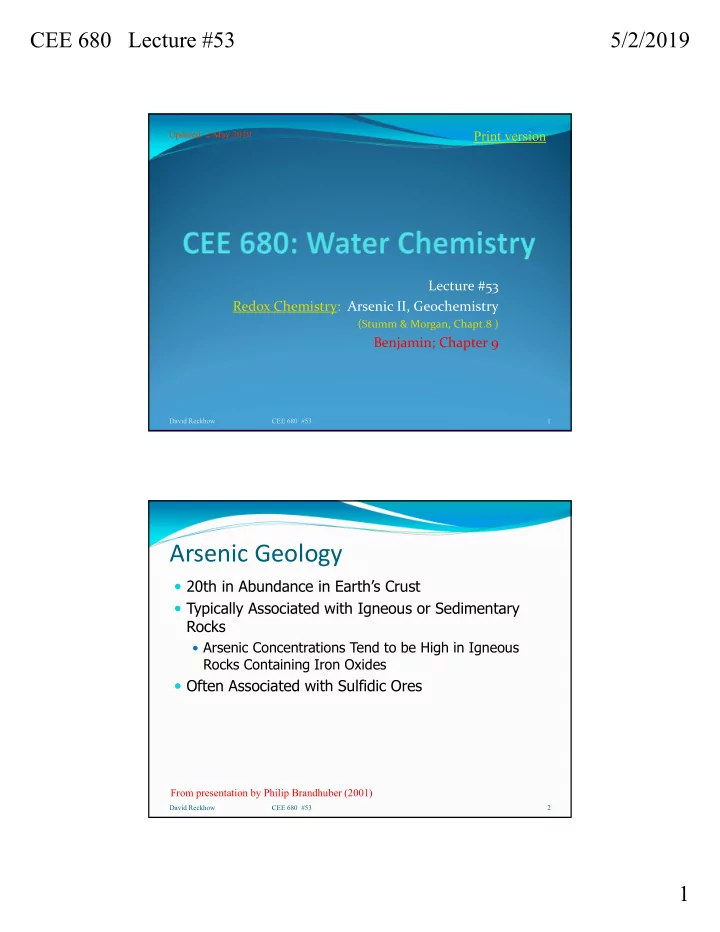
Arsenic Geology

 20th in Abundance in Earth’s Crust  Typically Associated with Igneous or Sedimentary

Rocks

 Arsenic Concentrations Tend to be High in Igneous

Rocks Containing Iron Oxides  Often Associated with Sulfidic Ores

David Reckhow CEE 680 #53 2

From presentation by Philip Brandhuber (2001)

slide-2
SLIDE 2

CEE 680 Lecture #53 5/2/2019 2

Geology (cont.)

 Approximately 245 Arsenic Bearing Minerals have

been Identified

 Some Common Arsenic Bearing Minerals

 Realgar (AsS)  Orpinent (As2O3)  Arsenopyrite (FeAsS)  Scorodite (FeAsO4

. H2O)

David Reckhow CEE 680 #53 3

From presentation by Philip Brandhuber (2001)

National Distribution of Arsenic in Groundwater

David Reckhow CEE 680 #53 4

Welsh et al. 2000

From presentation by Philip Brandhuber (2001)

slide-3
SLIDE 3

CEE 680 Lecture #53 5/2/2019 3

Arsenic Mobility

 Theoretically As(III) tends to be more Mobile

than As(V)

 As(V) will Strongly Sorb to Iron Oxides  To a lesser Extent, As(V) will Sorb to Manganese

Oxides

 However, As(VI) Associated with Iron Oxides

may be Transported (Colloidal As)

 Changes in Redox Conditions may Mobilize

Arsenic

David Reckhow CEE 680 #53 5

From presentation by Philip Brandhuber (2001)

Arsenic Size Distribution

David Reckhow CEE 680 #53 6

20 40 60 80 100 G1 G2 G3 G4 G5 G6 G7 G8 Ground Water % of Total As

20 40 60 80 100 S1 S2 S3 S4 S5 S6 S7 S8 Surface Water % of Total As Size < 3K Dalton 0.45u > Size > 3K Dalton Size > 0.45u

Reference: Brandhuber and Amy 1998

From presentation by Philip Brandhuber (2001)

slide-4
SLIDE 4

CEE 680 Lecture #53 5/2/2019 4

David Reckhow CEE 680 #53 7

From: Hering & Elimelech, 1996; AWWARF Report

Arsenic Eh - pH Diagram in Pure Water

David Reckhow CEE 680 #53 8

p H 12 14 10 2 4 6 .250 .500 1.000 .750

  • .250
  • .500
  • .750
  • 1.00

H2 O Unstable O2 (g) H2O Unstable H2 (g) H3 AsO4 H2 AsO4

  • HAsO4

2-

AsO4

3-

H2AsO3

  • H3AsO3

HAsO3

2-

As

8

Eh (V)

AsH3

Reference: Ferguson and Garvis (1972) H O O = As - OH O H

Arsenate Arsenite

H O As O O H H

From presentation by Philip Brandhuber (2001)

slide-5
SLIDE 5

CEE 680 Lecture #53 5/2/2019 5

As and S

 Ferguson & Gavis,

1972 [Wat. Res. 6:1259]

 AsT = 10‐5 M  ST = 10‐3 M  Solids in ()

David Reckhow CEE 680 #53 9

From: Evangelou, 1998, Environmental Soil and Water Chemistry, Wily Publ.

Regulatory Dates I

 1942, Public Health Service Establishes 50 ppb

Standard

 1975, EPA formalizes 50 ppb Standard  1989, EPA misses the First of Several Deadlines

for Revising Rule

 June 22, 2000, EPA Proposes MCL of 5 ppb  January 22, 2001, EPA Publishes Final Rule, MCL

  • f 10 ppb

David Reckhow CEE 680 #52 10

From presentation by Philip Brandhuber (2001)

slide-6
SLIDE 6

CEE 680 Lecture #53 5/2/2019 6

Regulatory Dates II

 March 20, 2001, EPA Announces it will “Reassess” Costs

and Scientific Issues, Delay Rule 60 Days

 April 23, 2001, EPA Announces Additional Delay of Nine

Months

 May 22, 2001, EPA Announces Delay Until February 22,

2002

 July 19, 2001, EPA Request Comment on MCL’s of 20, 5

and 3 as Alternative to 10 ppb

 October 31, 2001, EPA announces that As standard will

be 10 ppb (effective 2006?)

David Reckhow CEE 680 #52 11

From presentations by Brandhuber (2001) & Kempic (2001)

New regulated contaminants

 UCMR: 12 months of sampling within window

12 12

98 99 00 02 01 03 04 05 07 06 08 Year

CCL1

UCMR1 Monitoring

Possible Extension CCL2

10 09 12 13 11 14 15

UCMR3 Monitoring

CCL3 Initial List Final List

50 10 42 9

chemicals microbials

106 12

28 & 2 L1: 12 & 0 L2: 15 & 1 L1: 10 & 0 L2: 15 & 0

UCMR2 Monitoring

Preliminary Regulatory Determination Final Regulatory Determination Proposed Rule Final Rule Not actual Schedule

Health Occurrence

Rulemaking Process

slide-7
SLIDE 7

CEE 680 Lecture #53 5/2/2019 7

Other new or revised rules expected

 Revised TCR

 E. coli in; fecal coliforms out

<5% positive for TC as before

 Published: Feb 13, 2013 with Apr 1, 2016 effective date

http://water.epa.gov/lawsregs/rulesregs/sdwa/tcr/regulation_revisions.cfm

 Revised Pb/Cu Rule

 New site selection criteria & sampling procedures

no flushing or removal or aerators

 Same 0.015 mg/L & 1.3 mg/L action levels (in 10% of samples)

 Perchlorate (ClO4

‐)

 Peer review in 1/2017; Proposed rule is delayed

States: MA @ 2µg/L; CA @6µg/L; others advisory @1‐18µg/L

 Chlorate (ClO3

‐)

 Could be a problem for on‐site hypochlorite generation (Stanford, 2014)

 Hexavalent Chromium

 Currently regulated as total Cr  Likely carcinogen: Final health assessment: end of 2011  Late addition to UCMR 3 (2013‐2015)

13

Revised LCR: not before 2020

A “simple” view of what’s happening

14

2014

UCMR3 Proposal (3/ 2011) CCL3 Final (10/ 2009)

2012 2013 2015 2016

Reg Det 3 Final (<7/ 2013)1 Proposed Rule(s) (<7/ 2015)1

2017

Final Rule(s) (<1/ 2017)1 Reg Det 3 Proposal (<7/ 2012) Carcinogenic VOCs Proposal (10/ 2013) Carcinogenic VOCs Final (2/ 2018) Six-Year 2 (3/ 2010) Six-Year 3 (3/ 2016) Six-Year 3 Proposal (<3/ 2014) (not required) LT-LCR Proposal (10/ 2012) LT-LCR Final (10/ 2014) RTCR Final (S ummer, 2012) ClO4

  • Proposal

(3/ 2013) Note: As yet unassigned (fluoride, acrylamide, epichlorohydrin, total chromium / Cr(VI)) Modified from: Steve Via, AWWA

Key

Proposal –no fill Final –filled Uncertain –cross hatched Unique color for related regulatory actions CCL4 Final (<10/ 2014) CCL4 Proposal (<10/ 2013) LT2ESWTR Method Meeting (in 2011) LT2ESWTR Review Meetings CCR Review (12 –16 months) UCMR3 Monitoring (1/ 2013 –12/ 2015) Round 2 LT2ESWTR Monitoring (4/ 2015 –5/ 2021) RTCR Effective (S ummer, 2015) ClO4

  • Final

(3/ 2017)

slide-8
SLIDE 8

CEE 680 Lecture #53 5/2/2019 8

Impact to Utilities, Alternative MCL’s

David Reckhow CEE 680 #52 15

1 2 3 4 5 6 7 8 9 10 3 5 10 20 # CWS Impacted (1000s) Alternative MCL (ug/L) GW SW

EPA: Federal Register 65(121):38888

From presentation by Philip Brandhuber (2001)

 Key Features of Arsenic’s Chemistry in Water

 Present in two Oxidation States  Behaves as an Acid

 Arsenate (As(V))

 H3AsO4 => H2AsO4

  • => HAsO4

2- => AsO4 3-

 Arsenite (As(III))

 H3AsO3 => H2AsO3

  • => HAsO3

2-

David Reckhow CEE 680 #52 16

From presentation by Philip Brandhuber (2001)

slide-9
SLIDE 9

CEE 680 Lecture #53 5/2/2019 9

Coagulation

 As(V) is much

better removed than As(III)

David Reckhow CEE 680 #52 17

From: Hering & Elimelech, 1996; AWWARF Report

Coagulation

 Alum vs Ferric

 Fe(III) is clearly

better

 Why?

David Reckhow CEE 680 #52 18

From: Hering & Elimelech, 1996; AWWARF Report

slide-10
SLIDE 10

CEE 680 Lecture #53 5/2/2019 10

 Oxidize

 - Cl2 - MnO4

  • - O3

 Treat

 - RO/NF - Coagulation/MF - Activated Alumina -

Ion Exchange - Greensand - Iron media (GFH)  Dispose of Residual

  • POTW - Dewater
  • Landfill

David Reckhow CEE 680 #52 19

From presentation by Philip Brandhuber (2001)

Ferrous Arsenite

 Initial Arsenite:Fe ratio of 1:1

 From GEO‐CHEM‐PC

David Reckhow CEE 680 #53 20

From: Evangelou, 1998, Environmental Soil and Water Chemistry, Wily Publ.

slide-11
SLIDE 11

CEE 680 Lecture #53 5/2/2019 11

To next lecture

David Reckhow CEE 680 #53 21

DAR