SLIDE 1
APERTURE AND F-NUMBER 2
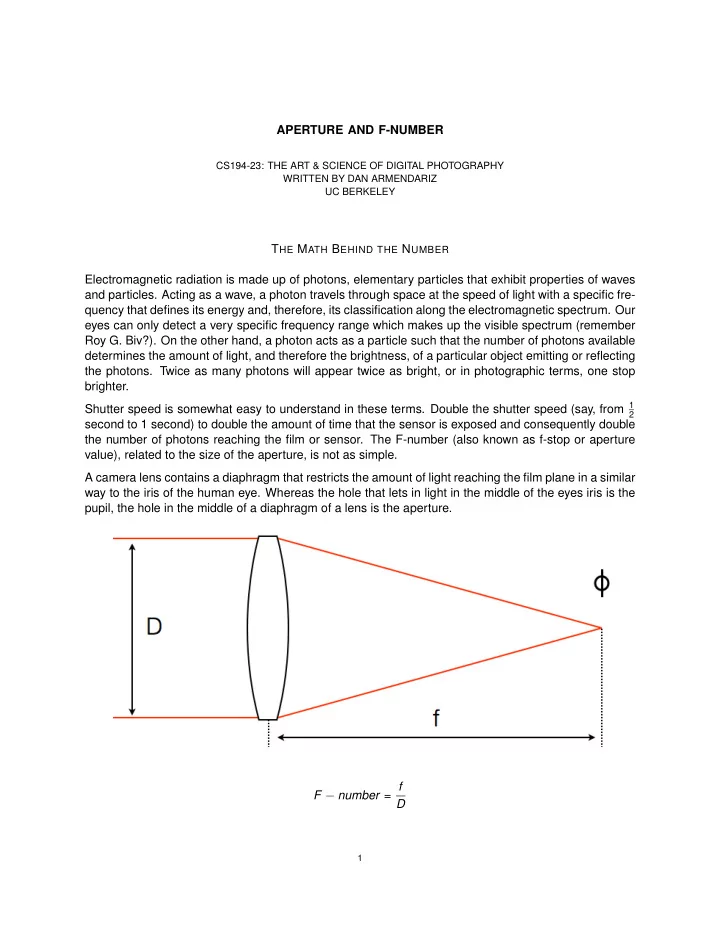
If the area of the aperture is doubled, the number of photons that can reach the sensor through the lens is also doubled. The F-number of a lens is the ratio of its focal length divided by the diameter of the
- aperture. Since the F-number is a ratio involving the diameter, and not the area, we lose the ability to
nicely double or halve a number to calculate a stop. Notice that, counterintuitively, higher F-numbers indicate that less light travels through the lens. To convince yourself of this, imagine what would happen to the F-number if the diameter decreases while the focal length remains the same or while the focal length increases while the diameter is the same. Also realize that the diagram above is an oversimplification of lenses. Almost all modern lenses are made up of more than one glass element, and it is not necessarily the very front element that contains the smallest diameter. An element inside of the lens may be a little bit smaller, for example, but this does not affect the focal length. Back on topic. Doubling or halving the area of the aperture respectively doubles or halves the amount
- f light entering the lens. It should be clear that the F-number is related to the diameter of the lens and
not the area. The question therefore arises: which F-numbers constitute a one stop difference? To answer this question, lets assume we have two separate lenses that have areas A1 and A2, shown below. A1 A2 A1 is twice the area of A2, and we will assume that the diameter (d1) and focal length (f) of A1 is 1, so the F-number would be 1. Let us further assume that the focal length of the lenses are the same. To figure out the F-number of A2, we need to determine how much smaller the diameter is compared to that of A1. Lets do the math! Area of a circle = πr 2 = π
d
2
2
radius (r) = diameter (d) 2 A1 = π
d1
2
2
= π
(d1)2
4
- = π(d1)2
4 A2 = π
d2
2
2
= π
(d2)2
4
- = π(d2)2
4 A1 = 2 · A2
π(d1)2
4 = 2 · π(d2)2 4
π(d1)2 4
π
4
= 2 · π(d2)2
4
π
4
- (d1)2 = 2(d2)2