Archived at http://orgprints.org/10686 Table 1: Total production of - - PDF document

archived at http orgprints org 10686
SMART_READER_LITE
LIVE PREVIEW

Archived at http://orgprints.org/10686 Table 1: Total production of - - PDF document

Tables Archived at http://orgprints.org/10686 Table 1: Total production of agricultural products in Denmark, 1996, and in the organic scenarios (Alre et al. 1998a; Danish EPA 1999a) Danish Organic scenarios agriculture Present yield level


slide-1
SLIDE 1

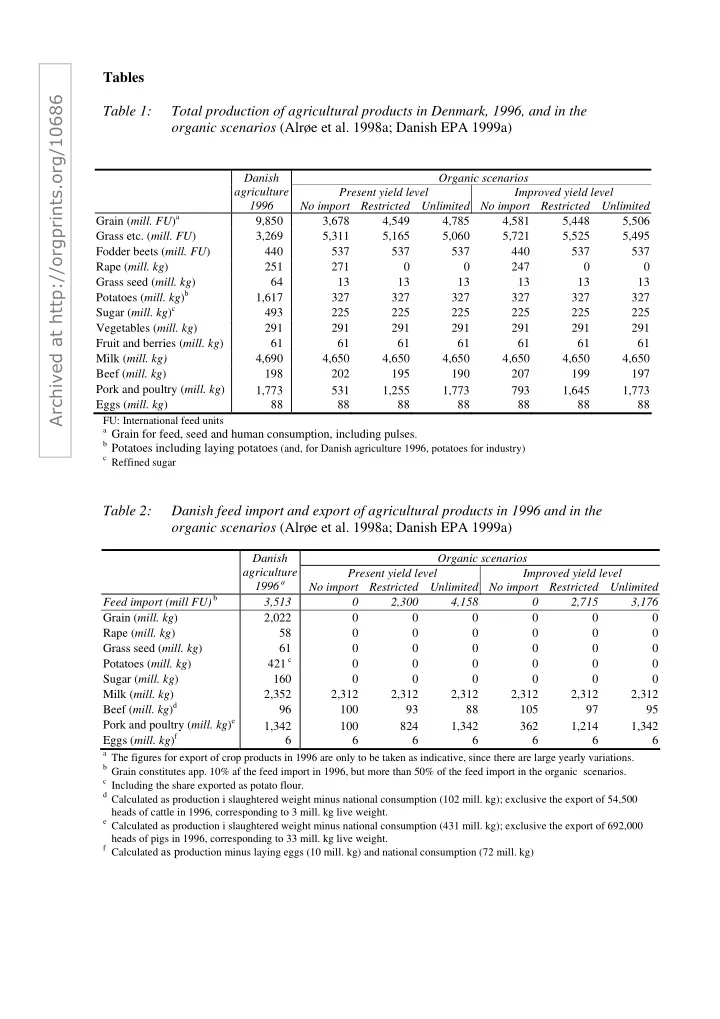
Tables Table 1: Total production of agricultural products in Denmark, 1996, and in the

  • rganic scenarios (Alrøe et al. 1998a; Danish EPA 1999a)

Organic scenarios Present yield level Improved yield level Danish agriculture 1996 No import Restricted Unlimited No import Restricted Unlimited Grain (mill. FU)a 9,850 3,678 4,549 4,785 4,581 5,448 5,506 Grass etc. (mill. FU) 3,269 5,311 5,165 5,060 5,721 5,525 5,495 Fodder beets (mill. FU) 440 537 537 537 440 537 537 Rape (mill. kg) 251 271 247 Grass seed (mill. kg) 64 13 13 13 13 13 13 Potatoes (mill. kg)b 1,617 327 327 327 327 327 327 Sugar (mill. kg)c 493 225 225 225 225 225 225 Vegetables (mill. kg) 291 291 291 291 291 291 291 Fruit and berries (mill. kg) 61 61 61 61 61 61 61 Milk (mill. kg) 4,690 4,650 4,650 4,650 4,650 4,650 4,650 Beef (mill. kg) 198 202 195 190 207 199 197 Pork and poultry (mill. kg) 1,773 531 1,255 1,773 793 1,645 1,773 Eggs (mill. kg) 88 88 88 88 88 88 88

FU: International feed units

a Grain for feed, seed and human consumption, including pulses. b Potatoes including laying potatoes (and, for Danish agriculture 1996, potatoes for industry) c Reffined sugar

Table 2: Danish feed import and export of agricultural products in 1996 and in the

  • rganic scenarios (Alrøe et al. 1998a; Danish EPA 1999a)

Organic scenarios Present yield level Improved yield level Danish agriculture 1996 a No import Restricted Unlimited No import Restricted Unlimited Feed import (mill FU) b 3,513 2,300 4,158 2,715 3,176 Grain (mill. kg) 2,022 Rape (mill. kg) 58 Grass seed (mill. kg) 61 Potatoes (mill. kg) 421 c Sugar (mill. kg) 160 Milk (mill. kg) 2,352 2,312 2,312 2,312 2,312 2,312 2,312 Beef (mill. kg)d 96 100 93 88 105 97 95 Pork and poultry (mill. kg)e 1,342 100 824 1,342 362 1,214 1,342 Eggs (mill. kg)f 6 6 6 6 6 6 6

a The figures for export of crop products in 1996 are only to be taken as indicative, since there are large yearly variations. b Grain constitutes app. 10% af the feed import in 1996, but more than 50% of the feed import in the organic scenarios. c Including the share exported as potato flour. d Calculated as production i slaughtered weight minus national consumption (102 mill. kg); exclusive the export of 54,500

heads of cattle in 1996, corresponding to 3 mill. kg live weight.

e Calculated as production i slaughtered weight minus national consumption (431 mill. kg); exclusive the export of 692,000

heads of pigs in 1996, corresponding to 33 mill. kg live weight.

f Calculated as production minus laying eggs (10 mill. kg) and national consumption (72 mill. kg)

Archived at http://orgprints.org/10686

slide-2
SLIDE 2

Table 3: Nitrogen balances in 1996, after the implementation of the plan for the aquatic environment (VMP 2), and in the organic scenarios (mill. kg per year) <Grant 1998; Danish EPA 1999b>

VMP 2 Organic scenarios Present yield level Improved yield level Danish agriculture 1995/96 No import Restricted Unlimited No import Restricted Unlimited Feed , etc. 205 179 6 94 148 18 109 122

  • Art. fertilizer

285 177 Sludge, waste 9 9

  • Atm. depositiona

57 57 57 57 57 57 57 57 Fixation 30 31 159b 159b 159b 177b 177b 177b N input 586 452 222 310 364 253 343 357 Crop products 63 42 19 19 19 19 19 19 Animal products 105 105 58 82 100 66 96 100 N output 168 147 76 100 118 85 114 119 N balance 418 305 146 209 245 167 229 238 Ammonia lossc 76 69 45 57 67 50 65 67 N to the soil, net 342 236 101 152 178 117 164 171

a The same atmospheric deposition is used in all scenarios, not incorporating the consequences of the changes in ammonia

loss following from the changes in livestock.

b An estimate for the uncertainty on the size of the fixation in the organic scenarios has been calculated to 56 mill. kg. c The calculation is based on etimates for N ab anima, estimates for ammonia loss and denitritficaiton in housings and stocks,

in the delivery of manure, and in grazing. These losses are dependent on the production system. Furthermore there is a loss

  • f ammonia from crops (11 mill. kg). In 1995/96 and the VMP 2 scenario there is furthermore a loss from artificial

fertilizer (7 mill. kg) and from the ammonia treatment of straw (4 mill. kg).

Table 4: Consumption of fossil energy in Danish agriculture and the organic scenarios, compared with crop and animal production <Dalgaard et al. 1998, Danish EPA 1999b>.

Organic scenarios Present yield level Improved yield level Danish agriculture 1996 No import Restricted Unlimited No import Restricted Unlimited Crop product. (mill. FU) 15,900 11,000 11,400 11,600 12,300 12,800 12,900 Crop product. (PJ ME) a 199 138 143 145 154 160 161 Number of animals (mill. Livestock Units) 2.3 1.7 2.1 2.4 1.9 2.3 2.4 Energy for crop production (PJ) 37 17 17 17 17 17 17 Energy for animal production (PJ) 41 13 29 41 14 31 37 Total energy consumption (PJ) 78 30 46 58 31 49 54 Energy production (PJ) 14b Net consumption (PJ) 64 30 46 58 31 49 54

a Converted from feed units to metabolic energy (1 FU = 12,5 MJ ME). b There is a potential for further energy production in the present agriculture, corresponding to the grain that was

exported in 1996 (2000 mill. kg * 15 MJ/kg = 30 PJ). The use of this potential will have other socioeconomic consequences.

slide-3
SLIDE 3

Overall structure of the material flows in a model of an all-organic agriculture in Denmark

CROPS grass clover, cereals, row crops, vegetables, fruit Animal products Crop products Feed input

LIVESTOCK

cattle, pigs, poultry Feed Manure Nutrient input

slide-4
SLIDE 4

The model for calculation of the organic scenarios.

Key to model symbols

Use of empirical data

Crops

Total production area in rotation and permanent grassland Total area in rotation and permanent grassland Crop composition and rotations on Danish

  • rganic farms

Area of specific crops in rotation Crop nutrient needs Production of different crops for feed Organic yields in agricultural and horticultural practice and experiments Organic yields in fruit, berries and vegetables 2 levels of default crop yields in model Area with fruit, berries and vegetables Crop composition and rotation Danish consump- tion of crop products Animal husbandry feed needs

  • Prod. of crops

for consumption Manure distri- bution to crops Adjusted grain yields Manure available for grain Manure from animal husbandry Available grass-clover for feed Rules on free-range and

  • rganic production

Free-range area for sows Free-range area per sow Number of sows Available grain,

  • etc. for feed

Feed ration and production for sows and pigs Production data on free-range production of pigs Yields on permanent grassland Available grass-clover for feed to cows Grass-clover to sows and pigs Number of cows in 3 groups Available beets for feed 3 different feed rations and milk yields for cows Feed consumption and milk yields in

  • rganic dairy

production Total milk production Danish national EC milk quota Total number

  • f cows

Total beef production 2 different feed rations for studs Share of cows and heifers, and number of studs, for slaughter Production data from

  • rganic dairy farms

and beef production Model variable Empirical variable Decision variable

Model calculation flow

Total danish production of fruit and berries Total production

  • f fruit, berries

and vegetables Rules for organic feed and medication Available grain,

  • etc. for pigs

Production data from free-range and organic egg production Total production

  • f eggs

Number of hens Feed ration and egg production for hens Total production

  • f pork

3 levels of import of feed Faktor for adjusment of corn yields Types and amounts

  • f waste products

in society Manure from recycled waste products

Livestock

Input or

  • utput variable

Surplus products from food industries Use of surplus products for feed

slide-5
SLIDE 5

The relation between the modelling proces and the value inquiry in an assessment like the one performed by the Bichel Committee

Basic presumptions The vision of the future state The model Empirical data The scenario results Value inquiry concerning the future state

slide-6
SLIDE 6

Three elements in the development of organic agriculture: practice, preferences, and rules – all related to the basic organic principles and values as well as to conventional practice

The organic agricultural practice Societal and consumer preferences for organic products and practice Rules and regulations of organic agricultural practice The basic principles and values of organic farming The conventional agricultural practice