Arc magmatism (volcanic/plutonic) Arcuate/linear chains of volcanoes - - PowerPoint PPT Presentation

arc magmatism volcanic plutonic
SMART_READER_LITE
LIVE PREVIEW

Arc magmatism (volcanic/plutonic) Arcuate/linear chains of volcanoes - - PowerPoint PPT Presentation

Arc magmatism (volcanic/plutonic) Arcuate/linear chains of volcanoes and/or plutons developed above active subduction zones. Why are the chains arcuate? The arc magma paradox . Why is there magmatic activity in regions where cold


slide-1
SLIDE 1

Arc magmatism (volcanic/plutonic)

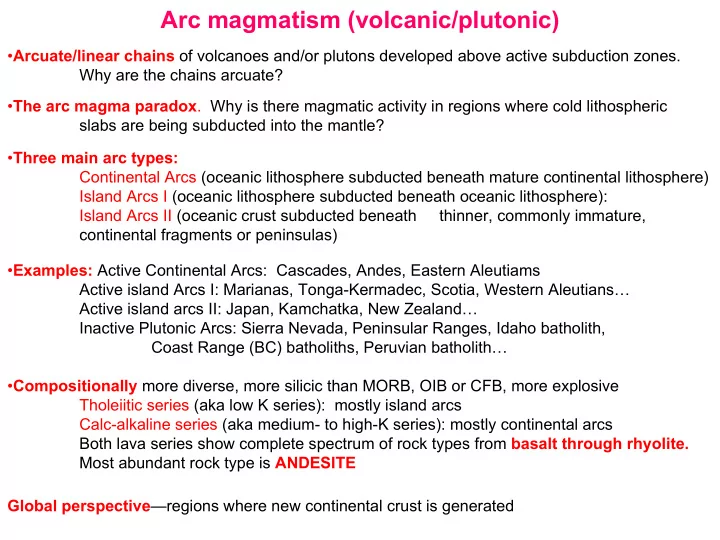
Global perspective—regions where new continental crust is generated

  • Arcuate/linear chains of volcanoes and/or plutons developed above active subduction zones.

Why are the chains arcuate?

  • The arc magma paradox. Why is there magmatic activity in regions where cold lithospheric

slabs are being subducted into the mantle?

  • Three main arc types:

Continental Arcs (oceanic lithosphere subducted beneath mature continental lithosphere) Island Arcs I (oceanic lithosphere subducted beneath oceanic lithosphere): Island Arcs II (oceanic crust subducted beneath thinner, commonly immature, continental fragments or peninsulas)

  • Examples: Active Continental Arcs: Cascades, Andes, Eastern Aleutiams

Active island Arcs I: Marianas, Tonga-Kermadec, Scotia, Western Aleutians… Active island arcs II: Japan, Kamchatka, New Zealand… Inactive Plutonic Arcs: Sierra Nevada, Peninsular Ranges, Idaho batholith, Coast Range (BC) batholiths, Peruvian batholith…

  • Compositionally more diverse, more silicic than MORB, OIB or CFB, more explosive

Tholeiitic series (aka low K series): mostly island arcs Calc-alkaline series (aka medium- to high-K series): mostly continental arcs Both lava series show complete spectrum of rock types from basalt through rhyolite. Most abundant rock type is ANDESITE

slide-2
SLIDE 2

Ocean crust Ocean crust → Island Arc (IA) Ocean crust Continental crust → Continental Arc

Principal subduction zones associated with orogenic volcanism and plutonism. Triangles are on the overriding plate. PBS = Papuan-Bismarck-Solomon-New Hebrides arc. After Wilson (1989) Igneous Petrogenesis, Allen Unwin/Kluwer.

slide-3
SLIDE 3

Schematic cross sectional view of an Island Arc

After Gill (1981), Orogenic Andesites and Plate Tectonics. Springer-Verlag. HFU= heat flow unit (4.2 x 10⁻⁶ joules/cm2/sec)

slide-4
SLIDE 4

trench Volcanic arc Arc width: 25-250 km Trench-arc gap: 160 ± 60 km Alkalic, e.g., Granada Inactive zone Spacing: 60-70 km Volcanic front trench—trench transform

Depth from arc volcanoes to Benioff-Wadati zone:

  • Main arc: 100-120 km
  • Back arc: up to 200 km
  • Forearc (rare): <100 km

Summary of tectonic features of magmatic arcs

  • Volcanism may migrate inward from trench with time
  • Volcano spacing averages ~60 - 70 km, as low as 20 km
  • Low dip and/or low convergence angle: amagmatic arc

Volcanoes behind the main arc: usually more K-rich Cessation of volcanism ~ 5 Ma after cessation of subduction

slide-5
SLIDE 5

Extension axis Magmatic arc Trench

Martinez & Taylor 2003

Mariana Island Arc

Island arc volcanoes: largely submarine

Remnant arc

slide-6
SLIDE 6

Development of remnant arcs and back arc basins

slide-7
SLIDE 7

Andesite lava flow on Bagana, Papua New Guinea

  • Mt. Mayon stratocone

Strombolian eruption at Cerro Negro, Nicaragua, 1968

Block-and-ash flow, Montserrat

Examples of active arc volcanoes

slide-8
SLIDE 8

Continental Arc Magmatism

The dip of the subducting slab has an important role in controlling the amount

  • f magmatic activity (if any) in a

continental arc. A shallow dipping slab pinches out the asthenosphere in the

  • verlying mantle wedge and also

restricts most of the slab dehydration processes to the lithospheric mantle

Winter (2001) An Introduction to Igneous and Metamorphic Petrology. Prentice Hall.

slide-9
SLIDE 9

Continental Arc Magmatism

Map of the Juan de Fuca plate- Cascade Arc system, after McBirney and White, (1982) The Cascade

  • Province. In R. S. Thorpe (ed.),
  • Andesites. Orogenic Andesites and

Related Rocks. John Wiley & Sons. New York. pp. 115-136. Also shown is the Columbia Embayment (the western margin of pre-Tertiary continental rocks) and approximate locations of the subduction zone as it migrated westward to its present location (after Hughes, 1990, J.

  • Geophys. Res., 95, 19623-19638).

Due to sparse age constraints and extensive later volcanic cover, the location of the Columbia Embayment is only approximate (particularly along the southern half).

Reproduced from Winter (2001) An Introduction to Igneous and Metamorphic Petrology. Prentice Hall.

slide-10
SLIDE 10

Continental Arc Magmatism

Map of western South America showing the plate tectonic framework, and the distribution of volcanics and crustal

  • types. NVZ, CVZ, and SVZ are the

northern, central, and southern volcanic

  • zones. After Thorpe and Francis (1979)

Tectonophys., 57, 53-70; Thorpe et al. (1982) In R. S. Thorpe (ed.), (1982).

  • Andesites. Orogenic Andesites and

Related Rocks. John Wiley & Sons. New York, pp. 188-205; and Harmon et

  • al. (1984) J. Geol. Soc. London, 141,

803-822.

Reproduced from Winter (2001) An Introduction to Igneous and Metamorphic Petrology. Prentice Hall.

slide-11
SLIDE 11

Major plutons of the North American Cordillera, a principal segment of a continuous Mesozoic- Tertiary belt from the Aleutians to Antarctica. After Anderson (1990, preface to The Nature and Origin

  • f Cordilleran Magmatism. Geol. Soc. Amer.

Memoir, 174. The Sr 0.706 line in N. America is after Kistler (1990), Miller and Barton (1990) and Armstrong (1988).

Continental arc magmatism

Reproduced from Winter (2001) An Introduction to Igneous and Metamorphic Petrology. Prentice Hall

slide-12
SLIDE 12

Continental Arc Magmatism

Major plutons of the South American Cordillera, a principal segment of a continuous Mesozoic-Tertiary belt from the Aleutians to Antarctica. After USGS.

Reproduced from Winter (2001) An Introduction to Igneous and Metamorphic Petrology. Prentice Hall.

slide-13
SLIDE 13

Volcanic Rocks of Island Arcs

Note the preponderance of basaltic andesite and andesite in island arcs

Table 16-1. Relative Proportions of Quaternary Volcanic Locality B B-A A D R Talasea, Papua 9 23 55 9 4 Little Sitkin, Aleutians 78 4 18

  • Mt. Misery, Antilles (lavas)

17 22 49 12

  • Ave. Antilles

17 42 39 2

  • Ave. Japan (lava, ash falls)

14 85 2

After Gill (1981, Table 4.4) B = basalt B-A = basaltic andesite A = andesite, D = dacite, R = rhyolite

Island Arc Rock Types

slide-14
SLIDE 14

Arc Magmatism

From: R. S. Thorpe (ed.), Andesites. Wiley. New York, pp. 25-95 and Winter (2001) An Introduction to Igneous and Metamorphic Petrology. Prentice Hall.

Relative frequency of rock types in the Andes vs. SW Pacific Island arcs. Data from 397 Andean and 1484 SW Pacific analyses in Ewart (1982)

slide-15
SLIDE 15

Classification of arc volcanics

The most useful single discriminator is K2O which Gill used to define 3 sub-series as shown The three andesite series. Contours represent the concentration of 2500 analyses of andesites. Andesite: grey, porphyritic rocks with abundant plagioclase + pyroxene phenocrysts (no quartz, sanidine of feldspathoids)

After Gill (1981) Orogenic Andesites and Plate Tectonics. Springer-Verlag.

48 53 63 68 4 3 2 1

High K shoshonite Med K Low K

Island arc tholeiite

B A D R

57

slide-16
SLIDE 16

Large symbols = averages. Differentiation within a series (most likely due to fractional crystallization) is indicated by arrow. Different primary magmas (to the left) are distinguished by vertical variations in K2O at low SiO2.

K2O-SiO2 diagram distinguishing high-K, medium-K and low-K island arc series.

After Gill, 1981, Orogenic Andesites and Plate Tectonics. Springer-Verlag.

slide-17
SLIDE 17

Distinction between tholeiitic and calc-alkalic series in island arc lavas

This is also known as a Miyashiro diagram.

From: Winter (2001) An Introduction to Igneous and Metamorphic Petrology. Prentice Hall.

slide-18
SLIDE 18

AFM diagram is also used to distinguishing tholeiitic and calc-alkaline series.

Arrows represent differentiation trends within a series. Note the FeO enrichment trend in the tholeiitic series relative to the calc-alkalic series.

From: Winter (2001) An Introduction to Igneous and Metamorphic Petrology. Prentice Hall.

slide-19
SLIDE 19

Six andesite sub-series

FromGill (1981) Orogenic Andesites and Plate Tectonics. Springer-Verlag.

Low K, medium K and high K series exist in both the tholeiitic and calc-alkalic trends giving a total of six sub-series. The low-K series is almost exclusively tholeiitic and largely restricted to island arcs, the medium-K series is primarily calc-alkalic while the high-K series is mixed. Note that the points plotted are based on a fit to the trends in a K2O vs SiO2 plot and a FeO/MgO vs. SiO2 plot. The value on the trends at 57.5 SiO2 is then plotted in this diagram. Note also that there is a continuum of compositions and the pigeon holes are largely as an aid to communication. It is not uncommon for a series at a single volcano to pass from tholeiitic to calc-alkalic or vice versa.

slide-20
SLIDE 20

Volcanic:

Basalt Andesite Dacite Rhyolite

Plutonic:

Gabbro Diorite Granodiorite Granite

SiO2

<53 wt% 53-63 63-68 >68% Plagioclase Orthoclase Quartz Pyroxene Hornblende Biotite Olivine Total mafic Total felsics

~50% <10% ~50% >90% Commonly zoned ~50% ~30% <2% An70-80 An80-90 An20-30 ~30 ~30 ~30 ~20% <5% <10% <5%

Mineral assemblages in arc rocks