April 2, 2019 Linda Austin of Artland, who try to attend our meetings - - PDF document

april 2 2019 linda austin of artland who try to attend
SMART_READER_LITE
LIVE PREVIEW

April 2, 2019 Linda Austin of Artland, who try to attend our meetings - - PDF document

March 2019 Newsletter The dance which occurs in the imaginable realm can be contained in various vesselsSongs, poetry, literature, musical compositions, dance, drawing, sculpting can all move us in the natural direction towards


slide-1
SLIDE 1

March 2019 Newsletter

‘The dance which occurs in the imaginable realm can be contained in various vessels…Songs, poetry, literature, musical compositions, dance, drawing, sculpting… can all move us in the natural direction towards individuation.” Penny Lewis, author of The Healing Power of the Arts

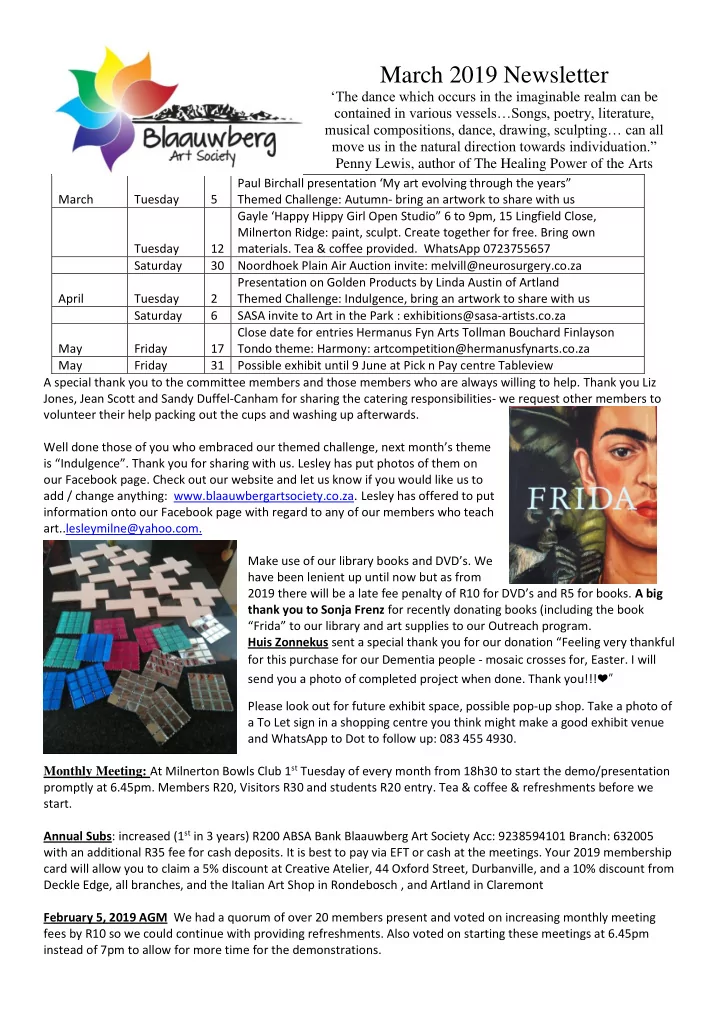
March Tuesday 5 Paul Birchall presentation ‘My art evolving through the years” Themed Challenge: Autumn- bring an artwork to share with us Tuesday 12 Gayle ‘Happy Hippy Girl Open Studio” 6 to 9pm, 15 Lingfield Close, Milnerton Ridge: paint, sculpt. Create together for free. Bring own

  • materials. Tea & coffee provided. WhatsApp 0723755657

Saturday 30 Noordhoek Plain Air Auction invite: melvill@neurosurgery.co.za April Tuesday 2 Presentation on Golden Products by Linda Austin of Artland Themed Challenge: Indulgence, bring an artwork to share with us Saturday 6 SASA invite to Art in the Park : exhibitions@sasa-artists.co.za May Friday 17 Close date for entries Hermanus Fyn Arts Tollman Bouchard Finlayson Tondo theme: Harmony: artcompetition@hermanusfynarts.co.za May Friday 31 Possible exhibit until 9 June at Pick n Pay centre Tableview A special thank you to the committee members and those members who are always willing to help. Thank you Liz Jones, Jean Scott and Sandy Duffel-Canham for sharing the catering responsibilities- we request other members to volunteer their help packing out the cups and washing up afterwards. Well done those of you who embraced our themed challenge, next month’s theme is “Indulgence”. Thank you for sharing with us. Lesley has put photos of them on

  • ur Facebook page. Check out our website and let us know if you would like us to

add / change anything: www.blaauwbergartsociety.co.za. Lesley has offered to put information onto our Facebook page with regard to any of our members who teach art..lesleymilne@yahoo.com. Make use of our library books and DVD’s. We have been lenient up until now but as from 2019 there will be a late fee penalty of R10 for DVD’s and R5 for books. A big thank you to Sonja Frenz for recently donating books (including the book “Frida” to our library and art supplies to our Outreach program. Huis Zonnekus sent a special thank you for our donation “Feeling very thankful for this purchase for our Dementia people - mosaic crosses for, Easter. I will send you a photo of completed project when done. Thank you!!!❤” Please look out for future exhibit space, possible pop-up shop. Take a photo of a To Let sign in a shopping centre you think might make a good exhibit venue and WhatsApp to Dot to follow up: 083 455 4930. Monthly Meeting: At Milnerton Bowls Club 1st Tuesday of every month from 18h30 to start the demo/presentation promptly at 6.45pm. Members R20, Visitors R30 and students R20 entry. Tea & coffee & refreshments before we start. Annual Subs: increased (1st in 3 years) R200 ABSA Bank Blaauwberg Art Society Acc: 9238594101 Branch: 632005 with an additional R35 fee for cash deposits. It is best to pay via EFT or cash at the meetings. Your 2019 membership card will allow you to claim a 5% discount at Creative Atelier, 44 Oxford Street, Durbanville, and a 10% discount from Deckle Edge, all branches, and the Italian Art Shop in Rondebosch , and Artland in Claremont February 5, 2019 AGM We had a quorum of over 20 members present and voted on increasing monthly meeting fees by R10 so we could continue with providing refreshments. Also voted on starting these meetings at 6.45pm instead of 7pm to allow for more time for the demonstrations.

slide-2
SLIDE 2

April 2, 2019 Linda Austin of Artland, who try to attend our meetings with art products and canvasses for sale, will give a presentation/demonstration on the Golden Product ranges. Any orders are to please be emailed to Linda (linda@artland.co.za) or call 021 671 6001 March 5, 2019 Paul Birchall presentation, “My art evolving through the years” Paul at age 19 was a musician in a Punk Rock Band and his creative streak was expressed in taking photos of the exciting life of rock musicians. He also experimented with long exposure (45 min) of waterfalls. His 1st painting was one

  • f his mother. He gave up his job as dental technician to go

to art school focussing on life drawing and painting, 5 hours a day for a year. He struggled with colour making his paintings too vivid. But as Paul says, getting to know how colour works is a life time study. He had an older brother who died when he was very young and always wondered what he would have been like to know, as he grew up with 3 sisters. He decided to create a fictitious version of his brother, inventing him as he wished. A red cartoon like character with the family trait of a large nose came into being. Paul made a series of geometrical pure color paintings. The painting on this wall was done in the UK and when he took the opportunity to go to Delhi as an exchange student for 6 months he wanted to continue with this theme. Just learning how to use color harmonies. He found it daunting being surrounded by so many people while painting in these surroundings and then began to notice stripes

  • f color everywhere he looked. So most of his time

in India, he took many photos and worked more in conceptualizing what he saw and felt about his surroundings: a man sitting in the street had a blue hat on the exact same color and tone as the door behind him and was sitting on a green blanket with the same color as the tiles on the wall. He was blending into his background almost like a chameleon. Paul then started painting with “found” color, for example the colors on this wall inspired him to use the same limited palette to create a color harmonious landscape. Next Paul did a series looking at visual symbols such as the shape

  • f the parrot as it comes into land, and incorporating these onto

minimalistic backgrounds. Once he walked into a gallery in India and laughed out loud, and at that moment knew he wanted to incorporate humor into his art. His fictitious brother, Jeffrey, came alive in his sketch book as he started documenting his real life experiences in India. A pink bird started appearing in the paintings that resulted from this.

slide-3
SLIDE 3

Paul next saw a man on the street painting little traditional miniatures on Perspex. He loved the way the color popped when these were turned around and so he experimented with reverse Perspex paintings. Because of the high cost of Perspex he approached a Plastics Factory who granted him 2000 pounds worth of Perspex in exchange for a commission for their foyer. So Paul could experiment with large Perspex paintings without worrying about the cost. Once he left art school where the focus was on creative conceptual head space, he had to figure

  • ut how to make money in the real world. A

London contemporary art publishing house commissioned him to do realistic floral water colors for a cruise liner company; of which they chose 3 and made 7000 prints to hang in their

  • cabins. He was paid for the originals and earned commission on the prints.

Paul realized to make money from his art, he had to be

  • varied. So he works on a series

and once he is finished with that particular style or theme he moves onto a different style and theme. Growing up as a gay man had its challenges and typical to Paul he incorporates this aspect of his life into his art in a humorous way. He did a series

  • f charcoal drawings entitled “The Devil’s boyfriends hairdresser” as it was deemed

by some, that if you were gay the worst thing you were was either a hairdresser or the devil. The result was a surreal set of drawings using lots of symbology. After Paul was retrenched he moved to RSA and has been a member of the Association of Visual Arts for the past 17 years. Teaching opportunities arose asking him to become involved in social development through Truworths and the UCT Summer

  • School. He gave reverse Perspex

painting workshops to many underprivileged children. And did a series himself of large Perspex paintings inspired by the designs on Japanese Kimonos; decorative and colorful. The next project that absorbed him was traditional landscapes of trees and woodlands; which were exhibited in Stellenbosch. After this series he did one of still life

  • bjects he collected at Milnerton

Flea Market. Looking at art history in a humorous way, subverting themes and incorporating symbology. An example of this being a mini mouse version of “Joan of Arc” about to be burned on a pyramid of match sticks.

slide-4
SLIDE 4

After a day of laborious detailed work he would have paint left on his palette, and with this left

  • ver paint he would then do an abstract simple

landscape using no reference material, just purely from memory. He, at this stage, had collected a whole lot of memorabilia from the war, so decided to use this in a series of three dimensional collages. He purchased old photos on EBay and combined these with found objects and etchings. Then he added some clock parts to make some of these objects move. This series was exhibited at the car festival in Outshooren. He also had an installation of ceramic medals which each turned randomly. The left over old military photos, Paul scanned and altered and made them into an artists book. And he did a series of Military themed etchings, learning from print maker, Judy Woodborne Having been on holiday to Bali, Paul was inspired by

  • bserving the locals who

in the midst of crazy noisy traffic, had a calm accepting demeanor. He painted a series of portraits aimed at portraying this spiritual aspect of ‘Zen like’ calm. The curator for the KKNK festival commissioned Paul and 7

  • ther artists to do a series of etchings which was entitled “The

exquisite corpse”. Groups of 3 artists were each asked to draw the head of Adam on one plate and the head of Eve on another

  • plate. These were then blocked out and swopped around for

the artists to do the bodies and then blocked out and swopped around for the third time for the artists to draw the legs. These unusual results are now on show at the Norval Foundation in Tokai. Paul, through SANAVA, was a resident artist at the Cite in Paris for three months. Sharing space with 310 other artists, writers and musicians. He had so much fun there, making full use of his museum card and visiting many interesting places. He didn’t have much time to paint, as he focused more on capturing the lights of Paris with his camera as his creative tool. Once again playing around with long exposures and using the lights as drawing lines. The wonderful thing about the digital camera is its immediacy. He took abstract images

  • f museum objects using a long exposure

and slowly turning the camera. Paul then did interesting design project with ceramics creating angular geometric shaped tea pots which were displayed at the Design Indaba. Everyone loved them, but unfortunately didn’t buy them.

slide-5
SLIDE 5

Paul was then involved in a project with the kids of the Observatory Junior school where each child created two reverse Perspex clocks served in a pizza box, one went home with them and the other was sold to raise funds for their school. This inspired Paul to paint a series of reverse Perspex portraits. A friend gave Paul an old silver tea pot which he then placed into different rooms and painted 60 different paintings in oil of the reflection of the rooms in the

  • pot. This series is
  • n exhibit at the

Irma Stern

  • museum. And one
  • f these won the

best on show prize

  • f R20 000 at the

Hermanus Fyn Art festival three years ago. The quirky side of Paul came to the fore with his recent body of work which was inspired by a plate of breakfast. He decorated various plates of food to look like faces and posted photos

  • nline and in America they actually sell some of these. From there came the idea of taking photos and video of

everyday objects and creating a mirror image of them, such as the image on the left of the bark of a tree. This idea developed into moving, talking characters created with images of his hands and this forms part of an exhibit at the Stellenbosch Word Fees on at the moment. Paul teaches 5 private classes a week and is in the process of moving his studio to the Ruth Prowse Art School. His message is: Find enthusiasm in what you do and paint your life story and then you will be able to develop your own unique style. To make a living as an artist be prepared to be diverse, teach and get funding for your projects as sometimes having a deadline helps to make things happen. Contact: pjbirchall@btconnect.com and 082 363 3046 Thank you Paul, for sharing your interesting art adventures with our society.