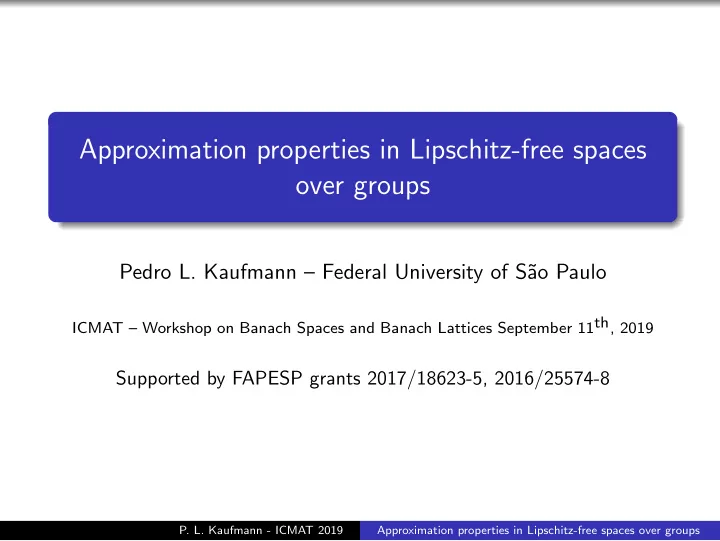
Approximation properties in Lipschitz-free spaces over groups Pedro - - PowerPoint PPT Presentation

approximation properties in lipschitz free spaces over
SMART_READER_LITE
LIVE PREVIEW

Approximation properties in Lipschitz-free spaces over groups Pedro - - PowerPoint PPT Presentation

Approximation properties in Lipschitz-free spaces over groups Pedro L. Kaufmann Federal University of S ao Paulo ICMAT Workshop on Banach Spaces and Banach Lattices September 11th, 2019 Supported by FAPESP grants 2017/18623-5,


slide-1
SLIDE 1

Approximation properties in Lipschitz-free spaces

  • ver groups

Pedro L. Kaufmann – Federal University of S˜ ao Paulo

ICMAT – Workshop on Banach Spaces and Banach Lattices September 11th, 2019

Supported by FAPESP grants 2017/18623-5, 2016/25574-8

  • P. L. Kaufmann - ICMAT 2019

Approximation properties in Lipschitz-free spaces over groups

slide-2
SLIDE 2

Lipschitz-free space definition reminder

Let (M, d) be a metric space, 0 ∈ M. Notation Lip0(M) := {f : M → R|f is Lipschitz, f (0) = 0} is a Banach space when equipped with the norm f Lip := sup

x=y

|f (x) − f (y)| d(x, y) . For each x ∈ M, consider the evaluation functional δx ∈ Lip0(M)∗ por δxf := f (x). Definition/Proposition F(M) := span{δx|x ∈ M} is the free space over M, and it is an isometric predual to Lip0(M).

  • P. L. Kaufmann - ICMAT 2019

Approximation properties in Lipschitz-free spaces over groups

slide-3
SLIDE 3

δ : M → F(M) is an isometry. Moreover: Linear interpretation property ∀ ϕ : M → N Lipschitz with ϕ(0M) = 0N ∃! ˆ ϕ : F(M) → F(N) linear such that the following diagram commutes: M

ϕ

− − − − → N   δM   δN F(M)

ˆ ϕ

− − − − → F(N) Also, ˆ ϕ = L(ϕ). On the w∗ topology of Lip0(M) On bounded subsets of Lip0(M), w∗ and the topology of pointwise convergence coincide.

  • P. L. Kaufmann - ICMAT 2019

Approximation properties in Lipschitz-free spaces over groups

slide-4
SLIDE 4

Metric framework: topological groups equipped with invariant, compatible metrics. Such metrics are plentyful:

  • A topological group G is left-invariant metrizable whenever: (1)

G is T0 and e admits a countable open basis, (2) G is locally countably compact and {e} is a countable intersection of open sets,

  • r (3) G is compact and {e} is a countable intersection of open

sets.

  • If G is compact with Haar measure dλ admitting a compatible

metric d, we can construct a compatible and bi-invariant one by taking: d′(x, y) . = d(zxw, zyw)dλ(z) dλ(w). General goal: study free spaces over such metrics, in particular concerning approximation properties.

  • P. L. Kaufmann - ICMAT 2019

Approximation properties in Lipschitz-free spaces over groups

slide-5
SLIDE 5

Metric framework: topological groups equipped with invariant, compatible metrics. Such metrics are plentyful:

  • A topological group G is left-invariant metrizable whenever: (1)

G is T0 and e admits a countable open basis, (2) G is locally countably compact and {e} is a countable intersection of open sets,

  • r (3) G is compact and {e} is a countable intersection of open

sets.

  • If G is compact with Haar measure dλ admitting a compatible

metric d, we can construct a compatible and bi-invariant one by taking: d′(x, y) . = d(zxw, zyw)dλ(z) dλ(w). General goal: study free spaces over such metrics, in particular concerning approximation properties.

  • P. L. Kaufmann - ICMAT 2019

Approximation properties in Lipschitz-free spaces over groups

slide-6
SLIDE 6

Metric framework: topological groups equipped with invariant, compatible metrics. Such metrics are plentyful:

  • A topological group G is left-invariant metrizable whenever: (1)

G is T0 and e admits a countable open basis, (2) G is locally countably compact and {e} is a countable intersection of open sets,

  • r (3) G is compact and {e} is a countable intersection of open

sets.

  • If G is compact with Haar measure dλ admitting a compatible

metric d, we can construct a compatible and bi-invariant one by taking: d′(x, y) . = d(zxw, zyw)dλ(z) dλ(w). General goal: study free spaces over such metrics, in particular concerning approximation properties.

  • P. L. Kaufmann - ICMAT 2019

Approximation properties in Lipschitz-free spaces over groups

slide-7
SLIDE 7

Different equivalent metrics can lead to very different free spaces: On T = R/Z, let d be the usual metric inherited from R and dα (0 < α < 1) be its snowflaked version. Then F(T, d) ≃ L1 and F(T, dα) is isomorphic to a dual space.

  • P. L. Kaufmann - ICMAT 2019

Approximation properties in Lipschitz-free spaces over groups

slide-8
SLIDE 8

Different equivalent metrics can lead to very different free spaces: On T = R/Z, let d be the usual metric inherited from R and dα (0 < α < 1) be its snowflaked version. Then F(T, d) ≃ L1 and F(T, dα) is isomorphic to a dual space.

  • P. L. Kaufmann - ICMAT 2019

Approximation properties in Lipschitz-free spaces over groups

slide-9
SLIDE 9

Approximation properties

Let λ ≥ 1. A Banach space X has the λ-bounded approximation property (λ-BAP) if it satisfies one of the following equivalent properties:

  • ∀ǫ > 0, ∀K ⊂ X compact, there is a λ-bounded finite rank
  • perator on X such that Tx − x < ǫ, ∀x ∈ K;
  • There is a λ-bounded net of finite rank operators (Tα) on X such

that Tα

WOT

− → IdX. X has the metric approximation property (MAP) if it has the 1-BAP. X has λ-FDD if there is a sequence Pn of commuting projections with increasing range such that dim(Pn − Pn−1)X < ∞ (P0 = 0), Pn ≤ λ and Pn

SOT

− → Id. If dim(Pn − Pn−1)X = 1, X has a λ-Schauder basis.

  • P. L. Kaufmann - ICMAT 2019

Approximation properties in Lipschitz-free spaces over groups

slide-10
SLIDE 10

Approximation properties

Let λ ≥ 1. A Banach space X has the λ-bounded approximation property (λ-BAP) if it satisfies one of the following equivalent properties:

  • ∀ǫ > 0, ∀K ⊂ X compact, there is a λ-bounded finite rank
  • perator on X such that Tx − x < ǫ, ∀x ∈ K;
  • There is a λ-bounded net of finite rank operators (Tα) on X such

that Tα

WOT

− → IdX. X has the metric approximation property (MAP) if it has the 1-BAP. X has λ-FDD if there is a sequence Pn of commuting projections with increasing range such that dim(Pn − Pn−1)X < ∞ (P0 = 0), Pn ≤ λ and Pn

SOT

− → Id. If dim(Pn − Pn−1)X = 1, X has a λ-Schauder basis.

  • P. L. Kaufmann - ICMAT 2019

Approximation properties in Lipschitz-free spaces over groups

slide-11
SLIDE 11

Approximation properties

Problem: if G is a compact group with a left invariant compatible metric, does F(M) have the MAP? Keep in mind: Godefroy, Ozawa 2012 If X is a separable Banach space and C ⊂ X is convex with spanC = X, then X has an 1-complemented isometric copy in F(C). Corollary There exists a compact metric K with F(K) failing AP.

  • P. L. Kaufmann - ICMAT 2019

Approximation properties in Lipschitz-free spaces over groups

slide-12
SLIDE 12

Approximation properties

Problem: if G is a compact group with a left invariant compatible metric, does F(M) have the MAP? Keep in mind: Godefroy, Ozawa 2012 If X is a separable Banach space and C ⊂ X is convex with spanC = X, then X has an 1-complemented isometric copy in F(C). Corollary There exists a compact metric K with F(K) failing AP.

  • P. L. Kaufmann - ICMAT 2019

Approximation properties in Lipschitz-free spaces over groups

slide-13
SLIDE 13

Let X be a Banach space. If for all δ > 0 X has the (λ + δ)-BAP, it follows that X hast the λ-BAP.

  • Proof. Fix a compact set K ⊂ X and ǫ > 0, and take δ small

enough so that Mδ(λ + δ)/λ < ǫ/2, where M = supx∈K x. Let T be a finite rank, (λ + δ)-bounded operator on X such that Tx − x < ǫ/2, for all x ∈ K. Then the λ-bounded operator S = λT/T satisfies, for each x ∈ K, Sx − x ≤ Sx − Tx + Tx − x =

  • T

λ − 1

  • Tx
  • + ǫ/2

≤ Mδ(λ + δ)/λ + ǫ/2 < ǫ.

  • P. L. Kaufmann - ICMAT 2019

Approximation properties in Lipschitz-free spaces over groups

slide-14
SLIDE 14

Harmonic analysis cannon

Let G be a locally compact group equipped with Haar measure λ. A D”-sequence in G is a sequence {Un, Vn} of pairs of Borel subsets of finite measure in G such that

1 U1 ⊃ U2 ⊃ ..., 2 there is an A > 0 such that 0 < λ(UnU−1

n ) < Aλ(Un), for all n,

3 every neighborhood of e contains some Un, and 4 V −1

n Vn ⊂ Un and there exists B > 0 such that

λ(Un) ≤ Bλ(Vn). We shall say that a locally compact group G is summability-friendly if it admits a D”-sequence Un with the property that each Un is invariant under inner automorphisms of G (∀g ∈ G, gUng−1 ∈ Un). Examples of summability-friendly groups: closed subgroups of finite dimensional unitary groups.

  • P. L. Kaufmann - ICMAT 2019

Approximation properties in Lipschitz-free spaces over groups

slide-15
SLIDE 15

Harmonic analysis cannon

Thm 44.25, Hewitt & Ross Abstract Harmonic Analysis Vol. 2 Suppose that G is a summability-friendly compact group equipped with left-invariant Haar measure λ. Then there exists a sequence Fn of positive functions on G satisfying

1 each Fn is a positive definite central (commutes under

convolution with any L1 function) trigonometric polynomial,

2 Fn(g−1) = Fn(g), g ∈ G, for each n, 3 for each n,

  • Fn dλ = 1, and

4 f ∗ Fn(x) → f (x) λ-almost everywhere for every

f ∈ Lp(G), 1 ≤ p < ∞. Key points:

  • if P is a trigonometric polynomial, the continuous operator

f ∈ C(G) → f ∗ P ∈ C(G) is of finite rank;

  • G equipped with left-invariant metric⇒f ∗ gLip ≤ f L1gLip.
  • P. L. Kaufmann - ICMAT 2019

Approximation properties in Lipschitz-free spaces over groups

slide-16
SLIDE 16

Harmonic analysis cannon

Thm 44.25, Hewitt & Ross Abstract Harmonic Analysis Vol. 2 Suppose that G is a summability-friendly compact group equipped with left-invariant Haar measure λ. Then there exists a sequence Fn of positive functions on G satisfying

1 each Fn is a positive definite central (commutes under

convolution with any L1 function) trigonometric polynomial,

2 Fn(g−1) = Fn(g), g ∈ G, for each n, 3 for each n,

  • Fn dλ = 1, and

4 f ∗ Fn(x) → f (x) λ-almost everywhere for every

f ∈ Lp(G), 1 ≤ p < ∞. Key points:

  • if P is a trigonometric polynomial, the continuous operator

f ∈ C(G) → f ∗ P ∈ C(G) is of finite rank;

  • G equipped with left-invariant metric⇒f ∗ gLip ≤ f L1gLip.
  • P. L. Kaufmann - ICMAT 2019

Approximation properties in Lipschitz-free spaces over groups

slide-17
SLIDE 17

Harmonic analysis cannon

Thm 44.25, Hewitt & Ross Abstract Harmonic Analysis Vol. 2 Suppose that G is a summability-friendly compact group equipped with left-invariant Haar measure λ. Then there exists a sequence Fn of positive functions on G satisfying

1 each Fn is a positive definite central (commutes under

convolution with any L1 function) trigonometric polynomial,

2 Fn(g−1) = Fn(g), g ∈ G, for each n, 3 for each n,

  • Fn dλ = 1, and

4 f ∗ Fn(x) → f (x) λ-almost everywhere for every

f ∈ Lp(G), 1 ≤ p < ∞. Key points:

  • if P is a trigonometric polynomial, the continuous operator

f ∈ C(G) → f ∗ P ∈ C(G) is of finite rank;

  • G equipped with left-invariant metric⇒f ∗ gLip ≤ f L1gLip.
  • P. L. Kaufmann - ICMAT 2019

Approximation properties in Lipschitz-free spaces over groups

slide-18
SLIDE 18

Aim and shoot

Characterization of BAP for Lipschitz-free spaces over compact metric spaces Let K be a compact metric space and λ ≥ 1. The following assertions are equivalent:

1 F(K) has the λ-BAP; 2 for each ǫ > 0 there is a net Tα of bounded operators on

C(K) such that

1

Tα are of finite rank,

2

Tα maps Lipschitz functions to Lipschitz functions,

3

Tαf Lip ≤ (λ + ǫ)f Lip for each α and each Lipschitz f , and

4

Tαf

pt

→ f , for each Lipschitz f .

  • P. L. Kaufmann - ICMAT 2019

Approximation properties in Lipschitz-free spaces over groups

slide-19
SLIDE 19

Aim and shoot

  • Proof. ((1)⇒(2)) Let Tα : F(K) → F(K) be λ-bounded, finite

rank, Tα

WOT

→ IdF(M). Then T ∗

α : Lip0(K) → Lip0(K) extend to

  • perators on C(K) satisfying (1)–(4).

((2)⇒(1)) Chose some 0 ∈ K. The operators Sα defined on C(K) by Sα(f )(x) = Tα(f )(x) − Tα(f )(0) are bounded, and satisfy (1)–(4) as Tα and are (λ + ǫ)-bounded

  • perators on Lip0(K). Lemma ⇒ ∃ Rα finite-rank, (λ + ǫ)-bounded
  • perators on F(K) with R∗

α = Sα, that is:

Sαf , γ = f , Rαγ, ∀f ∈ Lip0(K), ∀γ ∈ F(K). Now since Sαf is a bounded net in Lip0(K) converging pointwise to f , it must converge w∗, thus Rα converges to IdF(M) in the weak

  • perator topology.
  • P. L. Kaufmann - ICMAT 2019

Approximation properties in Lipschitz-free spaces over groups

slide-20
SLIDE 20

Aim and shoot

  • Proof. ((1)⇒(2)) Let Tα : F(K) → F(K) be λ-bounded, finite

rank, Tα

WOT

→ IdF(M). Then T ∗

α : Lip0(K) → Lip0(K) extend to

  • perators on C(K) satisfying (1)–(4).

((2)⇒(1)) Chose some 0 ∈ K. The operators Sα defined on C(K) by Sα(f )(x) = Tα(f )(x) − Tα(f )(0) are bounded, and satisfy (1)–(4) as Tα and are (λ + ǫ)-bounded

  • perators on Lip0(K). Lemma ⇒ ∃ Rα finite-rank, (λ + ǫ)-bounded
  • perators on F(K) with R∗

α = Sα, that is:

Sαf , γ = f , Rαγ, ∀f ∈ Lip0(K), ∀γ ∈ F(K). Now since Sαf is a bounded net in Lip0(K) converging pointwise to f , it must converge w∗, thus Rα converges to IdF(M) in the weak

  • perator topology.
  • P. L. Kaufmann - ICMAT 2019

Approximation properties in Lipschitz-free spaces over groups

slide-21
SLIDE 21

Summability methods are great for preserving constants

Another method: Godefroy 2016, “BAP characterization for free spaces via near-extensions” Let Mn be finite ǫn-dense subsets of a compact metric space M with ǫn ց 0. TFAE:

1 F(M) has the λ-BAP; 2 There are λ-bounded linear operators En from

(Lip0(Mn), · Lip) into (Lip0(M), · Lip) such that sup

f Lip0(Mn)≤1

En(f )|Mn − f ∞

n

→ 0. If moreover M1 ⊂ M2 ⊂ ... and (2) is satisfied with the · ∞ norm involved being always 0 (that is, En are actual extensions), we have that F(M) has the λ-FDD. Adapting from [Lancien, Perneck´ a 2013], we get 1-FDD for ℓn

1/Zn.

But not for ℓn

p/Zn!

  • P. L. Kaufmann - ICMAT 2019

Approximation properties in Lipschitz-free spaces over groups

slide-22
SLIDE 22

Summability methods are great for preserving constants

Yet another method. With the toolkit: Lang, Plaut 2001 (euclidean embedding tool) If a compact metric space is locally bilipschitz embeddable in some RN, then it is bilipschitz embeddable in some RM. Lee, Naor 2005 (Lipschitz extension tool) There is a universal constant C > 0 such that, for any N ∈ N and any subset F ⊂ RN (with the euclidean norm), there exists a C √ N-bounded and w∗ continuous linear extension operator from Lip0(F) into Lip0(RN). Godefroy, Kalton 2003 X finite dimensional ⇒ F(X) has the MAP. we can show that (Rn, · )/Zn has λ-BAP, for any norm · , but λ is sensitive to the choice of · .

  • P. L. Kaufmann - ICMAT 2019

Approximation properties in Lipschitz-free spaces over groups

slide-23
SLIDE 23

Summability methods are great for preserving constants

Yet another method. With the toolkit: Lang, Plaut 2001 (euclidean embedding tool) If a compact metric space is locally bilipschitz embeddable in some RN, then it is bilipschitz embeddable in some RM. Lee, Naor 2005 (Lipschitz extension tool) There is a universal constant C > 0 such that, for any N ∈ N and any subset F ⊂ RN (with the euclidean norm), there exists a C √ N-bounded and w∗ continuous linear extension operator from Lip0(F) into Lip0(RN). Godefroy, Kalton 2003 X finite dimensional ⇒ F(X) has the MAP. we can show that (Rn, · )/Zn has λ-BAP, for any norm · , but λ is sensitive to the choice of · .

  • P. L. Kaufmann - ICMAT 2019

Approximation properties in Lipschitz-free spaces over groups

slide-24
SLIDE 24

Summability methods are great for preserving constants

Yet another method. With the toolkit: Lang, Plaut 2001 (euclidean embedding tool) If a compact metric space is locally bilipschitz embeddable in some RN, then it is bilipschitz embeddable in some RM. Lee, Naor 2005 (Lipschitz extension tool) There is a universal constant C > 0 such that, for any N ∈ N and any subset F ⊂ RN (with the euclidean norm), there exists a C √ N-bounded and w∗ continuous linear extension operator from Lip0(F) into Lip0(RN). Godefroy, Kalton 2003 X finite dimensional ⇒ F(X) has the MAP. we can show that (Rn, · )/Zn has λ-BAP, for any norm · , but λ is sensitive to the choice of · .

  • P. L. Kaufmann - ICMAT 2019

Approximation properties in Lipschitz-free spaces over groups

slide-25
SLIDE 25

Thank you! Gracias! Obrigado!

  • P. L. Kaufmann - ICMAT 2019

Approximation properties in Lipschitz-free spaces over groups