
SLIDE 1
Approximating the Permanent of Positive Semidefinite Matrices
Nima Anari Joint work with Leonid Shayan Amin Gurvits Oveis Gharan Saberi
1 / 14
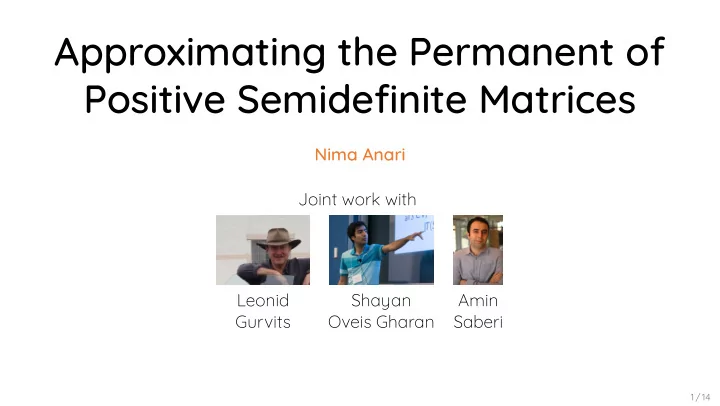
Approximating the Permanent of Positive Semidefinite Matrices Nima - - PowerPoint PPT Presentation
Approximating the Permanent of Positive Semidefinite Matrices Nima Anari Joint work with Leonid Shayan Amin Gurvits Oveis Gharan Saberi 1 / 14 Example a b M c d det M ad bc per M ad bc Determinant Permanent det ( M )
Nima Anari Joint work with Leonid Shayan Amin Gurvits Oveis Gharan Saberi
1 / 14
det(M) = ∑
σ∈Sn
sgn(σ)M1,σ(1) . . . Mn,σ(n)
per(M) = ∑
σ∈Sn
M1,σ(1) . . . Mn,σ(n)
Example
M a b c d det M ad bc per M ad bc
2 / 14
det(M) = ∑
σ∈Sn
sgn(σ)M1,σ(1) . . . Mn,σ(n)
per(M) = ∑
σ∈Sn
M1,σ(1) . . . Mn,σ(n)
2 × 2 Example
M = [ a b c d ] det(M) = ad − bc per(M) = ad + bc
2 / 14
#P-hard to compute per(M) for 0/1 matrices [Valiant’79]. #P-hard to compute sign of per M [Aaronson’11]. #P-hard to compute per M for M [Grier-Schaefger’16].
3 / 14
#P-hard to compute per(M) for 0/1 matrices [Valiant’79]. #P-hard to compute sign of per(M) [Aaronson’11]. #P-hard to compute per M for M [Grier-Schaefger’16].
3 / 14
#P-hard to compute per(M) for 0/1 matrices [Valiant’79]. #P-hard to compute sign of per(M) [Aaronson’11]. #P-hard to compute per(M) for M ⪰ 0 [Grier-Schaefger’16].
Additive ±ϵ |M|n approximation [Gurvits’05].
Permanent is always nonnegative: per M Randomized
(FRPAS) [Jerrum-Sinclair-Vigoda’04]. Deterministic
n-approximation
[Gurvits-Samorodnitsky’14].
Permanent is always nonnegative: per M Deterministic n -approximation [Marcus’63]: M Mn n. Improved to
n k n k -approximation in
time
O k log n
[Lieb’66].
4 / 14
Additive ±ϵ |M|n approximation [Gurvits’05].
Permanent is always nonnegative: per(M) ≥ 0. Randomized
(FRPAS) [Jerrum-Sinclair-Vigoda’04]. Deterministic
n-approximation
[Gurvits-Samorodnitsky’14].
Permanent is always nonnegative: per M Deterministic n -approximation [Marcus’63]: M Mn n. Improved to
n k n k -approximation in
time
O k log n
[Lieb’66].
4 / 14
Additive ±ϵ |M|n approximation [Gurvits’05].
Permanent is always nonnegative: per(M) ≥ 0. Randomized (1 + ϵ)-approximation (FRPAS) [Jerrum-Sinclair-Vigoda’04]. Deterministic
n-approximation
[Gurvits-Samorodnitsky’14].
Permanent is always nonnegative: per M Deterministic n -approximation [Marcus’63]: M Mn n. Improved to
n k n k -approximation in
time
O k log n
[Lieb’66].
4 / 14
Additive ±ϵ |M|n approximation [Gurvits’05].
Permanent is always nonnegative: per(M) ≥ 0. Randomized (1 + ϵ)-approximation (FRPAS) [Jerrum-Sinclair-Vigoda’04]. Deterministic 2n-approximation [Gurvits-Samorodnitsky’14].
Permanent is always nonnegative: per(M) ≥ 0. Deterministic n -approximation [Marcus’63]: M Mn n. Improved to
n k n k -approximation in
time
O k log n
[Lieb’66].
4 / 14
Additive ±ϵ |M|n approximation [Gurvits’05].
Permanent is always nonnegative: per(M) ≥ 0. Randomized (1 + ϵ)-approximation (FRPAS) [Jerrum-Sinclair-Vigoda’04]. Deterministic 2n-approximation [Gurvits-Samorodnitsky’14].
Permanent is always nonnegative: per(M) ≥ 0. Deterministic n!-approximation [Marcus’63]: M1,1 . . . Mn,n. Improved to
n k n k -approximation in
time
O k log n
[Lieb’66].
4 / 14
Additive ±ϵ |M|n approximation [Gurvits’05].
Permanent is always nonnegative: per(M) ≥ 0. Randomized (1 + ϵ)-approximation (FRPAS) [Jerrum-Sinclair-Vigoda’04]. Deterministic 2n-approximation [Gurvits-Samorodnitsky’14].
Permanent is always nonnegative: per(M) ≥ 0. Deterministic n!-approximation [Marcus’63]: M1,1 . . . Mn,n. Improved to
n! k!n/k -approximation in
time 2O(k+log(n)) [Lieb’66].
4 / 14
Theorem [A-Gurvits-Oveis Gharan-Saberi'17]
The permanent of PSD matrices M ∈ Cn×n can be approximated, in deterministic polynomial time, within (eγ+1)n ≃ 4.84n.
5 / 14
Re(z) Im(z) z ∼ CN(0, 1) P [z] = 1 πe−|z|2 Standard multivariate complex Gaussian: z z zn i.i.d. and zi . General (circularly-symmetric) complex Gaussian: g Cz g CC
Wick's Formula
g gn per CC
6 / 14
Re(z) Im(z) z ∼ CN(0, 1) P [z] = 1 πe−|z|2 Standard multivariate complex Gaussian: z = (z1, . . . , zn) i.i.d. and zi ∼ CN(0, 1). General (circularly-symmetric) complex Gaussian: g Cz g CC
Wick's Formula
g gn per CC
6 / 14
Re(z) Im(z) z ∼ CN(0, 1) P [z] = 1 πe−|z|2 Standard multivariate complex Gaussian: z = (z1, . . . , zn) i.i.d. and zi ∼ CN(0, 1). General (circularly-symmetric) complex Gaussian: g = Cz, g ∼ CN(0, CC†).
Wick's Formula
g gn per CC
6 / 14
Re(z) Im(z) z ∼ CN(0, 1) P [z] = 1 πe−|z|2 Standard multivariate complex Gaussian: z = (z1, . . . , zn) i.i.d. and zi ∼ CN(0, 1). General (circularly-symmetric) complex Gaussian: g = Cz, g ∼ CN(0, CC†).
Wick's Formula
E [ |g1|2 . . . |gn|2] = per(CC†).
6 / 14
The Schur power of an n × n matrix M is n! . . . . . . . . . . . . Mσ(1),τ(1) . . . Mσ(n),τ(n) . . . . . . . . . . . .
The Schur power is a minor of M
n.
M = schur M The permanent is an eigenvalue: schur M per M M = per M Permanent is monotone w.r.t. :
Permanent is Loewner-Monotone
M M = per M per M
7 / 14
The Schur power of an n × n matrix M is n! . . . . . . . . . . . . Mσ(1),τ(1) . . . Mσ(n),τ(n) . . . . . . . . . . . .
The Schur power is a minor of M⊗n. M ⪰ 0 = ⇒ schur(M) ⪰ 0 The permanent is an eigenvalue: schur M per M M = per M Permanent is monotone w.r.t. :
Permanent is Loewner-Monotone
M M = per M per M
7 / 14
The Schur power of an n × n matrix M is n! . . . . . . . . . . . . Mσ(1),τ(1) . . . Mσ(n),τ(n) . . . . . . . . . . . .
The Schur power is a minor of M⊗n. M ⪰ 0 = ⇒ schur(M) ⪰ 0 The permanent is an eigenvalue: schur(M)1 = per(M)1. M ⪰ 0 = ⇒ per(M) ≥ 0 Permanent is monotone w.r.t. :
Permanent is Loewner-Monotone
M M = per M per M
7 / 14
The Schur power of an n × n matrix M is n! . . . . . . . . . . . . Mσ(1),τ(1) . . . Mσ(n),τ(n) . . . . . . . . . . . .
The Schur power is a minor of M⊗n. M ⪰ 0 = ⇒ schur(M) ⪰ 0 The permanent is an eigenvalue: schur(M)1 = per(M)1. M ⪰ 0 = ⇒ per(M) ≥ 0 Permanent is monotone w.r.t. ⪰:
Permanent is Loewner-Monotone
M1 ⪰ M2 ⪰ 0 = ⇒ per(M1) ≥ per(M2) ≥ 0
7 / 14
Permanent is monotone w.r.t. ⪰: D ⪰ M ⪰ vv† = ⇒ per(D) ≥ per(M) ≥ per(vv†).
Theorem [A-Gurvits-Oveis Gharan-Saberi'17]
For any M there exist diagonal matrix D and rank-1 matrix vv such that D M vv and per D
n per vv .
8 / 14
Permanent is monotone w.r.t. ⪰: D ⪰ M ⪰ vv† = ⇒ per(D) ≥ per(M) ≥ per(vv†).
Theorem [A-Gurvits-Oveis Gharan-Saberi'17]
For any M ⪰ 0 there exist diagonal matrix D and rank-1 matrix vv† such that D ⪰ M ⪰ vv†, and per(D) ≤ 4.85n per(vv†).
8 / 14
Solve and output the following infD per(D), subject to D ⪰ M. Equivalently solve the convex program infD log per D subject to M D No such convex program for the best rank-1 matrix.
9 / 14
Solve and output the following infD per(D), subject to D ⪰ M. Equivalently solve the convex program infD−1 log(per((D−1)−1), subject to M−1 ⪰ D−1 ⪰ 0. No such convex program for the best rank-1 matrix.
9 / 14
Renormalize rows and columns to assume D = I. By duality, there is B with diag B such that I M B : B MB B is called a correlation matrix. Let P projimag B . Then M P because x imag B = x By = Mx MBy By x Px Prove the “PSD Van der Waerden”
PSD Van der Waerden [A-Gurvits-Oveis Gharan-Saberi'17]
If B is a correlation matrix and P the orthogonal projection onto the image of B, then per P
n
10 / 14
Renormalize rows and columns to assume D = I. By duality, there is B ⪰ 0 with diag(B) = 1 such that (I − M)B = 0: B = MB. B is called a correlation matrix. Let P projimag B . Then M P because x imag B = x By = Mx MBy By x Px Prove the “PSD Van der Waerden”
PSD Van der Waerden [A-Gurvits-Oveis Gharan-Saberi'17]
If B is a correlation matrix and P the orthogonal projection onto the image of B, then per P
n
10 / 14
Renormalize rows and columns to assume D = I. By duality, there is B ⪰ 0 with diag(B) = 1 such that (I − M)B = 0: B = MB. B is called a correlation matrix. Let P = projimag(B). Then M ⪰ P because x ∈ imag(B) = ⇒ x = By = ⇒ Mx = MBy = By = x = Px. Prove the “PSD Van der Waerden”
PSD Van der Waerden [A-Gurvits-Oveis Gharan-Saberi'17]
If B is a correlation matrix and P the orthogonal projection onto the image of B, then per P
n
10 / 14
Renormalize rows and columns to assume D = I. By duality, there is B ⪰ 0 with diag(B) = 1 such that (I − M)B = 0: B = MB. B is called a correlation matrix. Let P = projimag(B). Then M ⪰ P because x ∈ imag(B) = ⇒ x = By = ⇒ Mx = MBy = By = x = Px. Prove the “PSD Van der Waerden”
PSD Van der Waerden [A-Gurvits-Oveis Gharan-Saberi'17]
If B is a correlation matrix and P the orthogonal projection onto the image of B, then per(P) ≥ 4.85−n.
10 / 14
Given correlation matrix B (i.e. B ⪰ 0 and diag(B) = 1), want to show per(projimag(B)) ≥ 4.85−n. Show for some unit vector v imag B per vv
n
Let B be the Gram matrix of unit vectors u
normalizing the projection vector of u un onto some direction g v g u g un g u g un
11 / 14
Given correlation matrix B (i.e. B ⪰ 0 and diag(B) = 1), want to show per(projimag(B)) ≥ 4.85−n. Show for some unit vector v ∈ imag(B) per(vv†) ≥ 4.85−n. Let B be the Gram matrix of unit vectors u
normalizing the projection vector of u un onto some direction g v g u g un g u g un
11 / 14
Given correlation matrix B (i.e. B ⪰ 0 and diag(B) = 1), want to show per(projimag(B)) ≥ 4.85−n. Show for some unit vector v ∈ imag(B) per(vv†) ≥ 4.85−n. Let B be the Gram matrix of unit vectors u1, . . . , un. Generate v by normalizing the projection vector of u1, . . . , un onto some direction g v = [g†u1 . . . g†un] |[g†u1 . . . g†un]|.
11 / 14
Let u be a random vector (e.g., uniformly sampled from u1, . . . , un). Define the GM-AM ratio as: eE[log(|u|2)] E [ |u|2] The GM-AM ratio is always . Equality happens when u .
Lemma [A-Gurvits-Oveis Gharan-Saberi'17]
If u is a random unit vector, there exists g such that the GM-AM ratio of g u is at least e
u u
g
12 / 14
Let u be a random vector (e.g., uniformly sampled from u1, . . . , un). Define the GM-AM ratio as: eE[log(|u|2)] E [ |u|2] The GM-AM ratio is always ≤ 1. Equality happens when |u| = 1.
Lemma [A-Gurvits-Oveis Gharan-Saberi'17]
If u is a random unit vector, there exists g such that the GM-AM ratio of g u is at least e
u u
g
12 / 14
Let u be a random vector (e.g., uniformly sampled from u1, . . . , un). Define the GM-AM ratio as: eE[log(|u|2)] E [ |u|2] The GM-AM ratio is always ≤ 1. Equality happens when |u| = 1.
Lemma [A-Gurvits-Oveis Gharan-Saberi'17]
If u is a random unit vector, there exists g such that the GM-AM ratio of g†u is at least e−γ.
g
12 / 14
Let g be a standard complex Gaussian. Then with positive probability we have: GM-AM(g†u) ≥ E [ eE
[ log(|g†u|
2)
]]
E [ |g†u|2] ≥ eE
[ log(|g†u|
2)
]
E [ |g†u|2] But log g u and g u
13 / 14
Let g be a standard complex Gaussian. Then with positive probability we have: GM-AM(g†u) ≥ E [ eE
[ log(|g†u|
2)
]]
E [ |g†u|2] ≥ eE
[ log(|g†u|
2)
]
E [ |g†u|2] But E [ log(
) ] = −γ, and E [
= 1.
13 / 14
(eγ+1)n-approximation for the permanent of PSD matrices. Analysis is tight. Can we improve by sandwiching between block-diagonal matrices and higher rank matrices? Use lifts to get better approximations? Markov chains to get
14 / 14
(eγ+1)n-approximation for the permanent of PSD matrices. Analysis is tight. Can we improve by sandwiching between block-diagonal matrices and higher rank matrices? Use lifts to get better approximations? Markov chains to get
14 / 14
(eγ+1)n-approximation for the permanent of PSD matrices. Analysis is tight. Can we improve by sandwiching between block-diagonal matrices and higher rank matrices? Use lifts to get better approximations? Markov chains to get
14 / 14
(eγ+1)n-approximation for the permanent of PSD matrices. Analysis is tight. Can we improve by sandwiching between block-diagonal matrices and higher rank matrices? Use lifts to get better approximations? Markov chains to get (1 + ϵ)-approximation?
14 / 14
(eγ+1)n-approximation for the permanent of PSD matrices. Analysis is tight. Can we improve by sandwiching between block-diagonal matrices and higher rank matrices? Use lifts to get better approximations? Markov chains to get (1 + ϵ)-approximation?
14 / 14