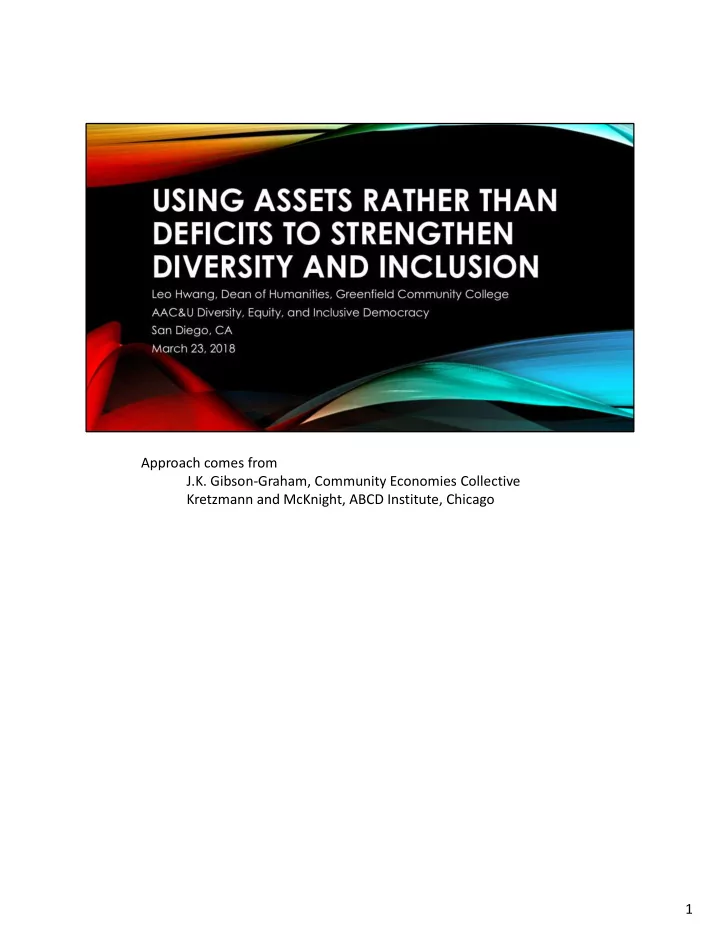
SLIDE 1
Approach comes from J.K. Gibson-Graham, Community Economies Collective Kretzmann and McKnight, ABCD Institute, Chicago 1
SLIDE 2
Predominantly Caucasian 2001 4.8% POC Students 4.8% POC Faculty and Staff 4.8% POC Residents in service area 2018 20% POC Students 9% Residents in service area 4.8% Faculty and Staff Plus GCC has become a valued resource for students of color. Best graduation rate in the state Very small achievement gap Negative Progressive faculty and staff have not kept up with changing populations, changing times One of the smallest community colleges in MA so funding resources low, turnover of faculty and staff slow Diversity Task Force in 2006 produced a report that was not 2
SLIDE 3
fully embraced or acted on by faculty, staff, or administration Old narrative: There are not enough POC students in our region to warrant a concerted effort New narrative: Faculty and staff are seeing the changing populations in their classrooms, hallways and offices The future growth in population and student body in Franklin County will come predominantly from POC. 2
SLIDE 4
New Initiatives Beacon (faculty, staff, students) Asset Mapping Creating living definitions Just One Thing Fermenting collective change through individual actions First Minute Response (from Framingham State U.) Anticipating the need for the college to anticipate addressing a current event of concern Black Lives Matter Confederate Statues DACA School Shootings Inclusion Pledge Politics, Sex, Religion Forums Annual Diversity Focused Panel Discussion Dismantling Institutionalized Racism #MeToo Movement 3
SLIDE 5
The Research Project Linda McCarthy, Sociologist 12 Students Trained in co-facilitation Asset-Based Community Development Diversity wheel 4 Focus Groups with Students What/where is GCC doing well with diversity and inclusion? Analysis Who/what offices/policies are identified? Faculty/Staff Focus Groups Student identified faculty and staff are pulled together to share what they think they are doing that encourages a positive environment for diversity and inclusion. Peer to peer learning model A couple of students continue co-facilitating 4
SLIDE 6
Let’s Talk Shop Faculty, staff, offices identified by students hold targeted workshops on specific issues Difficult Conversations Gender Pronouns Collaboration between academic and co- curricular programming Inclusive classrooms and offices Personal, professional, persona: Where is the boundary? Troubleshooting Language: keeping up with the latest lingo 5
SLIDE 7
Collective Voices—Common Ground Student group to talk about issues of diversity, equity, inclusion, identity Focus on #MeToo 6
SLIDE 8
Asset-Based Community Development model Glass of water Deficits vs Assets Deficits emphasize the impossibility Lack of resources Personnel Funding Time Assets emphasize possibility engender agency Much easier to do something with available resources Theory of possibility 7
SLIDE 9
Participatory Action Research methodology Who creates knowledge? From an institutional perspective, it seems easier to request data from IR or hire a consultant to do a survey, etc. then propose a solution. Action steps, policy change Primarily based on deficit-based model This perspective is necessary, but is also the default Community Generated Knowledge Rather than having an expert come in and explain strengths and deficits, ask the community to generate the data Asset bias to privilege possibility and agency Asset Mapping Analysis of assets to potential projects/endeavors Facilitator role/co-researchers 8
SLIDE 10
Leverage assets to strengthen diversity and inclusion rather than bogging down in the deficits and the absence of needed resources Building on strengths rather than focusing on weakness can engender a grassroots’ approach to change customized to the culture and history of the institution. 9
SLIDE 11
Asset Mapping How do we define assets? Physical Offices Staff Practices Preferred name policy Men of Color Student Support Group Individual Multicultural Conflict Mediation Training Personal library of books in office Life experiences growing up Korean 10
SLIDE 12
First work independently generating a personal/institutional asset map 5 min Next: Share with partner, ask questions, then add to your own map 5 min Compile collective map 5 min 11
SLIDE 13
Analysis 10 min Where do we see possibility? Where can we learn from one another? Potential Next Steps 5 min 12
SLIDE 14
13
SLIDE 15
14
SLIDE 16
15
SLIDE 17
16
SLIDE 18
17
SLIDE 19
18
SLIDE 20
19
SLIDE 21
20
SLIDE 22
Panel Discussion on Institutionalized Racism Formation of the Beacon Group Living definitions of terminology Asset Mapping Initiatives Just One Thing Pledge to support the GCC Statement of Inclusion Politics, Religion, and Sex Diversity and Inclusion Research Project Train students to be co-facilitators Focus groups with students Asset Mapping for where GCC is doing well with diversity and inclusion Focus groups with faculty and staff identified in student groups What are faculty and staff specifically doing that makes an impact on students and how? Collective Voices—Common Ground In response to the student experience in the facilitator training. This group will provide a forum for students to explore issues of identity, diversity, and community. We will work together to generate ideas for positive 21
SLIDE 23
social change. Difficult Conversations 21
SLIDE 24
22
SLIDE 25
23
SLIDE 26
24
SLIDE 27
25
SLIDE 28
26
SLIDE 29
27
SLIDE 30
28
SLIDE 31
29