Applying for Tax-Exempt Status with Form 1023-EZ Seattle, - - PDF document

applying for tax exempt
SMART_READER_LITE
LIVE PREVIEW

Applying for Tax-Exempt Status with Form 1023-EZ Seattle, - - PDF document

6/8/2015 The New Normal: Applying for Tax-Exempt Status with Form 1023-EZ Seattle, Washington June 15, 2015 Initial questions. Does proposed purpose qualify for 501(c)(3) status? Do you have an initial board of directors, majority


slide-1
SLIDE 1

6/8/2015 1

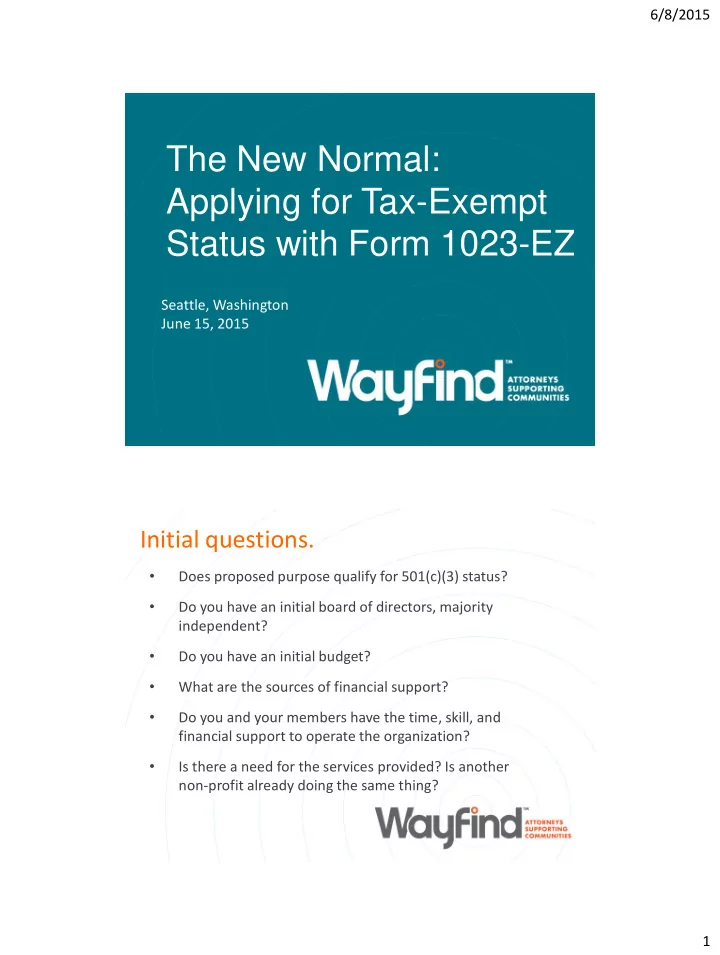
The New Normal: Applying for Tax-Exempt Status with Form 1023-EZ

Seattle, Washington June 15, 2015

  • Does proposed purpose qualify for 501(c)(3) status?
  • Do you have an initial board of directors, majority

independent?

  • Do you have an initial budget?
  • What are the sources of financial support?
  • Do you and your members have the time, skill, and

financial support to operate the organization?

  • Is there a need for the services provided? Is another

non-profit already doing the same thing?

Initial questions.

slide-2
SLIDE 2

6/8/2015 2

Non-Profit vs. Tax-Exempt

Non-Profits (formed with state )

501(c)(3) Tax- Exempt non-profits (tax-exempt status granted by IRS)

  • Tax-Exempt
  • “Tax-exempt” usually means exempt from federal

income tax

  • Most common type is 501(c)(3) charity.
  • Other types of tax-exempt organizations include:
  • 501(c)(4): “social welfare organizations”
  • 501(c)(5): unions and agricultural organizations
  • 501(c)(6): trade associations
  • 501(c)(7): social clubs
  • 501(c)(8) and (10): fraternal organizations

Are Non-Profit and Tax-Exempt the Same?

slide-3
SLIDE 3

6/8/2015 3

Why Become a 501(c)(3) Tax-Exempt Organization?

  • Contributions from

donors are tax deductible

Tax Deductible Donations

  • Organization’s income

(with limited exceptions) is exempt from income tax

Income Tax Benefits

  • Some organizations are automatically exempt

(e.g., churches)

  • Most organizations must file application for

tax-exempt status with IRS

  • Two different applications depending on type

and operations of organization:

  • Form 1023
  • Form 1023-EZ

Obtaining 501(c)(3) Tax-Exempt Status

slide-4
SLIDE 4

6/8/2015 4

  • 12-page core questionnaire
  • 14 pages of supplemental schedules
  • Submission of detailed information regarding activities
  • f organization and all organizational documents
  • 2-page checklist
  • $400 or $850 filing fee
  • Form submitted by mail to IRS
  • Response time by IRS typically 4-15 months

Form 1023

  • Applications began taking much longer in 2012
  • Reinstatements, increased volume
  • IRS budgets have been continually reduced
  • IRS response in July 2014: Form 1023-EZ
  • Reduced scrutiny at beginning with more

resources devoted towards audit and examination of organizations after tax-exempt status granted

Creation of Form 1023-EZ

slide-5
SLIDE 5

6/8/2015 5

  • 3-page core questionnaire
  • 7-page worksheet (part of instructions)
  • Only limited information submitted regarding activities
  • f organization
  • $400 filing fee
  • Form submitted online
  • Response time by IRS typically 2-3 weeks

Form 1023-EZ

Smaller Organizations

  • Annual gross receipts: $50,000 or less for 3 years
  • Total assets: $250,000 or less
  • Organizations that cannot file: formed as LLC, has

foreign address, is a successor to a for-profit entity, hospitals, universities, and credit counseling services

Who Can File 1023-EZ?

slide-6
SLIDE 6

6/8/2015 6

  • Form organization with state by filing Articles of

Incorporation

  • Obtain Tax Identification Number (Form SS-4)
  • Elect directors, officers, and adopt bylaws and
  • rganizational policies
  • Form articles, bylaws, and conflict of interest policy found
  • n www.Wayfindlegal.org
  • Apply for tax-exempt status
  • Apply within 27 months of formation

Initial Steps For All Organizations

  • Gather organizational documents and board information
  • Instructions and Questionnaire:
  • http://www.irs.gov/pub/irs-pdf/i1023-EZ.pdf
  • If you answer “yes” to any question, you cannot file Form

1023-EZ and must file Form 1023

  • You do not submit with application
  • Refer to Instructions
  • Form 1023-EZ
  • Completed online at pay.gov
  • Refer to Form

Completing Form 1023-EZ

slide-7
SLIDE 7

6/8/2015 7

Form 1023-EZ, Part I highlights

  • Top of page 1, Attestation of Eligibility
  • Line 2, Employer Identification Number:
  • Obtained by completing Form SS-4 after organization has

been formed with state

  • Line 8, Names, titles, and addresses of officers and directors
  • If more than 5 directors and officers, use priority list in

instructions

  • Can use organization’s address for board members
  • What if directors are related?

Completing Form 1023-EZ, cont.

Form 1023-EZ, Part II highlights

  • Lines 5-7, attestation regarding purpose, limitations,

and dissolution

  • Purpose: see sample Articles of Incorporation

(Article 3.1)

  • Limitations: see sample Articles of Incorporation

(Article 3.2.1 and Article 3.2.3)

  • Dissolution: see sample Articles of Incorporation

(Article 3.2.2)

Completing Form 1023-EZ, cont.

slide-8
SLIDE 8

6/8/2015 8

Organizational test

  • Articles of Incorporation must contain:
  • Purposes clause limiting purposes of the corporation to

501(c)(3) purposes only

  • Dissolution clause providing assets will be distributed on

dissolution only for exempt purposes (or to a government)

  • Articles of Incorporation cannot contain:
  • Provisions expressly empowering organization to engage in

non-exempt activity (e.g., political activity, distributing assets to private individuals or for-profit businesses)

501(c)(3) tax-exempt status

Charitable Activities

  • relief of the poor and distressed or of the underprivileged;
  • advancement of religion;
  • advancement of education or science;
  • erection or maintenance of public buildings, monuments, or works;

lessening of the burdens of Government; and

  • promotion of social welfare to:
  • lessen neighborhood tensions;
  • eliminate prejudice and discrimination;
  • defend human and civil rights secured by law;
  • combat community deterioration and juvenile delinquency.

Completing Form 1023-EZ, cont.

slide-9
SLIDE 9

6/8/2015 9

IRS resources regarding qualification for 501(c)(3) status:

  • irs.gov/Charities-&-Non-Profits/Charitable-Organizations/
  • IRS Publication 557 (“the basics”)
  • IRS Publication 1828 (for churches and religious orgs.)
  • IRS Publication 4220 (application process)
  • IRS Publication 1771 (charitable contributions)
  • IRS Publication 598 (unrelated business)

Completing Form 1023-EZ, cont.

Form 1023-EZ, Part III highlights

  • Line 1, NTEE code
  • See pages 18-20 of instructions
  • Line 3, attestation regarding prohibited activities
  • Lines 4 through 11, other activities
  • Not necessarily disqualifying, but may raise IRS

questions

Completing Form 1023-EZ, cont.

slide-10
SLIDE 10

6/8/2015 10

Operational test

  • This is about the activities of the non-profit
  • “Operated exclusively” for exempt purpose
  • “Exclusively” = “No substantial part” of

activities may be for a non-exempt purpose

  • Absolute prohibition on two things:
  • political campaign activity
  • “private inurement”

Completing Form 1023-EZ, cont.

  • What is “private inurement?”
  • Any use of charity’s assets or income for the benefit of an insider
  • “Insider” has no precise definition but likely includes:
  • Officers and directors
  • Major contributors
  • Key employees
  • Family of the above
  • Examples
  • Loans to directors, use of charitable property by officers for
  • wn benefit, building of charitable property on property
  • wned by director

Completing Form 1023-EZ, cont.

slide-11
SLIDE 11

6/8/2015 11

Form 1023-EZ, Part V highlights

  • Line 1, 509(a)(1) vs. 509(a)(2)
  • 509(a)(1) organizations are supported by donations to

the organization by the general public

  • 509(a)(2) organizations are supported by combination
  • f gifts, grants, contributions, membership fees and

gross receipts

  • Complete hypothetical Schedule A to 990 or 990-EZ to

determine more favorable classification based upon projected sources of funds

Completing Form 1023-EZ, cont.

Form 1023-EZ, Part VI highlights

  • Signed by officer, director, or trustee – not the

lawyer

  • Form submitted online by payment with credit
  • r debit card
  • If no IRS questions, organization should hear

from IRS in 2-4 weeks after submission

Completing Form 1023-EZ, cont.

slide-12
SLIDE 12

6/8/2015 12

  • Filing Tax Returns
  • Form 990, 990-EZ, 990N
  • Must file regardless of activities of
  • rganization
  • Failure to file for 3 years = revocation of

tax-exempt status

  • Staying up to date with the state
  • Annual filings

After Submission of Application

  • If organization does not qualify to submit Form

1023-EZ, it must file Form 1023

  • Form 1023 requires much more preparation

and submission of substantial information regarding activities of organization

  • Follow directions carefully and include all

required information

  • Consider consulting attorney

Filing Form 1023