Applied Machine Learning CIML Chap 4 (A Geometric Approach) - - PowerPoint PPT Presentation

applied machine learning
SMART_READER_LITE
LIVE PREVIEW

Applied Machine Learning CIML Chap 4 (A Geometric Approach) - - PowerPoint PPT Presentation

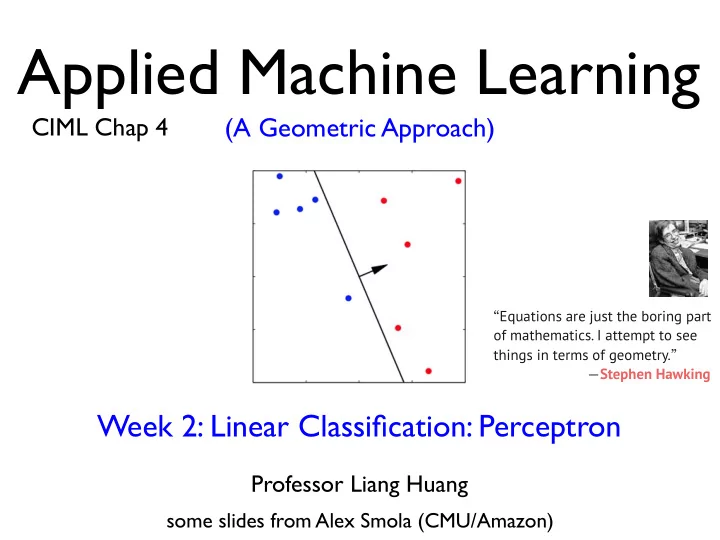
Applied Machine Learning CIML Chap 4 (A Geometric Approach) Equations are just the boring part of mathematics. I attempt to see things in terms of geometry. Stephen Hawking Week 2: Linear Classification: Perceptron Professor Liang


slide-1
SLIDE 1

Applied Machine Learning

Professor Liang Huang

Week 2: Linear Classification: Perceptron

some slides from Alex Smola (CMU/Amazon)

CIML Chap 4

(A Geometric Approach)

“Equations are just the boring part

  • f mathematics. I attempt to see

things in terms of geometry.” ―Stephen Hawking

slide-2
SLIDE 2
  • Week 2: Linear Classifier and Perceptron
  • Part I: Brief History of the Perceptron
  • Part II: Linear Classifier and Geometry (testing time)
  • Part III: Perceptron Learning Algorithm (training time)
  • Part IV: Convergence Theorem and Geometric Proof
  • Part

V: Limitations of Linear Classifiers, Non-Linearity, and Feature Maps

  • Week 3: Extensions of Perceptron and Practical Issues
  • Part I: My Perceptron Demo in Python
  • Part II:

Voted and Averaged Perceptrons

  • Part III: MIRA and Aggressive MIRA
  • Part IV: Practical Issues and HW1
  • Part

V: Perceptron vs. Logistic Regression (hard vs. soft); Gradient Descent

Roadmap for Weeks 2-3

2

slide-3
SLIDE 3
  • Brief History of the Perceptron

Part I

3

slide-4
SLIDE 4

Perceptron

Frank Rosenblatt

(1959-now)

slide-5
SLIDE 5

perceptron

1959

SVM

1964;1995

logistic regression

1958

  • cond. random fields

2001

structured perceptron

2002

multilayer perceptron deep learning

~1986; 2006-now

5

structured SVM

2003

kernels

1964

slide-6
SLIDE 6

Neurons

  • Soma (CPU)

Cell body - combines signals

  • Dendrite (input bus)

Combines the inputs from several other nerve cells

  • Synapse (interface)

Interface and parameter store between neurons

  • Axon (output cable)

May be up to 1m long and will transport the activation signal to neurons at different locations

6

slide-7
SLIDE 7

Frank Rosenblatt’s Perceptron

7

slide-8
SLIDE 8

Multilayer Perceptron (Neural Net)

8

slide-9
SLIDE 9

Brief History of Perceptron

1959 Rosenblatt invention 1962 Novikoff proof 1969* Minsky/Papert book killed it 1999 Freund/Schapire voted/avg: revived 2002 Collins structured 2003

Crammer/Singer

MIRA 1997 Cortes/Vapnik SVM 2006

Singer group

aggressive 2005*

McDonald/Crammer/Pereira

structured MIRA

DEAD

*mentioned in lectures but optional (others papers all covered in detail)

  • nline approx.

max margin

+max margin + k e r n e l s +soft-margin c

  • n

s e r v a t i v e u p d a t e s i n s e p a r a b l e c a s e

2007--2010

Singer group

Pegasos

subgradient descent minibatch

minibatch batch

  • nline

AT&T Research ex-AT&T and students

9

slide-10
SLIDE 10
  • Linear Classifier and Geometry (testing time)
  • decision boundary and normal vector w
  • not separable through the origin: add bias b
  • geometric review of linear algebra
  • augmented space (no explicit bias; implicit as w0=b)

Part II

10

Prediction σ(w ·x)

Test Time Training Time

Linear Classifier

Input x Model w

Perceptron Learner

Input x Output y

Model w

slide-11
SLIDE 11

σ

Linear Classifier and Geometry

f(x) = σ(w · x)

O

w

separating hyperplane (decision boundary)

w · x = 0

11

linear classifiers: perceptron, logistic regression, (linear) SVMs, etc.

positive

w · x > 0

x1

x2

weight vector w: “prototype” of positive examples it’s also the normal vector of the decision boundary meaning of w · x: agreement with positive direction test: input: x, w; output:1 if w · x >0 else -1 training: input: (x, y) pairs; output: w

w · x < 0

negative

x

θ

x1 x2 x3 xn . . .

  • utput

wn

weights

w1

kxk cos θ = w · x

kwk

slide-12
SLIDE 12

What if not separable through origin?

positive negative

O

x

12

w · x + b = 0

w · x + b > 0

w · x + b < 0 |b| kwk

w

solution: add bias b

kxk cos θ

θ

x1 x2 x3 xn . . .

  • utput

wn

weights

w1

f(x) = σ(w · x + b)

x1

x2

= w · x kwk

slide-13
SLIDE 13

Geometric Review of Linear Algebra

13

line in 2D (n-1)-dim hyperplane in n-dim

O

x1

x2

w1x1 + w2x2 + b = 0

O

x1

x2

w · x + b = 0

x3

(x∗

1, x∗ 2)

point-to-line distance point-to-hyperplane distance

x∗

|w · x + b| kwk

|b| k(w1, w2)k

|w1x∗

1 + w2x∗ 2 + b|

p w2

1 + w2 2

= |(w1, w2) · (x1, x2) + b| k(w1, w2)k

(w1, w2)

http://classes.engr.oregonstate.edu/eecs/fall2017/cs534/extra/LA-geometry.pdf

required: algebraic and geometric meanings of dot product

slide-14
SLIDE 14

Augmented Space: dimensionality+1

x1 x2 x3 xn . . .

  • utput

wn

weights

w1

x0 = 1

14

x1 x2 x3 xn . . .

  • utput

wn

weights

w1

w0 = b

explicit bias

f(x) = σ(w · x + b)

augmented space

f(x) = σ((b; w) · (1; x))

O 1

can’t separate in 1D from the origin can separate in 2D from the origin

O

slide-15
SLIDE 15

Augmented Space: dimensionality+1

15

x1 x2 x3 xn . . .

  • utput

wn

weights

w1

explicit bias

f(x) = σ(w · x + b)

x1 x2 x3 xn . . .

  • utput

wn

weights

w1

x0 = 1

w0 = b

augmented space

f(x) = σ((b; w) · (1; x))

can’t separate in 2D from the origin can separate in 3D from the origin

slide-16
SLIDE 16
  • The Perceptron Learning Algorithm (training time)
  • the version without bias (augmented space)
  • side note on mathematical notations
  • mini-demo

Part III

16

Prediction σ(w ·x)

Test Time Training Time

Linear Classifier

Input x Model w

Perceptron Learner

Input x Output y

Model w

slide-17
SLIDE 17

Perceptron

Spam Ham

17

slide-18
SLIDE 18

The Perceptron Algorithm

18

input: training data D

  • utput: weights w

initialize w ← 0 while not converged aafor (x, y) ∈ D aaaaif y(w · x) ≤ 0 aaaaaaw ← w + yx

  • the simplest machine learning algorithm
  • keep cycling through the training data
  • update w if there is a mistake on example (x, y)
  • until all examples are classified correctly

x w w0

slide-19
SLIDE 19

Side Note on Mathematical Notations

  • I’ll try my best to be consistent in notations
  • e.g., bold-face for vectors, italic for scalars, etc.
  • avoid unnecessary superscripts and subscripts by using a

“Pythonic” rather than a “C” notational style

  • most textbooks have consistent but bad notations

19

initialize w = 0 and b = 0 repeat if yi [hw, xii + b]  0 then w w + yixi and b b + yi end if until all classified correctly

bad notations: inconsistent, unnecessary i and b initialize w ← 0 while not converged aafor (x, y) ∈ D aaaaif y(w · x) ≤ 0 aaaaaaw ← w + yx good notations: consistent, Pythonic style

slide-20
SLIDE 20

Demo

(bias=0)

20

x w

← while not converged aafor (x, y) ∈ D aaaaif y(w · x) ≤ 0 aaaaaaw ← w + yx

slide-21
SLIDE 21

Demo

(bias=0)

20

x w

← while not converged aafor (x, y) ∈ D aaaaif y(w · x) ≤ 0 aaaaaaw ← w + yx

slide-22
SLIDE 22

Demo

(bias=0)

20

x w w0

← while not converged aafor (x, y) ∈ D aaaaif y(w · x) ≤ 0 aaaaaaw ← w + yx

slide-23
SLIDE 23

Demo

21

x w

← while not converged aafor (x, y) ∈ D aaaaif y(w · x) ≤ 0 aaaaaaw ← w + yx

slide-24
SLIDE 24

Demo

22

x

← while not converged aafor (x, y) ∈ D aaaaif y(w · x) ≤ 0 aaaaaaw ← w + yx

w

slide-25
SLIDE 25

Demo

22

w0 x

← while not converged aafor (x, y) ∈ D aaaaif y(w · x) ≤ 0 aaaaaaw ← w + yx

w

slide-26
SLIDE 26

Demo

23

w

← while not converged aafor (x, y) ∈ D aaaaif y(w · x) ≤ 0 aaaaaaw ← w + yx

slide-27
SLIDE 27

24

slide-28
SLIDE 28
  • Linear Separation, Convergence Theorem and Proof
  • formal definition of linear separation
  • perceptron convergence theorem
  • geometric proof
  • what variables affect convergence bound?

Part IV

25

slide-29
SLIDE 29

Linear Separation; Convergence Theorem

  • dataset D is said to be “linearly separable” if there exists

some unit oracle vector u: ∣∣u|| = 1 which correctly classifies every example (x, y) with a margin at least ẟ:

  • then the perceptron must converge to a linear separator

after at most R2/ẟ2 mistakes (updates) where

  • convergence rate R2/ẟ2
  • dimensionality independent
  • dataset size independent
  • order independent (but order matters in output)
  • scales with ‘difficulty’ of problem

y(u · x) ≥ δ for all (x, y) ∈ D R = max

(x,y)∈Dkxk

u · x ≥ δ

u : kuk = 1

x

δ δ R

slide-30
SLIDE 30

Geometric Proof, part 1

  • part 1: progress (alignment) on oracle projection

projection on u increases! (more agreement w/ oracle direction)

27

u · x ≥ δ

assume w(0) = 0, and w(i) is the weight before the ith update (on (x, y))

w(i+1) = w(i) + yx u · w(i+1) = u · w(i) + y(u · x) u · w(i+1) ≥ u · w(i) + δ u · w(i+1) ≥ iδ

  • w(i+1)
  • = kuk
  • w(i+1)
  • u · w(i+1) iδ

δ δ ⊕

x

w(i)

u · w(i) u · w(i+1)

y(u · x) ≥ δ for all (x, y) ∈ D

w(i+1)

u : kuk = 1

slide-31
SLIDE 31

Geometric Proof, part 2

  • part 2: upperbound of the norm of the weight vector

28

x w(i+1) = w(i) + yx

  • w(i+1)
  • 2

=

  • w(i) + yx
  • 2

=

  • w(i)
  • 2

+ kxk2 + 2y(w(i) · x) 

  • w(i)
  • 2

+ R2  iR2

R = max

(x,y)∈Dkxk

θ ≥ 90

  • cos θ ≤ 0

w(i) · x ≤ 0

mistake on x

w(i)

w(i+1)

⊕ R

slide-32
SLIDE 32

Geometric Proof, part 2

  • part 2: upperbound of the norm of the weight vector

28

Combine with part 1:

i ≤ R2/δ2

  • w(i+1)
  • = kuk
  • w(i+1)
  • u · w(i+1) iδ

x w(i+1) = w(i) + yx

  • w(i+1)
  • 2

=

  • w(i) + yx
  • 2

=

  • w(i)
  • 2

+ kxk2 + 2y(w(i) · x) 

  • w(i)
  • 2

+ R2  iR2

R = max

(x,y)∈Dkxk

θ ≥ 90

  • cos θ ≤ 0

w(i) · x ≤ 0

mistake on x

w(i)

w(i+1)

√ iR

R

slide-33
SLIDE 33

Convergence Bound

  • is independent of:
  • dimensionality
  • number of examples
  • order of examples
  • constant learning rate
  • and is dependent of:
  • separation difficulty (margin ẟ)
  • feature scale (radius R)
  • initial weight w(0)
  • changes how fast it converges, but not whether it’ll converge

R2/δ2

29

narrow margin: hard to separate wide margin: easy to separate

slide-34
SLIDE 34
  • Limitations of Linear Classifiers and Feature Maps
  • XOR: not linearly separable
  • perceptron cycling theorem
  • solving XOR: non-linear feature map
  • “preview demo”: SVM with non-linear kernel
  • redefining “linear” separation under feature map

Part V

30

slide-35
SLIDE 35

XOR

  • XOR - not linearly separable
  • Nonlinear separation is trivial
  • Caveat from “Perceptrons” (Minsky & Papert, 1969)

Finding the minimum error linear separator is NP hard (this killed Neural Networks in the 70s).

31

slide-36
SLIDE 36

Brief History of Perceptron

1959 Rosenblatt invention 1962 Novikoff proof 1969* Minsky/Papert book killed it 1999 Freund/Schapire voted/avg: revived 2002 Collins structured 2003

Crammer/Singer

MIRA 1997 Cortes/Vapnik SVM 2006

Singer group

aggressive 2005*

McDonald/Crammer/Pereira

structured MIRA

DEAD

*mentioned in lectures but optional (others papers all covered in detail)

  • nline approx.

max margin

+max margin + k e r n e l s +soft-margin c

  • n

s e r v a t i v e u p d a t e s i n s e p a r a b l e c a s e

2007--2010*

Singer group

Pegasos

subgradient descent minibatch

minibatch batch

  • nline

AT&T Research ex-AT&T and students

32

slide-37
SLIDE 37

What if data is not separable

  • in practice, data is almost always inseparable
  • wait, what exactly does that mean?
  • perceptron cycling theorem (1970)
  • weights will remain bounded and will not diverge
  • use dev set for early stopping (prevents overfitting)
  • non-linearity (inseparable in low-dim => separable in high-dim)
  • higher-order features by combining atomic ones (cf. XOR)
  • a more systematic way: kernels (more details in week 5)

33

slide-38
SLIDE 38

Solving XOR: Non-Linear Feature Map

  • XOR not linearly separable
  • Mapping into 3D makes it easily linearly separable
  • this mapping is actually non-linear (quadratic feature x1x2)
  • a special case of “polynomial kernels” (week 5)
  • linear decision boundary in 3D => non-linear boundaries in 2D

(x1, x2) (x1, x2, x1x2)

34

slide-39
SLIDE 39

Low-dimension <=> High-dimension

35

slide-40
SLIDE 40

Low-dimension <=> High-dimension

35

not linearly separable in 2D

slide-41
SLIDE 41

Low-dimension <=> High-dimension

35

not linearly separable in 2D linearly separable in 3D

slide-42
SLIDE 42

Low-dimension <=> High-dimension

35

not linearly separable in 2D linearly separable in 3D linear decision boundary in 3D

slide-43
SLIDE 43

Low-dimension <=> High-dimension

35

not linearly separable in 2D linearly separable in 3D linear decision boundary in 3D non-linear boundaries in 2D

slide-44
SLIDE 44
slide-45
SLIDE 45

Linear Separation under Feature Map

  • we have to redefine separation and convergence theorem
  • dataset D is said to be linearly separable under feature map ϕ if

there exists some unit oracle vector u: ∣∣u|| = 1 which correctly classifies every example (x, y) with a margin at least ẟ:

  • then the perceptron must converge to a linear separator after at

most R2/ẟ2 mistakes (updates) where

  • in practice, the choice of feature map (“feature engineering”) is
  • ften more important than the choice of learning algorithms
  • the first step of any machine learning project is data preprocessing:

transform each (x, y) to (ϕ(x), y)

  • at testing time, also transform each x to ϕ(x)
  • deep learning aims to automate feature engineering

37

R = max

(x,y)∈DkΦ(x)k

y(u · Φ(x)) ≥ δ for all (x, y) ∈ D