
Intro to Markov Chains
CS 70, Summer 2019 Lecture 26, 8/7/19
1 / 23
Applications of Markov Chains
I Models systems of states and transitions I PageRank – Google’s search algorithm. States are webpages, transitions are links. I Tons of applications outside of CS: statistical physics, speech recognition, bioinformatics, sabermetrics...
2 / 23
↳
baseball
statistics
!
Markov Chain Definition
Three key components (and one assumption): I Set S of Think of these as I Transition probabilities. Think of these as Transitions out of a node should sum to I Initial distribution µ(0). Gives the probability that we start at a state. I Memorylessness (aka Markov property)
3 / 23
States vertices
- f
a graph
Pfi
→ j ]
directed edges
in a graph
1
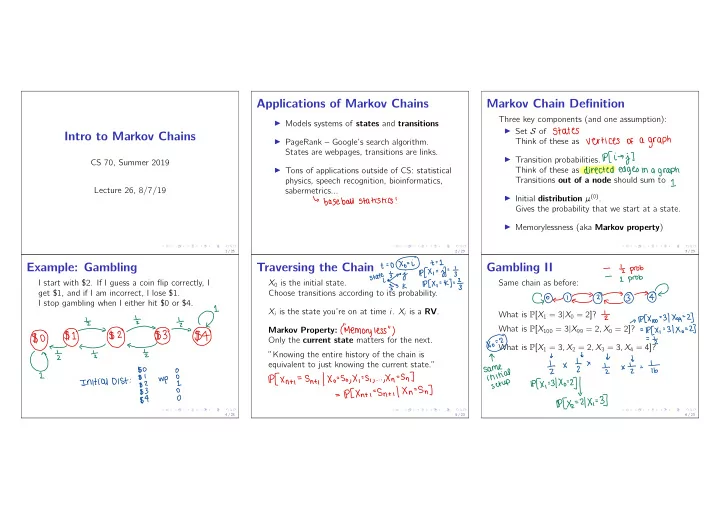
Example: Gambling
I start with $2. If I guess a coin flip correctly, I get $1, and if I am incorrect, I lose $1. I stop gambling when I either hit $0 or $4.
4 / 23
④
¥④÷F④÷÷④±$
↳
Initial Dist
:
¥ggIg
,
WP
gig
$
Traversing the Chain
X0 is the initial state. Choose transitions according to its probability. Xi is the state you’re on at time i. Xi is a RV. Markov Property: Only the current state matters for the next. ”Knowing the entire history of the chain is equivalent to just knowing the current state.”
5 / 23
+
=opf
hit 's
state .io/IYkpCx.=kI-- I
3-
(
"Memory less
" )
lpfxnti-sntilxo-sgxi.si
,
. ..gl/n--SnT--lPCXnti--Sn+i/Xn--Sn ]
Gambling II
Same chain as before: What is P[X1 = 3|X0 = 2]? What is P[X100 = 3|X99 = 2, X0 = 2]? What is P[X1 = 3, X2 = 2, X3 = 3, X4 = 4]?
6 / 23
- Iz
prob
- I
prob
G⑨←①0③→④ ?
¥
→ 117%0--31×99=2]
=p[ X , -31×0=2]
= Lz"
Ix Ix ¥x¥
.- it
sagging
xxx :3 "
.
axed