APPEARANCE IN ICECUBE September 29 th 2017 ATMOSPHERIC TAU NEUTRINOS - - PowerPoint PPT Presentation

β–Ά
appearance in icecube
SMART_READER_LITE
LIVE PREVIEW

APPEARANCE IN ICECUBE September 29 th 2017 ATMOSPHERIC TAU NEUTRINOS - - PowerPoint PPT Presentation

TAU NEUTRINO Philipp Eller Penn State University APPEARANCE IN ICECUBE September 29 th 2017 ATMOSPHERIC TAU NEUTRINOS - Intrinsic production in atmosphere negligible - When studying O(10) GeV Neutrinos and below, earth diameter provides


slide-1
SLIDE 1

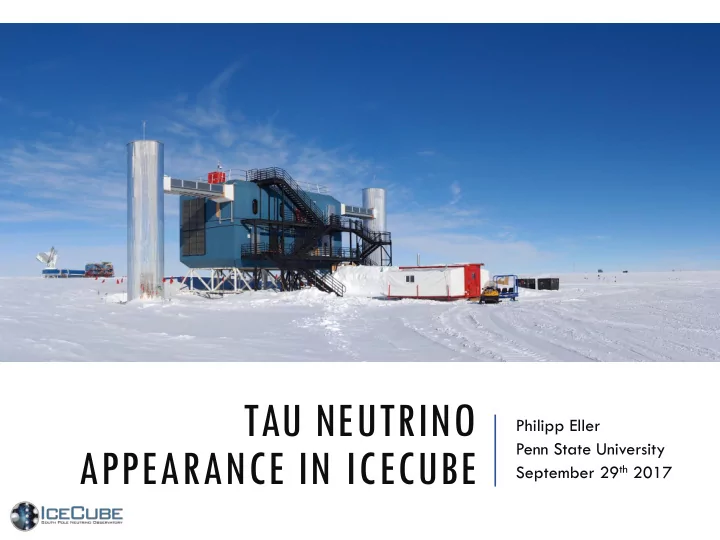
TAU NEUTRINO APPEARANCE IN ICECUBE

Philipp Eller Penn State University September 29th 2017
slide-2
SLIDE 2

ATMOSPHERIC TAU NEUTRINOS

2

πœ‰πœˆβ†’πœ‰e πœ‰πœˆβ†’πœ‰πœˆ πœ‰πœˆβ†’πœ‰πœ

Matter effects, here: transition to earth’s core

  • Intrinsic πœ‰Ο„ production in atmosphere negligible
  • When studying O(10) GeV Neutrinos and below, earth diameter provides

perfect L/E to look at πœ‰πœˆ disappearance

  • We look at events in the Energy-cos(zenith) plane
  • A disappeared πœ‰πœˆ should mostly appear in the πœ‰Ο„ flavor

cos(zenith) ο‚΅ baseline

slide-3
SLIDE 3

PREVIOUS RESULTS

  • OPERA 2015 (https://arxiv.org/abs/1507.01417)
  • CNGS ~17 GeV muon neutrinos / 732 km baseline
  • Observation of πœ‰Ο„ appearance with 5.1 sigma significance
  • Total of 5 individually identified πœ‰Ο„ candidates (over 0.25 total background)
  • Only weak constraints on πœ‰Ο„ normalization: 1.8 -1.1 +1.8 (90% C.L.)
  • Super-K 2016 (presented at Neutrino 2016)
  • Evidence with a significance of 4.6 sigma
  • Based on 15 years of data
  • Best constraint on πœ‰Ο„ normalization with 1.42 +/- 0.32 (68% C.L.)
  • Energies around ~5 GeV

3

slide-4
SLIDE 4

RELEVANCE

  • Ο„-sector of Neutrino oscillations is the least well measured
  • Experimental constraints ~order of magnitude worse than for e and Β΅ sectors
  • Measurement of tau appearance can be used to test PMNS unitarity
  • Deviation from unitarity can be an indicator for new physics

4

Park & Ross-Lonergan, 2015 All these contain one

  • r more Ο„-

elements

slide-5
SLIDE 5

DEEPCORE EXTENSION OF ICECUBE

  • Additional 8 strings with densely spaced, high efficiency optical modules

(DOMs) in addition to the 78 standard IceCube strings

  • In clearest part of Ice (below dust layer)
  • Surrounded by IceCube strings

(used as atm. muon veto)

  • Neutrino energies down to ~5 GeV

5

slide-6
SLIDE 6

CC AND NC INTERACTIONS

  • Charged Current (CC) interaction of neutrinos

reveals their flavor from the outgoing lepton

  • This channel needed to unambiguously identify πœ‰Ο„ (e.g. OPERA)
  • Cross-section suppressed by heavy Ο„, threshold energy of 3.5

GeV, cross section ~order of magnitude lower than that of πœ‰πœˆ

  • Neutral Current (NC) interactions are

indistinguishable for the 3 flavors

  • Still, the disappearance and appearance happen in specific

locations in L/E

  • can be used to help constrain the πœ‰Ο„ normalization

* for better comparison we provide both result separately, CC+NC and CC-only

6

slide-7
SLIDE 7

ICECUBE EVENT SIGNATURES

  • Fully contained events inside the DeepCore fiducial Volume
  • Reconstructed using a full Cascade + Track hypothesis
  • position, direction, energy and PID (= track or cascade like event)

7

Nucl eus

πœ‰πœˆ

𝜈

Hadron shower Cherenkov light

Nucl eus

πœ‰e/Ο„

Hadron shower (EM shower)

Typical πœ‰πœˆ event: Energy deposited in

  • Extended muon

track (E ~ length)

  • Hadron shower from

e.g. DIS Typical πœ‰e/Ο„ event: All energy deposited in form of showers (hadronic and electro-magnetic) Spatially more compact (no track) Track like Cascade like

slide-8
SLIDE 8

EVENT CLASSIFICATION

8

  • Our ability to distinguish track

and cascade events mainly depending on neutrino energy

  • Higher energy = longer muon tracks
  • Separation based on an

additional reconstruction using cascade only (no track)

  • Difference in likelihood to the standard

reconstruction used as classifier

slide-9
SLIDE 9

ANALYSIS

9

  • Actual fit of the data is done using two 2d-histograms
  • Reconstructed neutrino energy (between 5.6 and 56 GeV)
  • Reconstructed zenith angle (covering the full sky from cos(zenith) -1 to +1)
  • Using 8x8 bins, for cascade and track like events separately
  • S/sqrt(B) plot showing region where we get most significance from
  • S = πœ‰Ο„, B = (πœ‰e + πœ‰πœˆ + Atm. 𝜈)
slide-10
SLIDE 10

SYSTEMATIC UNCERTAINTIES

10

  • Incorporating a large variety of

nuisance parameters in the measurement

  • Covering uncertainties of:
  • Initial atmospheric neutrino flux
  • Interaction (cross sections)
  • Oscillation parameters
  • Detector uncertainties

(efficiencies of optical modules and ice uncertainties)

  • Atmospheric muon background
slide-11
SLIDE 11

DATA SAMPLE

  • Result based on 3 years
  • f data
  • Total ~41k events
  • 1.5k CC πœ‰Ο„ events
  • 600 NC πœ‰Ο„ events
  • ~2k background events from

atmospheric 𝜈

  • Excellent Data/MC agreement

11

slide-12
SLIDE 12

TAU NEUTRINO DISTRIBUTIONS

  • Visible energies distributed around ~15 GeV (Analysis range 5.6 – 56 GeV)
  • πœ‰Ο„ events appearing in upgoing (-1,0) (earth crossing trajectories)
  • Mostly classified in cascade event category

12

background subtracted data overlayed with best-fit πœ‰Ο„ expectations

slide-13
SLIDE 13

RESULT

13

  • πœ‰Ο„ normalization

(with 68% C.I.)

  • CC+NC: 1.25 +0.42 -0.37
  • CC-only: 1.20 +0.49 -0.45
  • πœ‰Ο„ appearance significance

(exclusion of no-appearance)

  • CC+NC: 4.1 Οƒ
  • CC-only: 3.0 Οƒ
  • c.f. talk β€œIceCube/DeepCore

Results and PINGU” from this session, PINGU able to constrain πœ‰Ο„ norm < 10%

slide-14
SLIDE 14

CONCLUSIONS

  • Measured πœ‰Ο„ normalizations of

1.25 +0.42 -0.37 (CC+NC) 1.20 +0.49 -0.45 (CC only)

  • Based on modestly sized 3y dataset
  • Improved event selection underway
  • Additional 2y of data already collected and experiment continues running
  • First πœ‰Ο„ appearance measurement by IceCube
  • Consistent with other results
  • Competitive result with worlds best measurements
  • Different (higher) energy regime than Super-K
  • Providing path forward for future measurements of the underexplored πœ‰Ο„ sector

β–Ί STAY TUNED!

14