AP Inflation.notebook November 25, 2015 Goal #3 Price Stability - - PDF document

ap inflation notebook november 25 2015
SMART_READER_LITE
LIVE PREVIEW

AP Inflation.notebook November 25, 2015 Goal #3 Price Stability - - PDF document

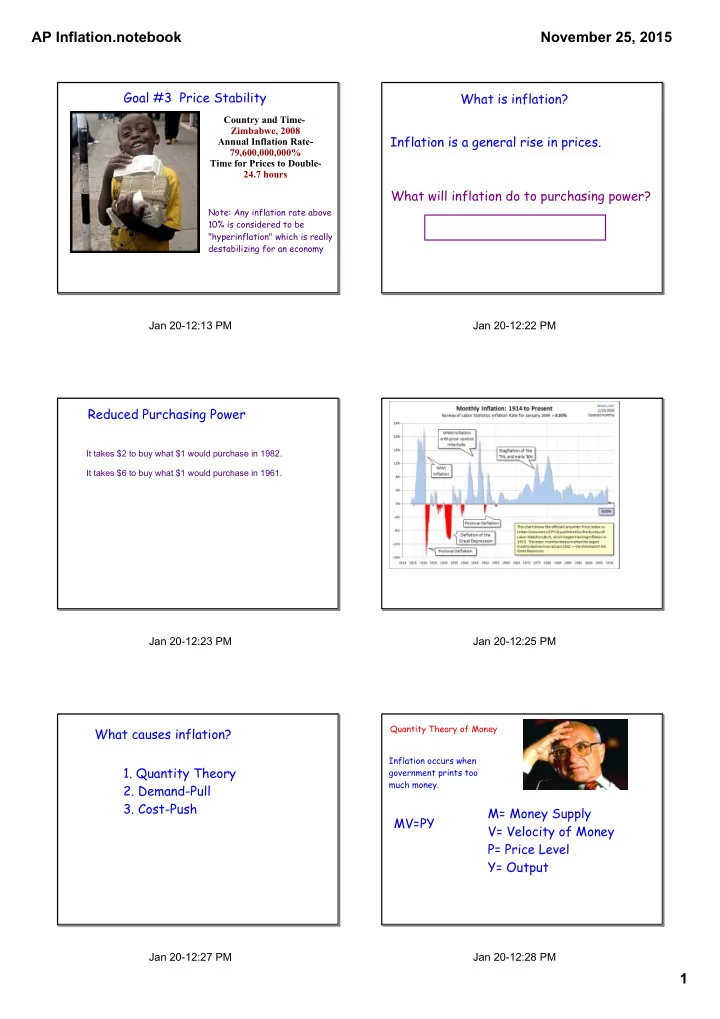
AP Inflation.notebook November 25, 2015 Goal #3 Price Stability What is inflation? Country and Time Zimbabwe, 2008 Inflation is a general rise in prices. Annual Inflation Rate 79,600,000,000% Time for Prices to Double 24.7 hours


slide-1
SLIDE 1

AP Inflation.notebook 1 November 25, 2015

Jan 20­12:13 PM

Goal #3 Price Stability

Country and Time­ Zimbabwe, 2008 Annual Inflation Rate­ 79,600,000,000% Time for Prices to Double­ 24.7 hours

Note: Any inflation rate above 10% is considered to be "hyperinflation" which is really destabilizing for an economy

Jan 20­12:22 PM

What is inflation? Inflation is a general rise in prices. What will inflation do to purchasing power? Purchasing Power will fall!

Jan 20­12:23 PM

Reduced Purchasing Power

It takes $2 to buy what $1 would purchase in 1982. It takes $6 to buy what $1 would purchase in 1961.

Jan 20­12:25 PM Jan 20­12:27 PM

What causes inflation?

  • 1. Quantity Theory
  • 2. Demand-Pull
  • 3. Cost-Push

Jan 20­12:28 PM

Quantity Theory of Money Inflation occurs when government prints too much money.

MV=PY M= Money Supply V= Velocity of Money P= Price Level Y= Output

slide-2
SLIDE 2

AP Inflation.notebook 2 November 25, 2015

Jan 20­12:32 PM

Demand-Pull Inflation "Too many dollars chasing too few goods." Essentially, higher demand for products leads to temporary shortages that drive up prices.

Jan 20­12:34 PM

Cost-Push Inflation

  • Higher production costs increase prices
  • Usually due to a negative supply shock

EX: Hurricane Katrina destroyed oil refineries decreasing the supply of oil and gas. Companies that needed to use gasoline had to raise their prices to cover fuel costs.

Can lead to STAGFLATION - rising prices coupled with FALLING real GDP.

Jan 20­12:36 PM Jan 20­12:26 PM

The Wage Price Spiral

A Perpetual Process: 1.Workers demand raises 2.Owners increase prices to pay for raises

  • 3. High prices cause workers

to demand higher raises

  • 4. Owners increase prices to

pay for higher raises

  • 5. High prices cause workers

to demand higher raises

  • 6. Owners increase prices to

pay for higher raises

Jan 20­12:41 PM

Interest Rates and Inflation

Jan 20­12:42 PM

Nominal Interest Rate v. Real Interest Rate What is the difference?

slide-3
SLIDE 3

AP Inflation.notebook 3 November 25, 2015

Jan 20­12:44 PM Real Interest Rates­

The percentage increase in purchasing power that a borrower pays. (adjusted for inflation) Real = nominal interest rate ­ expected inflation

Nominal Interest Rates­

the percentage increase in money that the borrower pays not adjusting for inflation. Nominal = Real interest rate + expected inflation

Fisher Principal - nominal rate of interest will adjust so that it is equal to real interest rate plus inflation

Jan 20­12:45 PM

Practice:

  • 1. Nominal interest rate is 15%; Rate of inflation is 10%.

What is the real interest rate?

  • 2. Nominal interest rate is 6%. The rate of inflation rises

unexpectedly to 8%. What is the real interest rate?

  • 3. The nominal interest rate is 10%. The real interest rate is

6%. What is the rate of inflation?

  • 4. Assume you have a loan on a used car at 4%. Determine

your real interest rate.

Jan 26­5:01 AM

Closing: Socrative Exit Ticket

Jan 20­12:50 PM

How do we measure inflation? 1) Consumer Price Index 2) GDP Deflator

Jan 20­1:05 PM

Consumer Price Index

  • most common measurement of inflation
  • Government tracks the same goods and services over a period
  • f time ("market basket")
  • % change in prices from year to year is the inflation rate
  • prices are also usually compared to a base year (usually 1982)

Jan 26­2:46 PM

To see recent CPI data go to: www.bls.gov

slide-4
SLIDE 4

AP Inflation.notebook 4 November 25, 2015

Jan 20­1:35 PM

CPI =

price of market basket price of market basket in a base year

X 100 See figuring CPI sheet to see an example of how CPIs are determined.

Jan 20­1:45 PM

Practice:

  • 1. CPI 2002: 100

CPI 2003: 104

  • 2. CPI 2005: 98

CPI 2006: 100

  • 3. CPI 2007: 120

CPI 2015: 135

Jan 20­1:48 PM

Problems with CPI:

  • 1. Substitution Bias - as prices rise,

people substitute for items not in the market basket

Jan 20­1:48 PM

Problems with CPI

  • 2. New Products - the basket may not

include the newest products people are buying

  • 3. Quality - CPI ignores improvements
  • r declines in quality of products

Jan 20­1:50 PM

Consumer Price Index GDP Deflator

provides a measure of inflation

measures prices of a specific set

  • f goods

and services people typically purchase measures prices of ALL goods and services produced domestically

Jan 20­1:52 PM

GDP Deflator

GDP Deflator = Nominal GDP Year 1 Real GDP Year 1 X 100 Nominal GDP = (Deflator) X (Real GDP) 100

slide-5
SLIDE 5

AP Inflation.notebook 5 November 25, 2015

Jan 20­1:56 PM

Practice:

  • 1. In an economy, Real GDP (base year 1996) is $100
  • billion. Nominal GDP is $150 billion. Calculate the GDP

Deflator.

  • 2. In an economy Real GDP (base year 1996) is $125
  • billion. Nominal GDP is $150 billion. Calculate the GDP

Deflator.

  • 3. In an economy Real GDP (base year 1996) is $200

billion and the GDP Deflator is 120. Calculate nominal GDP.

Jan 26­2:37 PM