
SLIDE 1
6/19/2015 1
IMPLICATION OF HLA ANTIBODIES & TRALI MITIGATION PROGRAM
Massimo Mangiola, Ph.D.
Director, Special Services Rhode Island Blood Center
LEARN Webinars: Management of TRALI
June 23, 2015 2:00 – 3:30 pm (EDT)
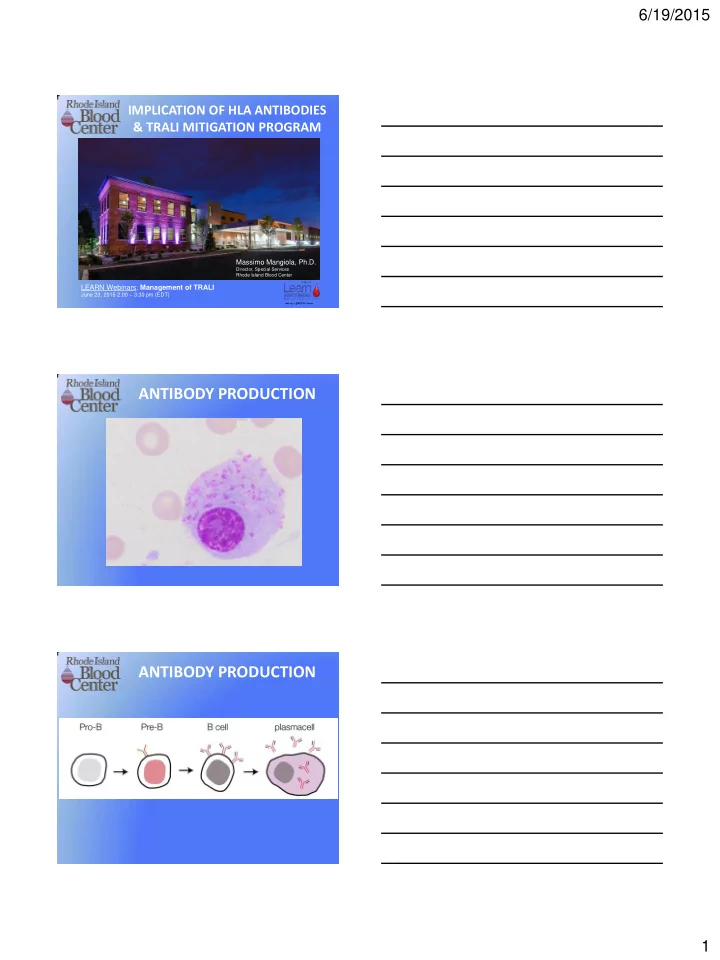
ANTIBODY PRODUCTION ANTIBODY PRODUCTION 1 6/19/2015 ANTIBODY - - PDF document
6/19/2015 IMPLICATION OF HLA ANTIBODIES & TRALI MITIGATION PROGRAM Massimo Mangiola, Ph.D. Director, Special Services Rhode Island Blood Center LEARN Webinars: Management of TRALI June 23, 2015 2:00 3:30 pm (EDT) ANTIBODY PRODUCTION
Massimo Mangiola, Ph.D.
Director, Special Services Rhode Island Blood Center
LEARN Webinars: Management of TRALI
June 23, 2015 2:00 – 3:30 pm (EDT)
About 9mm
Lumen: 5.5 mm Distance from alveolus: 0.5 mm
Lumen: 5.5 mm Distance from alveolus: 0.5 mm
Class I HLA antibody
Class II HLA antibody or FcgR
1st EVENT (1ST HIT)
Recipient predisposing clinical condition resulting in the sequestration of primed neutrophils in the lungs (cytokines promote priming and adherence of neutrophils).
2nd EVENT (2ND HIT)
Transfusion of blood product(s) carrying a biological substance able to activate primed neutrophils (i.e. leukocyte antibodies, DAMPs, LysoPC, etc.)
™DONORSCREEN HLA ASSAY
™DONORSCREEN HLA ASSAY
ANTIBODY SCREEN ASSAY
SOLID PHASE ANTIBODY SCREENING
LUMINEX SOLID PHASE
ELISA-BASED ANTIBODY SCREENING
INCUBATION WASH INCUBATION WASH INCUBATION STOP DETECTION
™DONORSCREEN HLA ASSAY
™DONORSCREEN HLA ASSAY
ANTIBODY SCREEN ASSAY
SOLID PHASE ANTIBODY SCREENING
LUMINEX SOLID PHASE
ELISA-BASED ANTIBODY SCREENING
CDC Screening Luminex Solid Phase ELISA (DonorScreen HLA)
ABC releases statement to encourage considering TRALI reduction strategies First AABB bulletin on TRALI ~1998 - 2002 2002 2004 2006 2008 - present 2016 AABB Standard 5.4.1.2 to be implemented
0-20(0.5%) 21-40 22% 41-60 56.5% >60 21%
RIBC Donor Population Age groups
High volume plasma donors 36,952 previously pregnant female Data Range: 2008 to April 2015
10000 20000 30000 40000 FEMALE BLOOD DONORS 36952 23823 13129 (35.5%) TOTAL NEGATIVE POSITIVE
Data Range: 2008 to April 2015
0-20
(0.4%) Positive Negative
41-60
(59.3%)
>60
(17.3%)
21-40
(23%)
High volume plasma donors 36,952 previously pregnant female 23, 823 negative for HLA antibodies 13,129 positive for HLA antibodies Data Range: 2008 to April 2015
0-20 (28%) 21-40 (36.5%) 41-60 (36.9%) >60 (28.8%)
Positive Negative
High volume plasma donors Rate of positive donors Normalized data by age group Data Range: 2008 to April 2015
TRALI is the leading cause of transfusion-related fatalities HLA antibodies can induce TRALI in sensitized recipients HLA pregnancy antibodies can disappear overtime HLA antibodies detection can be done by Luminex or ELISA solid phase RIBC TRALI Mitigation program started around 1998. Since then, only ~400 TRALI investigation have been done. Of these, only 5% had HLA antibodies in the donor sample and just a handful of cases may be due to reverse-TRALI. Donor age is NOT a factor; number of pregnancies may be more relevant
Mitigation proves to be effective in reducing TRALI occurrence An action plan must be in place by October 1st, 2016
Mitigation proves to be effective in reducing TRALI occurrence An action plan must be in place by October 1st, 2016
Should positive donors be re-screened and when ? If a donor is still positive after re-screen, should testing be repeated ? testing frequency ? for how long to re-test ? Because age of donor does not seems to be a factor, changes in recruitment strategies may not help in decreasing the positive rate. Can PAS help us in re-entry of some aphaeresis donor ? How do we establish which donor to re-entry with PAS ? Should we consider transfusion risk ? What about HNA antibody screening ? What else ? LEARN Webinars: Management of TRALI
May 21, 2015 2:00 – 3:30 pm (EDT)