Antibiotics in GP WONCA October 2015 Dr Nuala O Connor IRL Dr - - PowerPoint PPT Presentation

antibiotics in gp wonca october 2015
SMART_READER_LITE
LIVE PREVIEW

Antibiotics in GP WONCA October 2015 Dr Nuala O Connor IRL Dr - - PowerPoint PPT Presentation

Quality Circles at a glance Use of Antibiotics in GP WONCA October 2015 Dr Nuala O Connor IRL Dr Christina Svanholm Dk Dr Andree Rochfort IRL Key Learning objectives- Participants and Facilitators Understand the scale of the problem


slide-1
SLIDE 1

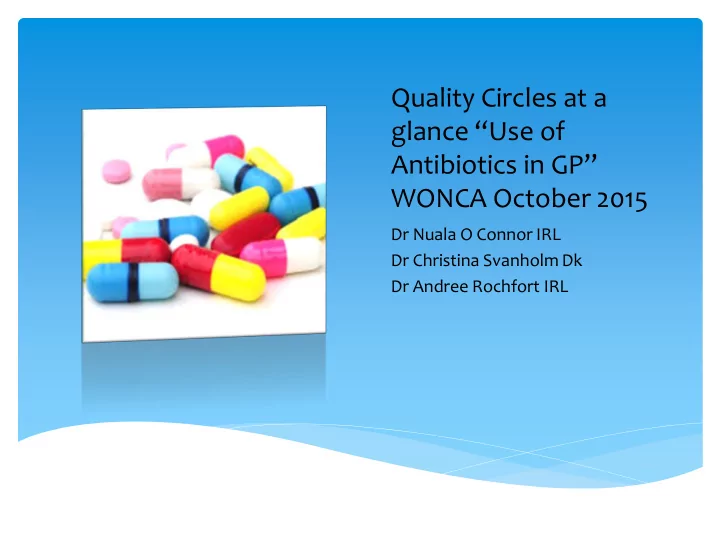
Quality Circles at a glance “Use of Antibiotics in GP” WONCA October 2015

Dr Nuala O Connor IRL Dr Christina Svanholm Dk Dr Andree Rochfort IRL
slide-2
SLIDE 2

 Understand the scale of the problem of AB Resistance in Europe – why we should all be worried  Antibiotic consumption in the European countries  Explore what initiatives might help to combat AB resistance  What you as individual GP prescribers can do to help  Provide the tools to facilitate QC on Antibiotic prescribing in your country

Key Learning objectives- Participants and Facilitators

slide-3
SLIDE 3

 Scale of the problem of antibiotic resistance in your country and how you got to this point  What is happening in your country to combat antibiotic resistance?  What can you as an individual GP do?  Do you have infection control guidelines?

5 minutes

slide-4
SLIDE 4

“Without urgent, coordinated action by many stakeholders, the world is headed for a post-antibiotic era, in which common infections and minor injuries which have been treatable for decades can once again kill,” BBC WORLD NEWS

“WHO’s first global report on antibiotic resistance reveals serious, worldwide threat to public health” APRIL 2014

slide-5
SLIDE 5

TIME IS RUNNING OUT……….

We have limited expectations from a “renewable pipeline of products.” We hope for some modest success, but the existing classes of antibiotics are probably the best we will ever have.

BMJ 2012 Antibiotic Research –Dr Martin Cormican , Dr Akke Vellinga

slide-6
SLIDE 6

CAUSES OF DEATH 1926 - 2006

Data source: Society of Actuaries in Ireland 2011 & Dr. Robert Cunney

slide-7
SLIDE 7
slide-8
SLIDE 8

25,ooo deaths from multi-drug resistant

  • rganisms each year in

Europe

“SUPERBUGS “

HCAI from resistant bacteria- Difficult to treat, prolonged illness, hospital stays, risk of death

slide-9
SLIDE 9
slide-10
SLIDE 10

Methicillin resistant Staphylococcus aureus (MRSA) isolates in participating countries

2002 2013

slide-11
SLIDE 11

Macrolide Resistant (R) Streptococcus

pneumoniae Isolates in Participating Countries

2004 2013

slide-12
SLIDE 12

E.coli resistant to 3rd generation Cephalosporins

2002

2013

slide-13
SLIDE 13

E.coli resistant to 3rd generation Cephalosporins

2012

2013

slide-14
SLIDE 14

Fluoroquinolones (R) resistant Escherichia coli

isolates in participating countries

2003 -2003 2013

slide-15
SLIDE 15

Fluoroquinolones (R) resistant Escherichia coli

isolates in participating countries

2012 2013

slide-16
SLIDE 16

Carbapenem resistant Klebsiella pneumoniae (“CRE”) bloodstream infections in Europe

2010 2013

slide-17
SLIDE 17

Proportion of Vancomycin Resistant (R) Enterococcus faecalis Isolates in Participating Countries

2010 2013 Levels of AMR consistently correlate with the levels of antibiotic consumption

slide-18
SLIDE 18

Antimicrobial resistance trends: Bloodstream infections in Ireland: 2002-2012

Data source: HPSC/EARS-Net

0% 5% 10% 15% 20% 25% 30% 35% 40% 45% 50%

Proportion resistance Year

Meticillin-Resistant

  • Staph. aureus

Vancomycin-Resistant Enterococcus faecium Penicillin-Resistant

  • Strep. pneumoniae

Erythromycin-Resistant

  • S. pneumoniae

Cephalosporin- Resistant E. coli Quinolone-Resistant

  • E. coli

Multiple-Resistant

  • E. coli

18

slide-19
SLIDE 19

 Why are there such differences between countries ?  What about the northern southern European divide ?  Have you any idea about antibiotic consumption rates in your country ? HINT –ECDC website  Were you aware of the scale of the problem we are facing with antimicrobial resistance ?  Why has this problem arisen ? What factors other than antibiotic prescribing in the community might be involved ?

First Discussion

slide-20
SLIDE 20
slide-21
SLIDE 21

ANTIBIOTIC USE 1997 – 2013: GREECE, IRELAND, NORWAY

slide-22
SLIDE 22

France v Netherlands v Slovakia

slide-23
SLIDE 23

Why has this problem of Antibiotic resistance emerged? Multifactorial

 Increasing complexity of healthcare  Ageing population  Concerns about ‘missing sepsis’  Overuse of broad spectrum agents  Failure to de-escalate from broad spectrum to narrow spectrum

 Not sending specimens to lab  Not acting on lab reports

 Overly lengthy treatment courses  Lack of awareness about the issue of resistance among HCW  Lack of patients awareness about the issue of resistance  Patient compliance issues  Time pressure  Patient pressure  High antimicrobial use in veterinary sector  Lack of regulation of antimicrobial dispensing in some countries  Poor sanitation in developing world

slide-24
SLIDE 24

 What can we do combat the problem of AB resistance ?  Who is responsible ?

Second Discussion

slide-25
SLIDE 25 talk to your GP or pharmacist or visit www.hse.ie

Taking antibiotics for colds and flu? There’s no point.

A cold or flu is caused by a virus and antibiotics do not work on viruses.

Undertheweather.ie

What to look for What can you do ? When to seek help ? KEY MESSAGES Antibiotics can kill bacteria. They have no effect on viruses such as head cold, flu, chickenpox. They will not reduce a fever They will not relieve pain. Rest, fluids and TLC important part of recovery from all infections. Do they know how to take them correctly?

http://www.hse.ie/antibiotics/

Public Antibiotic Awareness Campaign Explain why we need to need to preserve this precious resource

slide-26
SLIDE 26

Not just all about reducing antibiotic usage Other things patients can do to fight AMR

Immunisation Flu and pneumonia ,Hib meningits C, hepatitis B , whooping cough ,measles , mumps ,rubella …the options increasing every year Practice Good Infection Prevention Control Measures Hand Hygiene,Cough Etiquette Educate Parent and Children about infection prevention

slide-27
SLIDE 27

Every time we consider prescribing GP’s need to ask themselves ……. Is this antibiotic really necessary ?

slide-28
SLIDE 28

If you decide to prescribe ask the following questions ?

  • What condition?
  • Right drug ?
  • Right dose?
  • Prescribed time?
  • Any investigations?
  • Do I know about

guidelines and am I using them?

slide-29
SLIDE 29

Narrow versus broad-spectrum

GP’s need to think more scientifically – what are you treating ?

Penicillin V for strep throat Co amoxiclav for strep throat

slide-30
SLIDE 30

Reflect on your individual prescribing habits .

Have I consulted the antibiotic guidelines recently? www.antibioticprescribing.ie

What can individual Gp’s do to ensure safe antibiotic use?

slide-31
SLIDE 31

 Where might you start in your country ?  How might you change what you do in your clinical practice after today ?

Third discussion

slide-32
SLIDE 32

Things you can do now to help reduce Antimicrobial Drug resistance

Do not prescribe antibiotics unless there is a definite clinical indication to do so

Prescribe first line preferred antibiotics Co-amoxiclav is not a first-line drug for the common conditions encountered in General Practice Prescribe phenoxymethylpenecillin for tonsillitis unless the patient is truly allergic to penicillin.

Restrict macrolides to patient with true penicillin allergy or definite clinical indication e.g mycoplasma Review any patients in LTCF on prophylactic treatment for UTI Develop simple antibiotic prescribing policy for your practice and for nursing home residents based on www.antibioticprescribing.ie Possible idea for audit requirement's 2014/2015 cycle

slide-33
SLIDE 33

We can reduce consumption –look at Greece

slide-34
SLIDE 34

Ireland – We can improve the quality of a Antibiotic Prescribing

Community Antibiotic Consumption first half 2014

Use of co amoxiclav

slide-35
SLIDE 35

Keeping Antibiotics Safe And Effective For Future Generations … It’s everyone’s

responsibility

Dept of Health HSE Pharmacists

Surgeons

Dept of Agriculture gp

Vets Patients

Physicians

It is individuals who decide to use antibiotics, and it is individuals who have the power to minimize use and halt antibiotic resistance.