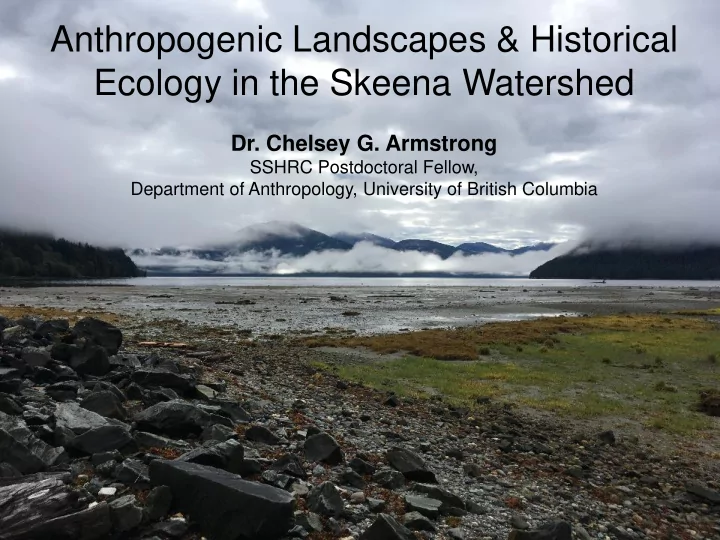
SLIDE 1 Anthropogenic Landscapes & Historical Ecology in the Skeena Watershed
SSHRC Postdoctoral Fellow, Department of Anthropology, University of British Columbia
SLIDE 2
Skeena Watershed
SLIDE 3
The Anthropocene
SLIDE 4
SLIDE 5
3,500+ Years of Land Use
SLIDE 6
www.hauyat.ca
Húyat, Heiltsuk Territory
SLIDE 7 Tsm’syen villages 1,500 / 2000 ya
Martindale and Marsden 2003
SLIDE 8 ~1700 AD Martindale 2009
SLIDE 9
- Documenting ancient and ongoing land-
use patterns in Skeena Watershed
- Untangling social-ecological dynamics
- Plant translocations (species)
- Enhancement of novel ecosystems,
resource management (niche space/ landscape)
- = complex biophysical and cultural
interactions over 1000s of years
- “Positive” vs. “Negative” impacts
Today
SLIDE 10 Acknowledge and Thanks
Nancy Turner Richard Wright Christina Stanley Morgan Ritchie Dawn Charlie Spencer Greening Leslie Main Johnson Tony Mclean Dana Lepofsky
SLIDE 11
Translocations
SLIDE 12
Hazelnut (Corylus cornuta, Betulaceae)
SLIDE 13 “Around our home yeah, you take hazelnut …just plant them so that they’re all together…that was my job in the spring. So when you go
- ut to harvest them in the
fall, they’re all in one spot…more like we do with apples…. You know, you transplant them.” Marion Wal’ceckwu Dixon (Nlaka’pamux)
Hazelnut (Corylus cornuta, Betulaceae)
Marion in the Coquihalla, 1939
SLIDE 14
Southern variety (Corylus cornuta var. californica) Interior variety (Corylus cornuta var. cornuta) Disjunct/Isolate/Remnant?
Modern Hazelnut Distribution
SLIDE 15
Southern variety (Corylus cornuta var. californica) Interior variety (Corylus cornuta var. cornuta) Corylus californica?
Hazelnut Disjunct?
SLIDE 16
Proto Salish: *[ts’ik] or *[ts’ik’] Skwxwú7mesh: [ts’ik]
Hazelnut Paleobiolinguistics
Gitxsan (Tsimshianic): [sgan] [ts’ek]
SLIDE 17
Hazelnut Distribution in Terrace
SLIDE 18 Hazelnut Pop Gens: 3/12 Microsatellites (SSR)
Alleles in each “population”
SLIDE 19
Pacific Crabapple (Moołks, Malus fusca)
SLIDE 20 Pacific Crabapple and Siberian Crabapple
Pacific Crabapple Siberian Crabapple
SLIDE 21
Pacific Crabapple Genome Project
SLIDE 22 Bringing Moołks Back to Old Town
Łaaya no’os x x x x x xx x x x x x x x x x x
SLIDE 23
Ecosystem Enhancement
(“novel ecosystems”)
SLIDE 24
Forest Gardens
SLIDE 25
Dałk Gyilakyaw (Robin Town) – Gitsm’geelm, Tsm’syen
SLIDE 26 Forest Gardens in BC
Village Periphery
Gitseax (Kitselas Canyon)
Village Core Village Periphery
SLIDE 27
Indicator Species Analysis
SLIDE 28
Village Core Village Periphery Species Richness
SLIDE 29 Beyond Species Composition:
Forest gardens more rich = likely to provide a suite of ecosystem functions that peripheral forests do not…
SLIDE 30 Beyond Species Composition:
Forest gardens more rich = likely to provide a suite of ecosystem functions that peripheral forests do not… What are those functions?
SLIDE 31 Beyond Species Composition:
Forest gardens more rich = likely to provide a suite of ecosystem functions that peripheral forests do not… What are those functions? Functional ecology uses plant traits to understand plant impacts on ecosystems
SLIDE 32 Beyond Species Composition:
Forest gardens more rich = likely to provide a suite of ecosystem functions that peripheral forests do not… What are those functions? Functional ecology uses plant traits to understand plant impacts on ecosystems 3 traits (seed mass, pollination & dispersal syndrome) to compare functions between villages and peripheries
SLIDE 33
Functional Trait: Seed Mass
SLIDE 34
Functional Trait: Animal Dispersed/Pollinated
SLIDE 35 Forest Gardens and Sts’ailes Land Claims
Pacific Crabapple
Cranberry Hazelnut
Conifer- Dominant Peripheral Forest
Garden and Food Prepara@
Pits
Habita@
Area and Forest Garden
Lily
Forest Garden Landscape Before SeKler Colonial Displacement S@ nging NeKle
Fuel
Cherry
- Lepofsky, Armstrong et al. 2019
SLIDE 36 5 km
Luutkudziiwus Lax ’yip (Suskwa Watershed)
SLIDE 37 Canada Film Board 1946
SLIDE 38 Black Midden Soils Lithics and Fire Cracked Rock
Terra-forming
SLIDE 39
Suskwa Cultural Landscape
SLIDE 40 (Black huckleberry, Vaccinium membranaceum)
Sim ma’ay Burning/Management
Gathering What the Great Nature Provided, 1980
SLIDE 41 (Black huckleberry, Vaccinium membranaceum)
Sim ma’ay Burning/Management
SLIDE 42 “We estimate that at least 28.1%
- f the world’s land surface is
- wned or managed by
Indigenous Peoples, including some of the most ecologically intact and biodiverse landscapes remaining on Earth.”
Global Land-Use and Climate Change..
SLIDE 43
- Landscape modifications do not always produce negative impacts
- Impacts are not stagnant
- Relationship/interactions depend on a culture/community/society’s
actions and values Adaptation through space and time?
- Don’t expect the past to be a blueprint for the future…but…
- We can learn how anthropogenic impacts effect species distributions
and functions
- …how they relate to applied issues of sovereignty and title
- Social-ecological feedbacks are incredibly complex!
- But we should strive to model management practices that are
designed by and for the right communities
- Contribute to wiser management decisions in an uncertain future
Anthropogenic Impacts ≠ Negative Impacts/Climate Change
SLIDE 44
Thank You Dana Lepofsky, Nancy Turner, Leslie Main Johnson, Alex McAlvay, Jesse Miller, Ken Lertzman, Morgan Ritchie, Christina Stanley, Storm Carroll, Tony McClean, Logan Kistler, Phillip Blundon, Denzel Sutherland-Wilson, Spencer Greening, Carilia Horning, Torben Rick, and Jim McDonald