Announcements Piazza started Matlab Grader homework, email Friday, 2 - - PowerPoint PPT Presentation

announcements
SMART_READER_LITE
LIVE PREVIEW

Announcements Piazza started Matlab Grader homework, email Friday, 2 - - PowerPoint PPT Presentation

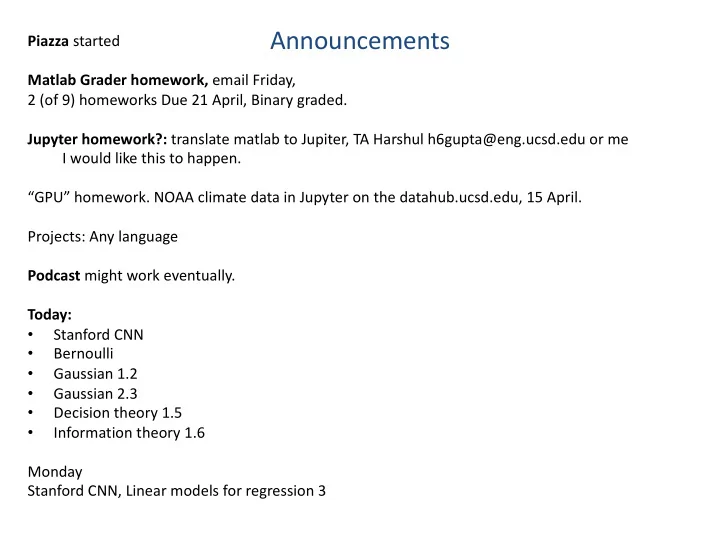
Announcements Piazza started Matlab Grader homework, email Friday, 2 (of 9) homeworks Due 21 April, Binary graded. Jupyter homework?: translate matlab to Jupiter, TA Harshul h6gupta@eng.ucsd.edu or me I would like this to happen. GPU


slide-1
SLIDE 1

Announcements

Piazza started Matlab Grader homework, email Friday, 2 (of 9) homeworks Due 21 April, Binary graded. Jupyter homework?: translate matlab to Jupiter, TA Harshul h6gupta@eng.ucsd.edu or me I would like this to happen. “GPU” homework. NOAA climate data in Jupyter on the datahub.ucsd.edu, 15 April. Projects: Any language Podcast might work eventually. Today:

  • Stanford CNN
  • Bernoulli
  • Gaussian 1.2
  • Gaussian 2.3
  • Decision theory 1.5
  • Information theory 1.6

Monday Stanford CNN, Linear models for regression 3

slide-2
SLIDE 2

Non-parametric method

K means

E

slide-3
SLIDE 3
slide-4
SLIDE 4
slide-5
SLIDE 5

Coin estimate (Bishop 2.1)

  • Binary variables x={0,1}
  • Bernoulli distributed
  • N observations, Likelihood:
  • Max likelihood

p(x = 1|µ) = µ

E[x] = µ var[x] = µ(1 − µ).

Bern(x|µ) = µx(1 − µ)1−x (2.2) the Bernoulli distribution. It is easily verified that this distribution

| p(D|µ) =

N

  • n=1

p(xn|µ) =

N

  • n=1

µxn(1 − µ)1−xn. (2.5) ln p(D|µ) =

N

  • n=1

ln p(xn|µ) =

N

  • n=1

{xn ln µ + (1 − xn) ln(1 − µ)} . (2.6)

µML = 1 N

N

  • n=1

xn

PA4

pCH

µ

par D

PCT

I µ

EG fxpas di

I µ O Ci µ

fl

Ver KkEfx E

2

D µ

2

µ

  • M

l fl

l

Ifn

E F

t

the

l µ

slide-6
SLIDE 6

Coin estimate (Bishop 2.1)

  • Bayes p(x|y)=p(y|x)p(x)
  • Conjugate prior
µ a = 0.1 b = 0.1 0.5 1 1 2 3 µ a = 1 b = 1 0.5 1 1 2 3 µ a = 2 b = 3 0.5 1 1 2 3 µ a = 8 b = 4 0.5 1 1 2 3

Beta(µ|a, b) = Γ(a + b) Γ(a)Γ(b)µa−1(1 − µ)b−1

µ prior 0.5 1 1 2 µ likelihood function 0.5 1 1 2 µ posterior 0.5 1 1 2

Bayes:

post

like

prior

G

a 2 l

g

H

I

slide-7
SLIDE 7

ML MAP BAYES

  • ML point estimate
  • MAP point estimate (often in literature ML=MAP)
  • Bayes => probability =>From which all information can be obtained

– MAP, median, error estimates – Further analysis as sequential – Disadvantage… not a point estimate.

µ prior 0.5 1 1 2 µ likelihood function 0.5 1 1 2 µ posterior 0.5 1 1 2

e

a

slide-8
SLIDE 8

Bayes Rule

P(hypothesis|data) = P(data|hypothesis)P(hypothesis) P(data)

Rev’d Thomas Bayes (1702–1761)

  • Bayes rule tells us how to do inference about hypotheses from data.
  • Learning and prediction can be seen as forms of inference.
slide-9
SLIDE 9

The Gaussian Distribution

Gaussian Mean and Variance

slide-10
SLIDE 10

Gaussian Parameter Estimation

Likelihood function

Maximum (Log) Likelihood

L Een al

slide-11
SLIDE 11

Curve Fitting Re-visited, Bishop1.2.5

slide-12
SLIDE 12

Maximum Likelihood

p(t|x, w, β) =

N

  • n=1

N tn|y(xn, w), β−1 . (1.61) As we did in the case of the simple Gaussian distribution earlier, it is convenient to maximize the logarithm of the likelihood function. Substituting for the form of the Gaussian distribution, given by (1.46), we obtain the log likelihood function in the form ln p(t|x, w, β) = −β 2

N

  • n=1

{y(xn, w) − tn}2 + N 2 ln β − N 2 ln(2π). (1.62) Consider first the determination of the maximum likelihood solution for the polyno- 1 βML = 1 N

N

  • n=1

{y(xn, wML) − tn}2 . (1.63)

p(t|x, wML, βML) = N t|y(x, wML), β−1

ML

  • .

(1.64) take a step towards a more Bayesian approach and introduce a prior

Giving estimates of W and beta, we can predict

6

slide-13
SLIDE 13

MAP: A Step towards Bayes 1.2.5

Determine by minimizing regularized sum-of-squares error, . Regularized sum of squares

prior

Nutt B l NG t

In parte

Az WIN th f

t ENT w t cost

11Wh

I

slide-14
SLIDE 14

Predictive Distribution

True data Estimated +/- std dev

slide-15
SLIDE 15

Parametric Distributions

Basic building blocks: Need to determine given Representation: or ? Recall Curve Fitting

We focus on Gaussians!

slide-16
SLIDE 16

The Gaussian Distribution

i

slide-17
SLIDE 17

Central Limit Theorem

  • The distribution of the sum of N i.i.d. random variables becomes increasingly

Gaussian as N grows.

  • Example: N uniform [0,1] random variables.

r

slide-18
SLIDE 18

Geometry of the Multivariate Gaussian

e

Cx Mlt E

x

µ

C

mythy

slide-19
SLIDE 19

Moments of the Multivariate Gaussian (2)

A Gaussian requires D*(D-1)/2 +D parameters. Often we use D +D or Just D+1 parameters.

Ect

M

e

I

62 I

G

  • V

ate

slide-20
SLIDE 20

Partitioned Conditionals and Marginals, page 89

Conditional

marginal

Mmm

S

slide-21
SLIDE 21

ML for the Gaussian (1) Bisphop 2.3.4

Given i.i.d. data , the log likelihood function is given by

∂ ∂A ln |A| = A−1T (C.28) ∂ ∂x

  • A−1

= −A−1 ∂A ∂x A−1 (C.21) ∂ ∂ATr (AB) = BT. (C.24)

l

lap

N

zcnlzltftrfzcx mfz tx MD

N

z.cn EltftrCZcx

m1Ct mFE

N

zfnlzlttnnsgz

ljsg

FEG mkt.mg I

2M

JIE 54g 52 40

trLAB4

treats

z

slide-22
SLIDE 22

Maximum Likelihood for the Gaussian

  • Set the derivative of the log likelihood function to zero,
  • and solve to obtain
  • Similarly
slide-23
SLIDE 23

Mixtures of Gaussians (Bishop 2.3.9)

Single Gaussian Mixture of two Gaussians Old Faithful geyser: The time between eruptions has a bimodal distribution, with the mean interval being either 65

  • r 91 minutes, and is dependent on the length of the prior eruption. Within a margin of error of

±10 minutes, Old Faithful will erupt either 65 minutes after an eruption lasting less than 2 1⁄2 minutes, or 91 minutes after an eruption lasting more than 2 1⁄2 minutes. I I

slide-24
SLIDE 24

Mixtures of Gaussians (Bishop 2.3.9)

  • Combine simple models

into a complex model:

Component Mixing coefficient K=3

I

slide-25
SLIDE 25

Mixtures of Gaussians (Bishop 2.3.9)

slide-26
SLIDE 26

Mixtures of Gaussians (Bishop 2.3.9)

  • Determining parameters p, µ, and S using maximum log likelihood
  • Solution: use standard, iterative, numeric optimization methods or the

expectation maximization algorithm (Chapter 9).

Log of a sum; no closed form maximum.

EM

slide-27
SLIDE 27

Entropy 1.6

Important quantity in

  • coding theory
  • statistical physics
  • machine learning
slide-28
SLIDE 28

Differential Entropy

Put bins of width ¢ along the real line For fixed differential entropy maximized when in which case

slide-29
SLIDE 29

The Kullback-Leibler Divergence

P true distribution, q is approximating distribution