
SLIDE 1
Announcements Project 4 due tonight HW7 due Wednesday Contest 2 is - - PowerPoint PPT Presentation
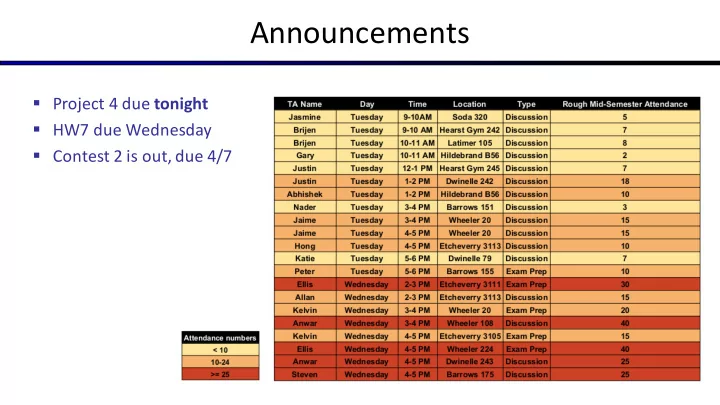
Announcements Project 4 due tonight HW7 due Wednesday Contest 2 is out, due 4/7 CS 188: Artificial Intelligence Decision Networks and Value of Perfect Information Instructors: Sergey Levine and Anca Dragan University of California,
Instructors: Sergey Levine and Anca Dragan University of California, Berkeley
[These slides were created by Dan Klein, Pieter Abbeel, Sergey Levine for CS188 Intro to AI at UC Berkeley. All CS188 materials are available at http://ai.berkeley.edu.]
§ A collection of distributions over X, one for each combination
§ As a product of local conditional distributions § To see what probability a BN gives to a full assignment, multiply all the relevant conditionals together:
Weather Forecast Umbrella U
§ MEU: choose the action which maximizes the expected utility given the evidence
Weather Forecast Umbrella U
§ Can directly operationalize this with decision networks
§ Bayes nets with nodes for utility and actions § Lets us calculate the expected utility for each action
§ New node types:
§ Chance nodes (just like BNs) § Actions (rectangles, cannot have parents, act as observed evidence) § Utility node (diamond, depends on action and chance nodes)
Weather Forecast Umbrella U
Weather Umbrella U
W P(W) sun 0.7 rain 0.3
Umbrella = leave Umbrella = take Optimal decision = leave
A W U(A,W) leave sun 100 leave rain take sun 20 take rain 70
U(t,s) Weather | {} Weather | {} {} U(t,r) U(l,s) U(l,r) Weather Umbrella U
Weather Forecast =bad Umbrella U
A W U(A,W) leave sun 100 leave rain take sun 20 take rain 70 W P(W|F=bad) sun 0.34 rain 0.66
Umbrella = leave Umbrella = take Optimal decision = take
U(t,s) W | {b} W | {b} U(t,r) U(l,s) U(l,r) {b} Weather Forecast =bad Umbrella U
§ On the ghost: red § 1 or 2 away: orange § 3 or 4 away: yellow § 5+ away: green P(red | 3) P(orange | 3) P(yellow | 3) P(green | 3) 0.05 0.15 0.5 0.3
Ghost Location Sensor (1,1) Bust U Sensor (1,2) Sensor (1,3) Sensor (1,n) Sensor (2,1) Sensor (m,1) Sensor (m,n)
§ Idea: compute value of acquiring evidence
§ Can be done directly from decision network
§ Example: buying oil drilling rights
§ Two blocks A and B, exactly one has oil, worth k § You can drill in one location § Prior probabilities 0.5 each, & mutually exclusive § Drilling in either A or B has EU = k/2, MEU = k/2
§ Question: what’s the value of information of O?
§ Value of knowing which of A or B has oil § Value is expected gain in MEU from new info § Survey may say “oil in a” or “oil in b,” prob 0.5 each § If we know OilLoc, MEU is k (either way) § Gain in MEU from knowing OilLoc? § VPI(OilLoc) = k/2 § Fair price of information: k/2 OilLoc DrillLoc U
D O U a a k a b b a b b k O P a 1/2 b 1/2
Weather Forecast Umbrella U
A W U leave sun 100 leave rain take sun 20 take rain 70
MEU with no evidence MEU if forecast is bad MEU if forecast is good
F P(F) good 0.59 bad 0.41
Forecast distribution
§ Assume we have evidence E=e. Value if we act now: § Assume we see that E’ = e’. Value if we act then: § BUT E’ is a random variable whose value is unknown, so we don’t know what e’ will be § Expected value if E’ is revealed and then we act: § Value of information: how much MEU goes up by revealing E’ first then acting, over acting now: P(s | +e) {+e} a U {+e, +e’} a P(s | +e, +e’) U {+e} P(+e’ | +e)
{+e, +e’}
P(-e’ | +e)
{+e, -e’}
a
If Parents(U) Z | CurrentEvidence Then VPI( Z | CurrentEvidence) = 0
OilLoc DrillLoc U Scouting Report Scout
§ States S § Actions A § Transition function P(s’|s,a) (or T(s,a,s’)) § Rewards R(s,a,s’)
§ Observations O § Observation function P(o|s) (or O(s,o))
a s s, a s,a,s’ s’ a b b, a
§ Belief state determined by evidence to date {e} § Tree really over evidence sets § Probabilistic reasoning needed to predict new evidence given past evidence
§ One way: use truncated expectimax to compute approximate value of actions § What if you only considered busting or one sense followed by a bust? § You get a VPI-based agent!
a {e} e, a e’ {e, e’} a b b, a b’ abust {e} {e}, asense e’ {e, e’} asense U(abust, {e}) abust U(abust, {e, e’}) e’
§ Can divide regions of belief space (set of belief functions) into policy regions (gets complex quickly) § Can build approximate policies using discretization methods § Can factor belief functions in various ways