Announcements This week : My office hours for Thurs (11/20) are - - PDF document

announcements
SMART_READER_LITE
LIVE PREVIEW

Announcements This week : My office hours for Thurs (11/20) are - - PDF document

11/19/2008 Announcements This week : My office hours for Thurs (11/20) are moved to Friday (11/21) from 1 2 pm. Pset 3 returned today Shape Matching p g Check all semester grades on eGradebook Tuesday, Nov 18 Kristen Grauman UT


slide-1
SLIDE 1

11/19/2008 1

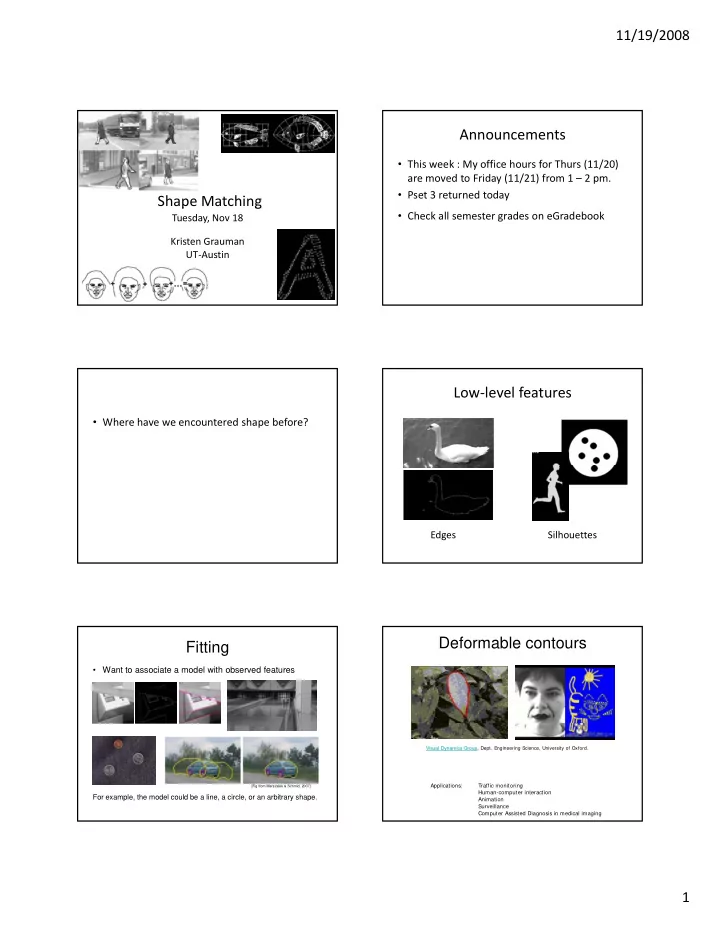
Shape Matching p g

Tuesday, Nov 18 Kristen Grauman UT‐Austin

Announcements

  • This week : My office hours for Thurs (11/20)

are moved to Friday (11/21) from 1 – 2 pm.

  • Pset 3 returned today
  • Check all semester grades on eGradebook
  • Where have we encountered shape before?

Low‐level features

Edges Silhouettes

Fitting

  • Want to associate a model with observed features

[Fig from Marszalek & Schmid, 2007]

For example, the model could be a line, a circle, or an arbitrary shape.

Deformable contours

Visual Dynamics Group, Dept. Engineering Science, University of Oxford.

Traffic monitoring Human-computer interaction Animation Surveillance Computer Assisted Diagnosis in medical imaging Applications:

slide-2
SLIDE 2

11/19/2008 2

Role of shape

Analysis of anatomical structures

Figure from Grimson & Golland

Recognition, detection

Fig from Opelt et al.

Morphology

http://usuarios.lycos.es/lawebdelosfosiles/i

Pose Characteristic feature

Fig from Belongie et al.

Shape in recognition Questions

  • What features?
  • How to compare shapes?

Figure from Belongie et al.

Chamfer distance

  • Average distance to nearest feature
  • T: template shape a set of points
  • I: image to search a set of points
  • dI(t): min distance for point t to some point in I

Chamfer distance

  • Average distance to nearest feature

How is the measure different than just filtering with a mask having the shape points?

Edge image

points? How expensive is a naïve implementation?

slide-3
SLIDE 3

11/19/2008 3

Distance transform

3 2 2 2 1 2 1 1 2 1 1 1 2 1 2 3 2 1 1 1 1 2 3 3 2 1 1 1 1 1 2 3 4 3 2 1 1 2 2 Distance Transform Image features (2D)

Source: Yuri Boykov

3 4 2 3 2 3 5 4 4 2 2 3 1 1 2 1 1 1 1 2 2

Distance Transform is a function that for each image pixel p assigns a non-negative number corresponding to distance from p to the nearest feature in the image I ) (⋅ D ) (p D

Features could be edge points, foreground points,…

Distance transform

d

  • riginal

distance transform edges

Value at (x,y) tells how far that position is from the nearest edge point (or other binary mage structure)

>> help bwdist

Distance transform (1D)

// 0 if j is in P, infinity otherwise

Adapted from D. Huttenlocher

Distance Transform (2D)

Adapted from D. Huttenlocher

Chamfer distance

  • Average distance to nearest feature

Edge image Distance transform image

Chamfer distance

Fig from D. Gavrila, DAGM 1999

Edge image Distance transform image

slide-4
SLIDE 4

11/19/2008 4

A limitation of active contours

  • External energy: snake does not really “see” object

boundaries in the image unless it gets very close to it.

image gradients are large only directly on the boundary

I ∇

Distance transform can help

  • External image cost can also be taken from the

distance transform of the edge image.

  • riginal
  • gradient

distance transform edges

  • What limitations might we have using only

edge points to represent a shape?

  • How descriptive is a point?

Comparing shapes

What points on these two sampled contours are most similar? How do you know?

Shape context descriptor

Count the number of points inside each bin, e.g.: Count = 4 Count = 10 ... Compact representation

  • f distribution of points

relative to each point

Shape context descriptor

slide-5
SLIDE 5

11/19/2008 5

Comparing shape contexts

Compute matching costs using Chi Squared distance: Recover correspondences by solving for least cost assignment, using costs Cij (Then use a deformable template match, given the correspondences.)

Shape context matching with handwritten digits

Only errors made out of 10,000 test examples

CAPTCHA’s

  • CAPTCHA: Completely Automated Turing Test

To Tell Computers and Humans Apart

  • Luis von Ahn, Manuel Blum, Nicholas Hopper

and John Langford, CMU, 2000. g

  • www.captcha.net

Image-based CAPTCHA

Shape matching application: breaking a visual CAPTCHA

  • Use shape matching to recognize characters,

words in spite of clutter, warping, etc.

Recognizing Objects in Adversarial Clutter: Breaking a Visual CAPTCHA, by G. Mori and J. Malik, CVPR 2003

Fast Pruning: Representative Shape Contexts

d

  • Computer Vision Group

University of California

Berkeley

  • Pick k points in the image at random

– Compare to all shape contexts for all known letters – Vote for closely matching letters

  • Keep all letters with scores under threshold

p

slide-6
SLIDE 6

11/19/2008 6

Algorithm A: bottom-up

  • Look for letters

– Representative Shape Contexts

  • Find pairs of letters that

Input Locations

  • f possible

letters

Computer Vision Group

University of California

Berkeley

p are “consistent”

– Letters nearby in space

  • Search for valid words
  • Give scores to the words

Possible strings of letters Matching words

EZ-Gimpy Results with Algorithm A

  • 158 of 191 images correctly identified: 83%

– Running time: ~10 sec. per image (MATLAB, 1 Ghz P3) horse spade

Computer Vision Group

University of California

Berkeley

smile canvas p join here

Gimpy

Computer Vision Group

University of California

Berkeley

  • Multiple words, task is to find 3 words in the

image

  • Clutter is other objects, not texture

Algorithm B: Letters are not enough

  • Hard to distinguish single letters with so much clutter
  • Find words instead of letters

Computer Vision Group

University of California

Berkeley

– Use long range info over entire word – Stretch shape contexts into ellipses

  • Search problem becomes huge

– # of words 600 vs. # of letters 26 – Prune set of words using opening/closing bigrams

Results with Algorithm B

# Correct words % tests (of 24) 1 or more 92% 2 or more 75% 3 33% EZ-Gimpy 92%

dry clear medical

Computer Vision Group

University of California

Berkeley

EZ Gimpy 92%

dry clear medical door farm important card arch plate

Shape matching application II: silhouettes and body pose

What kind of assumptions do we need?

slide-7
SLIDE 7

11/19/2008 7

Example-based pose estimation …and animation

  • Build a two-character “motion graph” from examples of

people dancing with mocap

  • Populate database with synthetically generated

silhouettes in poses defined by mocap (behavior specific dynamics) dynamics)

  • Use silhouette features to identify similar examples in

database

  • Retrieve the pose stored for those similar examples to

estimate user’s pose

  • Animate user and hypothetical partner

Ren, Shakhnarovich, Hodgins, Pfister, and Viola, 2005.

Fun with silhouettes

  • Liu Ren, Gregory Shakhnarovich, Jessica Hodgins, Hanspeter

Pfister and Paul Viola, Learning Silhouette Features for Control

  • f Human Motion
  • http://graphics.cs.cmu.edu/projects/swing/

Summary

  • Shape can be defining feature in recognition, useful for

analysis tasks

  • Chamfer measure to compare edge point sets

– Distance transform for efficiency

  • Isolated edges points ambiguous

– Shape context : local shape neighborhood descriptor

  • Example applications of shape matching

Next: Motion and tracking

Tomas Izo