Announcements Project 2a: Graded see Learn@UW; contact your TA if - - PDF document

announcements
SMART_READER_LITE
LIVE PREVIEW

Announcements Project 2a: Graded see Learn@UW; contact your TA if - - PDF document

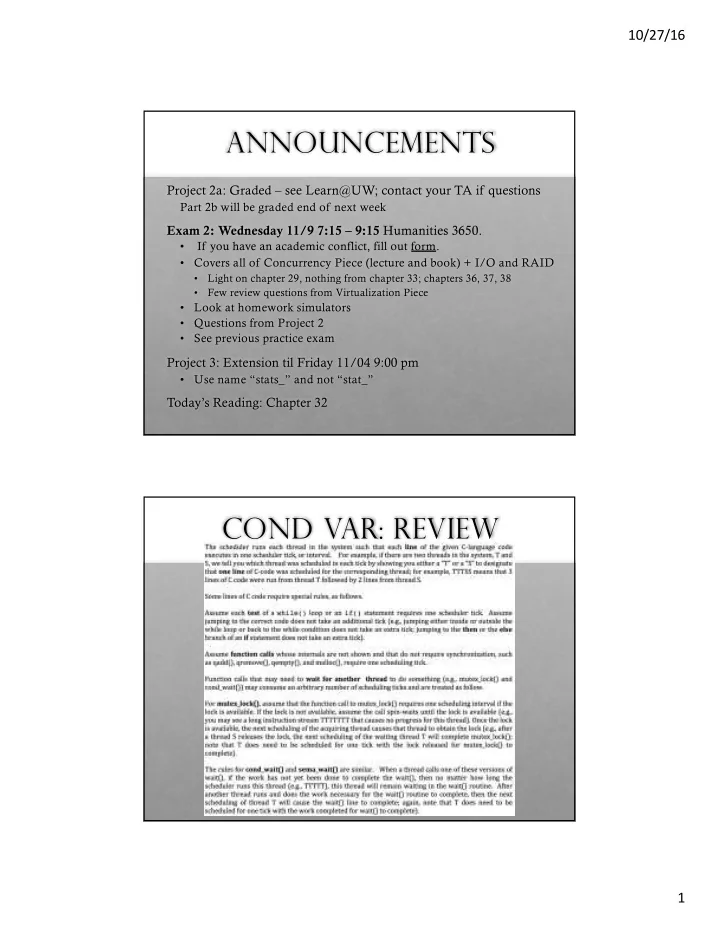
10/27/16 Announcements Project 2a: Graded see Learn@UW; contact your TA if questions Part 2b will be graded end of next week Exam 2: Wednesday 11/9 7:15 9:15 Humanities 3650. If you have an academic conflict, fill out form.


slide-1
SLIDE 1

10/27/16 1

Announcements

Project 2a: Graded – see Learn@UW; contact your TA if questions

Part 2b will be graded end of next week

Exam 2: Wednesday 11/9 7:15 – 9:15 Humanities 3650.

  • If you have an academic conflict, fill out form.
  • Covers all of Concurrency Piece (lecture and book) + I/O and RAID
  • Light on chapter 29, nothing from chapter 33; chapters 36, 37, 38
  • Few review questions from Virtualization Piece
  • Look at homework simulators
  • Questions from Project 2
  • See previous practice exam

Project 3: Extension til Friday 11/04 9:00 pm

  • Use name “stats_” and not “stat_”

Today’s Reading: Chapter 32

Cond Var: Review

slide-2
SLIDE 2

10/27/16 2

After the instruction stream “P” (i.e., after scheduler runs one line from parent), which line of the parent’s will execute when it is scheduled again? Assume the scheduler continues on with “C” (the full instruction stream is PC). Which line will child execute when it is scheduled again? After PPP (full is PCPPP), which line for parent next? After CCC (full is PCPPPCCC), which line for child next? After PP (full is PCPPPCCCPP), which line for parent next? After CC (full is PCPPPCCCPPCC, which line for child next? After PPP (full PCPPPCCCPPCCPPP), which line for parent next?

  • p2. P will have acquired lock and

finished mutex_lock().

  • C1. C must wait to acquire the lock since it is currently held by P.
  • p3. Since done = 0, P will execute p2 and p3; it is stuck in p3 until signaled.
  • c4. C finishes c1, c2, c3. Next time it executes c4. CV signaled but mutex still locked
  • p3. P cannot return from cond_wait() until it acquires lock held by C; P stays in p3
  • Beyond. C executes c4 and then code beyond c4.
  • Beyond. P finishes p3, rechecks p2, then p4. Next time beyond p4.

Concurrency Bugs

Questions answered in this lecture: What type of concurrency bugs occur? How to fix atomicity bugs (with locks)? How to fix ordering bugs (with condition variables)? How does deadlock occur? How to prevent deadlock (with waitfree algorithms, grab all locks atomically, trylocks, and ordering across locks)?

UNIVERSITY of WISCONSIN-MADISON Computer Sciences Department

CS 537 Introduction to Operating Systems Andrea C. Arpaci-Dusseau Remzi H. Arpaci-Dusseau

slide-3
SLIDE 3

10/27/16 3

Concurrency in Medicine: Therac-25 (1980’s)

“The accidents occurred when the high-power electron beam was activated instead of the intended low power beam, and without the beam spreader plate rotated into place. Previous models had hardware interlocks in place to prevent this, but Therac-25 had removed them, depending instead on software interlocks for safety. The software interlock could fail due to a race condition.” “…in three cases, the injured patients later died.”

Source: http://en.wikipedia.org/wiki/Therac-25

Lu etal. Study: For four major projects, search for concurrency bugs among >500K bug reports. Analyze small sample to identify common types of concurrency bugs.

15 30 45 60 75 MySQL Mozilla Bugs

Atomicity Order Deadlock Other

Source: http://pages.cs.wisc.edu/~shanlu/paper/asplos122-lu.pdf

Concurrency Study from 2008

OpenOffice

Apache

slide-4
SLIDE 4

10/27/16 4

MySQL: Atomicity, Order, or deadlock?

Thread 1: if (thd->proc_info) { … fputs(thd->proc_info, …); … }

What’s wrong?

Thread 2: thd->proc_info = NULL;

Test (thd->proc_info != NULL) and set (writing to thd->proc_info) should be atomic

Fix Atomicity Bugs with Locks

Thread 1: pthread_mutex_lock(&lock); if (thd->proc_info) { … fputs(thd->proc_info, …); … } pthread_mutex_unlock(&lock); Thread 2: pthread_mutex_lock(&lock); thd->proc_info = NULL; pthread_mutex_unlock(&lock);

slide-5
SLIDE 5

10/27/16 5

Mozilla: Atomicity, Ordering, or Deadlock

Thread 1: void init() { … mThread = PR_CreateThread(mMain, …); … } Thread 2: void mMain(…) { … mState = mThread->State; … }

What’s wrong?

Thread 1 sets value of mThread needed by Thread2 How to ensure reading MThread happens after mThread initialization?

Fix Ordering bugs with Condition variables

Thread 2: void mMain(…) { … Mutex_lock(&mtLock); while (mtInit == 0) Cond_wait(&mtCond, &mtLock); Mutex_unlock(&mtLock); mState = mThread->State; … } Thread 1: void init() { … mThread = PR_CreateThread(mMain, …); pthread_mutex_lock(&mtLock); mtInit = 1; pthread_cond_signal(&mtCond); pthread_mutex_unlock(&mtLock); … }

slide-6
SLIDE 6

10/27/16 6

Lu etal. Study: For four major projects, search for concurrency bugs among >500K bug reports. Analyze small sample to identify common types of concurrency bugs.

15 30 45 60 75 MySQL Mozilla Bugs

Atomicity Order Deadlock Other

Source: http://pages.cs.wisc.edu/~shanlu/paper/asplos122-lu.pdf

Concurrency Study from 2008

OpenOffice

Apache

Deadlock

Deadlock: No progress can be made because two or more threads are waiting for the other to take some action and thus neither ever does “Cooler" name: deadly embrace (Dijkstra)

slide-7
SLIDE 7

10/27/16 7

STOP STOP STOP STOP STOP STOP STOP STOP

A

slide-8
SLIDE 8

10/27/16 8

STOP STOP STOP STOP

A B

STOP STOP STOP STOP

A B

Both cars arrive at same time Is this deadlocked?

slide-9
SLIDE 9

10/27/16 9

STOP STOP STOP STOP

A B

who goes?

STOP STOP STOP STOP

A B

slide-10
SLIDE 10

10/27/16 10

STOP STOP STOP STOP

A B

STOP STOP STOP STOP

slide-11
SLIDE 11

10/27/16 11

STOP STOP STOP STOP

A B C D

4 cars arrive at same time Is this deadlocked?

STOP STOP STOP STOP

A B C D

who goes?

slide-12
SLIDE 12

10/27/16 12

STOP STOP STOP STOP

A B C D

4 cars move forward same time Is this deadlocked?

STOP STOP STOP STOP

A B C D

Deadlock!

slide-13
SLIDE 13

10/27/16 13

Code Example

Thread 2: lock(&B); lock(&A); Thread 1: lock(&A); lock(&B);

Can deadlock happen with these two threads?

Circular Dependency

Lock A Lock B Thread 1 Thread 2

holds holds wanted by wanted by

slide-14
SLIDE 14

10/27/16 14

Fix Deadlocked Code

Thread 2 lock(&A); lock(&B); Thread 1 lock(&A); lock(&B); Thread 2: lock(&B); lock(&A); Thread 1: lock(&A); lock(&B);

How would you fix this code?

Non-circular Dependency (fine)

Lock A Lock B Thread 1 Thread 2

holds wanted by wanted by

slide-15
SLIDE 15

10/27/16 15

What’s Wrong?

set_t *set_intersection (set_t *s1, set_t *s2) { set_t *rv = Malloc(sizeof(*rv)); Mutex_lock(&s1->lock); Mutex_lock(&s2->lock); for(int i=0; i<s1->len; i++) { if(set_contains(s2, s1->items[i]) set_add(rv, s1->items[i]); Mutex_unlock(&s2->lock); Mutex_unlock(&s1->lock); }

Encapsulation

Modularity can make it harder to see deadlocks

Thread 1: rv = set_intersection(setA, setB); Thread 2: rv = set_intersection(setB, setA);

Solution?

if (m1 > m2) { // grab locks in high-to-low address order pthread_mutex_lock(m1); pthread_mutex_lock(m2); } else { pthread_mutex_lock(m2); pthread_mutex_lock(m1); }

Any other problems?

Code assumes m1 != m2 (not same lock)

slide-16
SLIDE 16

10/27/16 16

Deadlock Theory

Deadlocks can only happen with these four conditions:

  • mutual exclusion
  • hold-and-wait
  • no preemption
  • circular wait

Eliminate deadlock by eliminating any one condition

STOP STOP STOP STOP

A B C D

Mutual Exclusion

Def: Threads claim exclusive control of resources that they require (e.g., thread grabs a lock)

slide-17
SLIDE 17

10/27/16 17

Wait-Free Algorithms

Strategy: Eliminate locks!

  • Try to replace locks with atomic primitive:

int CompAndSwap(int *addr, int expected, int new) Returns 0: fail, 1: success

void add (int *val, int amt) { do { int old = *value; } while(!CompAndSwap(val, ??, old+amt); } void add (int *val, int amt) { Mutex_lock(&m); *val += amt; Mutex_unlock(&m); } ?? à old

Wait-Free Algorithms: Linked List Insert

Strategy: Eliminate locks! int CompAndSwap(int *addr, int expected, int new) Returns 0: fail, 1: success void insert (int val) { node_t *n = Malloc(sizeof(*n)); n->val = val; lock(&m); n->next = head; head = n; unlock(&m); } void insert (int val) { node_t *n = Malloc(sizeof(*n)); n->val = val; do { n->next = head; } while (!CompAndSwap(&head, n->next, n)); }

slide-18
SLIDE 18

10/27/16 18

Deadlock Theory

Deadlocks can only happen with these four conditions:

  • mutual exclusion
  • hold-and-wait
  • no preemption
  • circular wait

Eliminate deadlock by eliminating any one condition

Break

  • What was your best halloween costume?
  • Do you have a halloween costume yet for this year?
slide-19
SLIDE 19

10/27/16 19

Hold-and-Wait

Def: Threads hold resources allocated to them (e.g., locks they have already acquired) while waiting for additional resources (e.g., locks they wish to acquire).

Eliminate Hold-and-Wait

Strategy: Acquire all locks atomically once

Can release locks over time, but cannot acquire again until all have been released

How to do this? Use a meta lock, like this:

lock(&meta); lock(&L1); lock(&L2); … unlock(&meta); // Critical section code unlock(…);

Disadvantages?

Must know ahead of time which locks will be needed Must be conservative (acquire any lock possibly needed) Degenerates to just having one big lock

slide-20
SLIDE 20

10/27/16 20

Deadlock Theory

Deadlocks can only happen with these four conditions:

  • mutual exclusion
  • hold-and-wait
  • no preemption
  • circular wait

Eliminate deadlock by eliminating any one condition

No preemption

Def: Resources (e.g., locks) cannot be forcibly removed from threads that are holding them.

slide-21
SLIDE 21

10/27/16 21

Support Preemption

Strategy: if thread can’t get what it wants, release what it holds top: lock(A); if (trylock(B) == -1) { unlock(A); goto top; } …

Disadvantages?

Livelock: no processes make progress, but the state

  • f involved processes constantly changes

Classic solution: Exponential back-off

Deadlock Theory

Deadlocks can only happen with these four conditions:

  • mutual exclusion
  • hold-and-wait
  • no preemption
  • circular wait

Eliminate deadlock by eliminating any one condition

slide-22
SLIDE 22

10/27/16 22

Circular Wait

Def: There exists a circular chain of threads such that each thread holds a resource (e.g., lock) being requested by next thread in the chain.

Eliminating Circular Wait

Strategy:

  • decide which locks should be acquired before others
  • if A before B, never acquire A if B is already held!
  • document this and write code accordingly

Works well if system has distinct layers

slide-23
SLIDE 23

10/27/16 23

Lock Ordering in Linux

In linux-3.2.51/include/linux/fs.h /* inode->i_mutex nesting subclasses for the lock * validator: * 0: the object of the current VFS operation * 1: parent * 2: child/target * 3: quota file * The locking order between these classes is * parent -> child -> normal -> xattr -> quota */

Homework

[HW-Threads-RealDeadlock] Look at code and run:

vector-deadlock.c vector-global-order.c vector-avoid-hold-and-wait.c vector-nolock.c vector-try-wait.c

slide-24
SLIDE 24

10/27/16 24

Summary

When in doubt about correctness, better to limit concurrency (i.e., add unneccessary lock) Concurrency is hard, encapsulation makes it harder! Have a strategy to avoid deadlock and stick to it Choosing a lock order is probably most practical