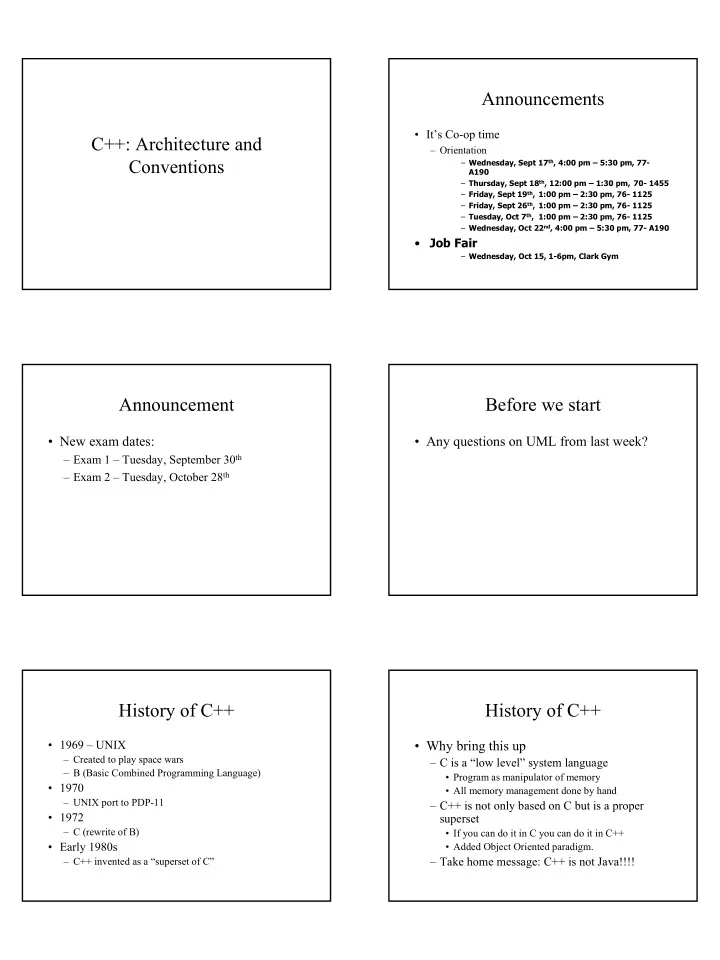
Announcements Its Co-op time C++: Architecture and Orientation - - PDF document

announcements
SMART_READER_LITE
LIVE PREVIEW

Announcements Its Co-op time C++: Architecture and Orientation - - PDF document

Announcements Its Co-op time C++: Architecture and Orientation Conventions Wednesday, Sept 17 th , 4:00 pm 5:30 pm, 77- A190 Thursday, Sept 18 th , 12:00 pm 1:30 pm, 70- 1455 Friday, Sept 19 th , 1:00 pm 2:30


slide-1
SLIDE 1

C++: Architecture and Conventions Announcements

  • It’s Co-op time

– Orientation

– Wednesday, Sept 17th, 4:00 pm – 5:30 pm, 77- A190 – Thursday, Sept 18th, 12:00 pm – 1:30 pm, 70- 1455 – Friday, Sept 19th, 1:00 pm – 2:30 pm, 76- 1125 – Friday, Sept 26th, 1:00 pm – 2:30 pm, 76- 1125 – Tuesday, Oct 7th, 1:00 pm – 2:30 pm, 76- 1125 – Wednesday, Oct 22nd, 4:00 pm – 5:30 pm, 77- A190

  • Job Fair

– Wednesday, Oct 15, 1-6pm, Clark Gym

Announcement

  • New exam dates:

– Exam 1 – Tuesday, September 30th – Exam 2 – Tuesday, October 28th

Before we start

  • Any questions on UML from last week?

History of C++

  • 1969 – UNIX

– Created to play space wars – B (Basic Combined Programming Language)

  • 1970

– UNIX port to PDP-11

  • 1972

– C (rewrite of B)

  • Early 1980s

– C++ invented as a “superset of C”

History of C++

  • Why bring this up

– C is a “low level” system language

  • Program as manipulator of memory
  • All memory management done by hand

– C++ is not only based on C but is a proper superset

  • If you can do it in C you can do it in C++
  • Added Object Oriented paradigm.

– Take home message: C++ is not Java!!!!

slide-2
SLIDE 2

File Structure

  • One class, two files

– Header file (.h)

  • Contains class declaration (interface++)

– Source file (.c, .cpp, .C, .cxx)

  • Contains class definition

– implementation of methods

File Structure

  • Cpp – The C Preprocessor

– Reads all C code before compilation – Directives

  • Including text files

– #include

  • Conditional compilation

– #if / #ifdef / #ifndef / #else / #endif

  • Macros

– #define

File Structure

  • #include “filename.h”

– Inserts text from one file into another before compilation – Contain info needed by other files to compile

  • Libraries – function signature
  • Classes – class interface (I.e. header file)

Compilation – Java

Foo.java javac Foo.java Foo.class java Foo Java compiler JVM (platform dependent) (platform independent) Other Java classes

Compilation – C++

Foo.C Foo.h g++ Foo.C C++ compiler Foo.o Object file (platform dependent) g++ foo.o .. linking Other

  • bject

linked Foo.exe Executable file (platform dependent)

Compilation – Java vs C++

  • Java

– Compilation unit is the class – External classes located using a predefined path – JVM needed to execute

  • C++

– Compilation unit is the file – External classes require header and precompiled object file – Executable file need to execute.

slide-3
SLIDE 3

Compilation – C++

  • Use CC/g++ to compile individual files into
  • bject files
  • Use CC/g++ to link object files into an

executable file

– Need to specify executable name, otherwise will be named a.out

  • Run the executable file.

Using C Libraries

  • Like Java, C/C++ has a multitude of useful

auxillary functions and classes in libraries

  • Unlike Java, C++ does not have the notion
  • f packages.
  • C / C++ also doesn’t have nice javadocs
  • Use man instead

Using C Libraries

  • Library header files must be #included for

compilation

– #include “mylib.h” – #include <math.h>

  • Library object files must be linked when

linking.

– CC file file file –lm mylib.o

Managing C++ Projects

  • make

– Files to be compiled – Compiler options – Libraries – Dependencies – Make will build an executable – makemake – Makes Makefiles! – Lab 1

Running C++ Executables

  • No top level “main” class

– main() in its own file – main (int argc, char *argv[])

  • If there is a problem…

– Bus error (core dumped) – Segmentation fault (core dumped)

  • Questions?

Anatomy of a class

  • Let’s take a look at a header and source file

for a C++ class, shall we?

slide-4
SLIDE 4

Anatomy of a class

  • Things to remember

– .h & .C files – No package, but namespaces – C++ Style guidelines – Comment, comment, comment

  • Questions?