
SLIDE 1
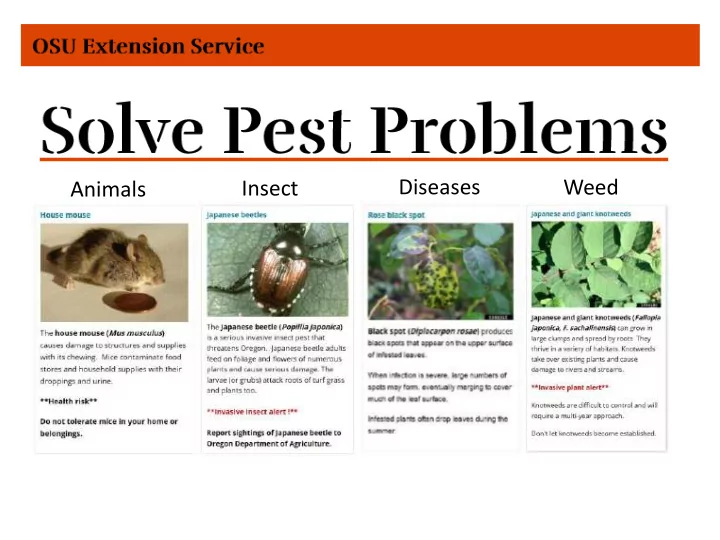
Weed s Animals Diseases Insect s
Animals s s Audience question: Who has experienced a pest - - PowerPoint PPT Presentation
Insect Diseases Weed Animals s s Audience question: Who has experienced a pest problem at home in the last year? Animals Household Plant problems Weeds Pest proble lems happen! Brown Marmorated Stink Bug
Weed s Animals Diseases Insect s
Who has experienced a pest problem at home in the last year?
Brown Marmorated Stink Bug http://agsci.oregonstate.edu/bmsb
And increasing numbers of pests…
Azalea lace bug damage Photo: Robin Rosetta, OSU
And inc increasin ing numbers of f in invasiv ive sp specie ies
Lesser celandine
http://www.nyis.info/index.php?action=invasive_detail&id=71
Con
ing arr array of
pest t info
In Information res esources es not
alw lways mobile le fri friendly ly
Photo: http://thesceneisdead.com/2013/04/08/
Weeds Animals Diseases Insects
District
District
The purpose of Solve Pest Problems is to reduce the impacts of pests and pest management practices on people and the environment in non-agricultural settings. The resource will be built in English and Spanish and will address inequities in access to unbiased, science-based pest management information.
professionals
Naturalist, and Beekeeper volunteers
underserved by OSU’s IPM resources
and pesticides and provide information to help avoid/minimize the risk.
Red educe the the ris risk of
pestic icides to
people
For both applicators and incidental exposure
Photo: Metro
Red educe the the risk risk of
pestic icides to
rways
Photo: Rob Emanuel, OSU Extension
Reduce th the risk risk of
ticid ides to
Oregon Legislature charge to improve pollinator health in the state (see House Bills 3361 and 3362).
Liaisons (funded)
(funded)
Broad coali liti tion of
support! t!
Oregon In Invasiv ive Sp Specie ies Cou
il connection
Highlight invasives in website footer
year with both lay and pro audiences
volunteers
the time to weigh-in
agencies
Hom
page mock
in Eng ngli lish an and Spa panis ish
2017
Home pag age mock-up up- con
2017
Dr Drupal l 8 8 development si site establi lish shed
Highlight invasive weeds Highlight invasive insects, etc.
2018 Beta content -85 pages
Sa Sample pag age: Yell llow jac jackets
2018
Dr Draft ft content de developed and and rele eleased for
akeholder revi view and and fee eedback k (Jul uly 2018 2018)
76 survey entries from stakeholders Take home messages:
Plain language editing Templates need improvement Style sheet needed More welcoming home page Suggestions for improvement of
specific pages
On the right track!
Missed the mark
Lit Literacy rates in in the the US
below a fifth-grade level Functional illiteracy is the inability to read or write well enough to accomplish everyday tasks in modern society.
Basic” in “Prose Literacy,” Source: National Assessment of Adult Literacy
Plain Plain lan language ed editin iting - Before
Text before editing: Never drain pesticide containers
Improper pesticide handling can contaminate water. Misapplication, spills, and improper storage, mixing/loading, or disposal of unused or unwanted pesticides are the most likely pathways for pesticides to move from your home landscape into the storm drain system.
Plain Plain lan language ed editin iting- Af After
Don’t drain pesticides or rinse water into storm drains! You can pollute water if you do not handle pesticides correctly. Pesticides are most likely to move from your home and into the storm drain system due to mistakes with:
Weeds Animals Diseases Insects
Leverage partners and existing relationships with media
prompts for OSU Master Gardener and partners to distribute at community events.
hardware stores with easy instructions to access the website.
Oregonian video series
The $3 $3.9 Mill illio ion Question?
Questions? Recom
Th Thoughts? Sol
Ple Please contact t us: s:
SolvePestProblems.edu Weston Miller, program manager Weston.miller@oregonstate.edu 503-706-9193