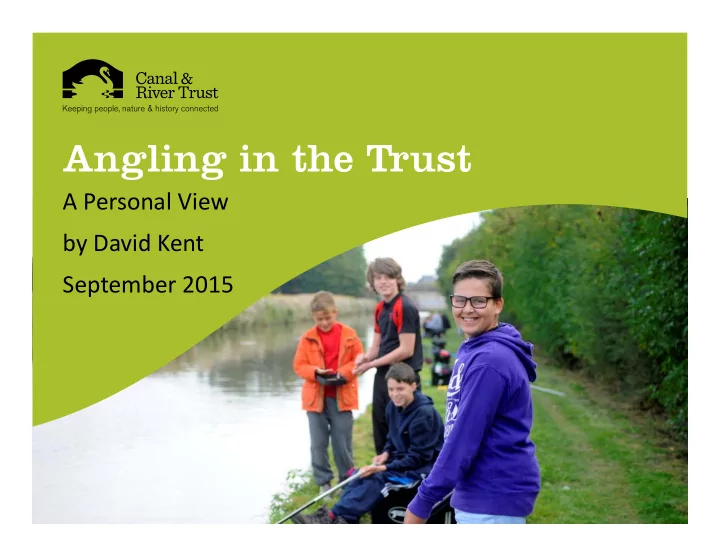
Angling in the Trust A Personal View by David Kent September 2015 - - PowerPoint PPT Presentation
Angling in the Trust A Personal View by David Kent September 2015 Why Have Angling? Transport Act 1968 Classification of the Waterways Section 104: The waterways referred to as cruising waterways are to be principally available for cruising,
Why Have Angling?
Transport Act 1968 Classification of the Waterways Section 104: The waterways referred to as cruising waterways are to be principally available for cruising, fishing and other recreational activities.
2
What should this mean to the Trust in 2015?
And how can we ensure the Trust meets its inherited
- bligation?
Without professional fisheries management, angling won’t exist. You can’t have angling without a fishery to support it. It means making fishing readily available where realistically possible across the network and to do that there is a need for:
3
- An appropriately resourced national team of Fisheries & Angling experts to
take the lead
- This national team to have internal status commensurate with boating,
heritage, environment, hydrology etc. and an appropriate level of resource
- Adequate car parking and access along the towing path
- Available and safe fishing on the towing path
- Suitable water quality and quantity to support fish life and the associated
food chain
- Suitable aquatic habitat to support all the stages of the life cycle of fish and
the food chain that supports fish life
- Fish stocks at an appropriate level and species diversity
- Ongoing consultation with customer club regarding all activities likely to
impact on the fishery.
4
This is what the All Party Waterway Group had to say about this in their 2014 review:
- Recommendation 10: The Trust should continue to
develop its open approach with stakeholders and build upon its strong community relations
- Recommendation 11: That the Trust consults all
relevant stakeholders when planning repair & maintenance work on the waterways
5
What benefits does angling bring for the Trust?
- A vital component of a thriving waterway
- Through angling events, a way of raising the
profile of the waterways
- A significant contributor to local economies,
especially major events for example the Division 1 National on the Gloucester Canal £185k
- A simple way to introduce people to the
waterways
- An affordable way for the public to use the
waterways
- Its totally inclusive, no barriers to participation
- A proven crime reduction and anti-social
behaviour tool
- Angling clubs are as yet a relatively untapped
source of volunteers
6
About the standard angling agreement
- It’s the legal agreement between the club customer and the Trust
- Includes bailiffing and insurance obligation under standard angling
agreement which all clubs sign up to
- Existing bailiffing effort (personal estimate)
- Eyes and ears, in particular vandalism, low water, fish in distress,
illegal instruments
- A useful source of income, currently circa £550,000, the net surplus
being used to maintain the waterways
- When the points on slide 4 are not met, clubs will choose to terminate
their agreements
7
The National Angling Advisory Group
- One of 8 advisory groups, the successor of the BW Fisheries Advisory
Group
- Good geographical spread of members
- Good spread of skillsets including angling development, fisheries
management and competitions
- Occasional joint meeting with Environment Advisory Group
- There are lots of cross cutting issues that need to be discussed at more
than one advisory group. Should the chairs of the groups meet up periodically?
8
1. Fisheries & Angling Action Plans 2. Fisheries & Angling Component of Internal Environmental Appraisal 3. Fisheries & Angling as an educational tool
Three key developments to move fisheries & angling forward
9
Fisheries & Angling Action Plans
10
- Eleven Waterway FAAPs now at first draft stage
- They combine local actions, operational actions, the
national fisheries and angling team and other national team actions
- They will be an integral part of the business plans at
both waterway and national level The actions are grouped under ten themes, listed
- verleaf:
FAAP Actions
1. Retain existing angling customers and attracting new ones 2. Develop & improve access to the fishery 3. The opportunities to engage with local communities 4. Take advantage of the opportunities for volunteering & adoptions 5. Improving communication between the Trust and its customers 6. Funding 7. Fish passage and migration 8. Predation & non native species 9. Fish stocks & fisheries management 10. Fisheries and water quality and quantity
11
Fisheries & Angling Component of Internal Environmental Appraisal
Currently, there is insufficient fisheries & angling team input into the process. Consequently:
- There have been numerous complaints,
some of which lead to significant reputational damage
- Implementation will require better
communications with angling club customers
- Implementation will lead to a better
- utcome for the fishery.
- Implementation will minimise reputational
damage to the Trust and customer clubs will have improved confidence in the Trust
12
IMAGE TITLE
Fisheries & Angling as an educational tool
Angling is a means by which people, especially young people:
- Can be introduced to the waterways
for the first time
- Can learn a new skill such as how to
fish
- Can learn to respect the whole canal
environment
- Can learn to respect the rights of
- ther users
- Can learn about fish and their
environment through events such as fish rescue education days
13